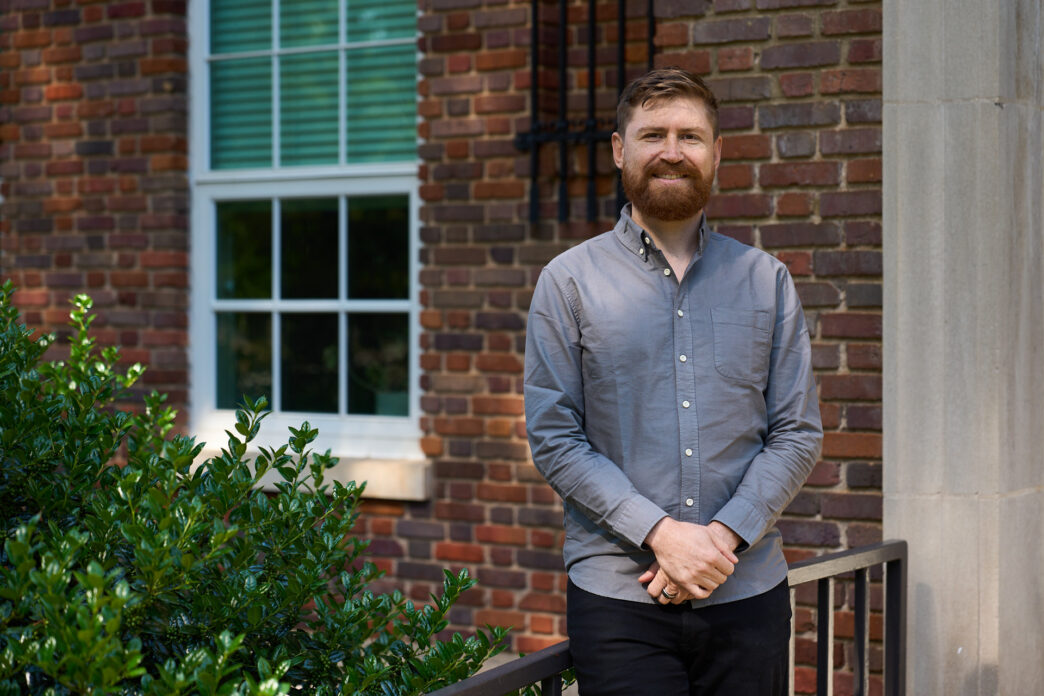
Casey Youngflesh, a Clemson University scientist whose work leverages ecological big data to understand the natural world, has been named an Early Career Fellow by the Ecological Society of America (ESA).
The fellowship, one of the field’s top recognitions for emerging scientific leaders, honors scientists who demonstrate strong contributions and future potential across research, education, communication and the application of ecology to real-world problems.

“My brand as a scientist is working at this intersection of ecology and data science. I use computational tools to understand the mechanisms that shape biodiversity across space and time,” Youngflesh said.
Traditionally, ecology research tended to focus on small, localized studies. While those studies provided detailed insight on the ecosystem being analyzed, they often failed to reveal the broader patterns that emerge across regions and species.
“Ecological systems are incredibly idiosyncratic,” he said. “We don’t want to just understand the system in Pickens County. We want to understand how these systems work more generally. But part of that general understanding is acknowledging how these things vary over time and space and across species, and why they vary across these different axes.”
Broader patterns
To do that, his work uses statistical and computational tools to extract broader patterns from large data sets.
“We need to leverage these large-scale data resources that we didn’t have access to even a couple of decades ago. I often say in the age of big data, it’s not about just the data themselves. It’s about the resources we now have to actually make use of these complex data,” he said. “It’s really being in the right place at the right time.”
Since 2017, Youngflesh has published 29 peer-reviewed papers, with additional work under review, including articles in journals such as PNAS, Nature Ecology & Evolution, Ecology Letters and Current Biology. His research has also drawn attention from outlets including The New York Times, the BBC and Wired.
His projects span species and systems. Much of his work focuses on birds, which offer both ecological diversity and unusually strong datasets thanks to widespread public participation in bird observation. Using those data, he studies phenology, which is the timing of seasonal biological events, and how shifts in climate are altering migration and breeding patterns.
Satellite-monitoring of wildlife
More recently, his lab has expanded into satellite-based monitoring of wildlife. Earlier work helped identify large penguin colonies in remote regions. A current NASA-funded project uses artificial intelligence to detect walrus populations across the Arctic, allowing researchers to track changes in distribution and abundance in response to environmental change.
Youngflesh’s work extends beyond research into teaching and outreach, another key component of the ESA fellowship.
He has developed workshops at multiple institutions focused on computational skills such as hierarchical Bayesian modeling and high-performance computing, with materials made freely available to the research community. In the classroom, he incorporates real-world data into instruction, including a peer-reviewed case study based on his own research.
At Clemson, where he joined the faculty in 2024, he teaches courses that reflect the growing role of data in ecology. His undergraduate class introduces students to data-driven approaches, while his graduate course emphasizes hands-on analysis and reproducible research practices.
Through programs such as Skype-a-Scientist, public talks and past roles as an expert lecturer on Antarctic expeditions, he has engaged audiences ranging from elementary school students to international travelers. His collaboration with Scholastic Math Magazine translated his research into classroom materials for middle school students.
Informing management
A third pillar of the ESA fellowship is the application of ecology to management and policy.
Youngflesh’s Arctic walrus project involves collaboration with environmental managers and Indigenous communities in Alaska. By using satellite imagery to monitor populations across vast and remote regions, the work addresses a key challenge in conservation: obtaining reliable data at the scale needed for effective management.
“These are questions we really don’t know the answer to,” he said, referring to changes in walrus distribution and population size. “And these types of big data approaches have the potential to bring us into this new age of environmental monitoring.”