You might not have heard of Clemson University alumnus Alex Bina, but if you watch Clemson Tigers football you see the results of his work on Saturdays in the fall.
Bina, the team’s director of applied science, is part of a small army that works behind the scenes to get players ready for game day.
It’s a role Bina helped build from the ground up, starting more than a decade ago as a Clemson bioengineering Ph.D. student. He has been connected to the team through two NCAA National Championships.
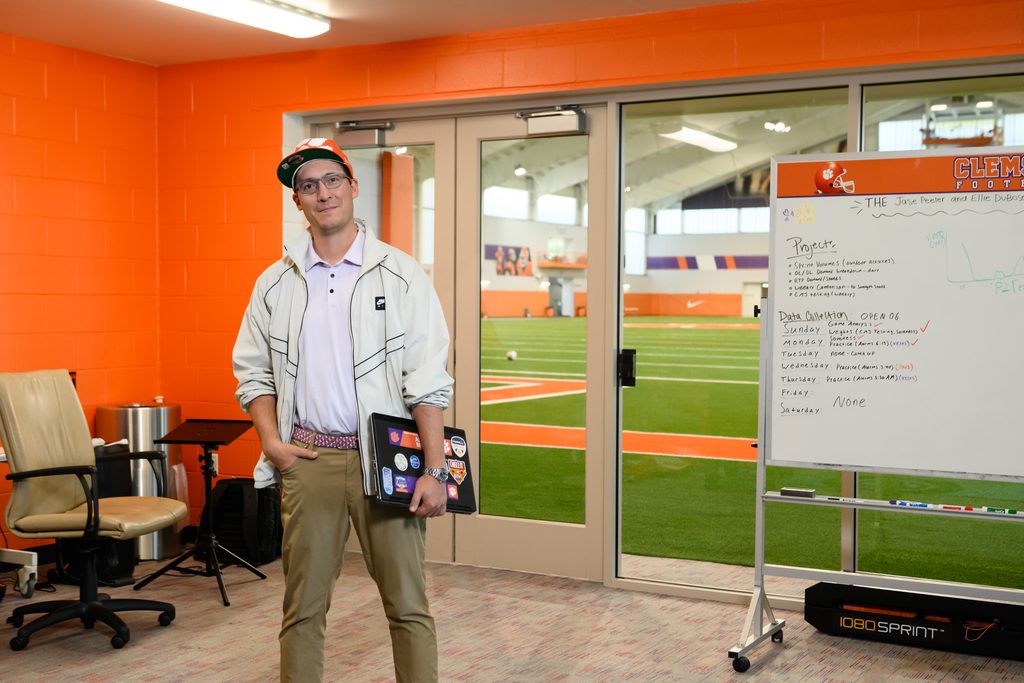
Bina’s memorabilia-filled office in the Allen N. Reeves Football Complex is the kind of place every Tigers fan dreams of working. When the door is open, he has a second-story view of the indoor practice field.
Bina’s job is to oversee the collection and analysis of performance data to track how players are progressing physically throughout the season.
He also helps manage recovery efforts, giving players access to cryotherapy, infrared light, stretching and other treatments designed to ease soreness and keep them ready to practice and play.
“We’re in the business of quality of life improvements to make this really hard thing– playing and training for college football– a little bit easier and a little more human,” Bina said. “I love being in this role. I love being a part of a team.”
His connection to Clemson Football goes back to 2015 when he was a Ph.D. student, working with advisors John DesJardins, the Hambright Distinguished Professor in Engineering Leadership, and Gregory Batt, a professor of packaging science with a joint appointment in bioengineering.
It started with a chance encounter between Batt and Tigers strength coach Paul Hogan while their children were on a playground. Batt connected Hogan with Bina, and that led to a Creative Inquiry project analyzing GPS data from sensors worn in players’ shoulder pads.
In the beginning, the operation was sometimes little more than Bina sitting in a corner of the weight room with a laptop, studying the data and looking for anything that might help the team.
“I was just trying to provide value wherever I could,” Bina said.
The collaboration kept growing. Bina went on to study players’ sleep, expand the use of performance data and help build a recovery program that laid the foundation for his current role.
His dissertation also revolved around football. Bina studied methods for evaluating football facemasks, including how their stiffness affects the performance of the helmet during an impact.
The work led to a U.S. patent, with Bina, DesJardins and Batt named as inventors on a non-destructive method for measuring football facemask stiffness.
“Alex was always looking for ways to apply what he was learning and create something useful from it,” said DesJardins, who is also the director of the Robert H. Brooks Sports Science Institute. “It has been rewarding to watch that develop into the work he is doing today.”
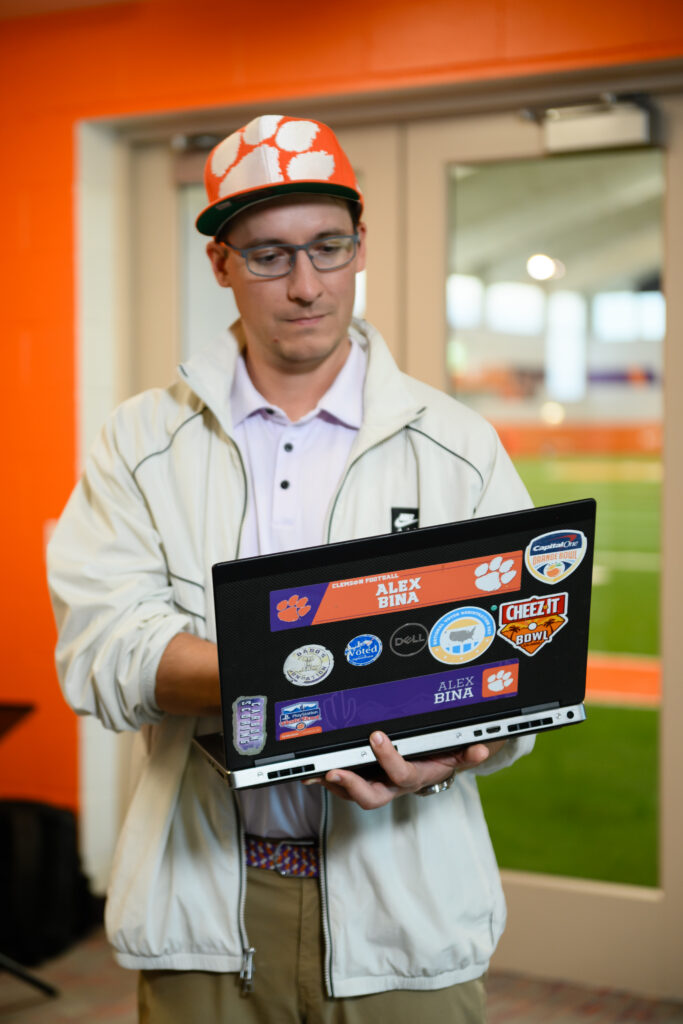
Batt, who holds a Ph.D. in mechanical engineering from Clemson, said Bina brought curiosity and initiative to projects from the beginning.
“Alex was eager to take on something new, progress in his learning and find a way to contribute,” said Batt, who is also the director of the Clemson Package Dynamics Laboratory.
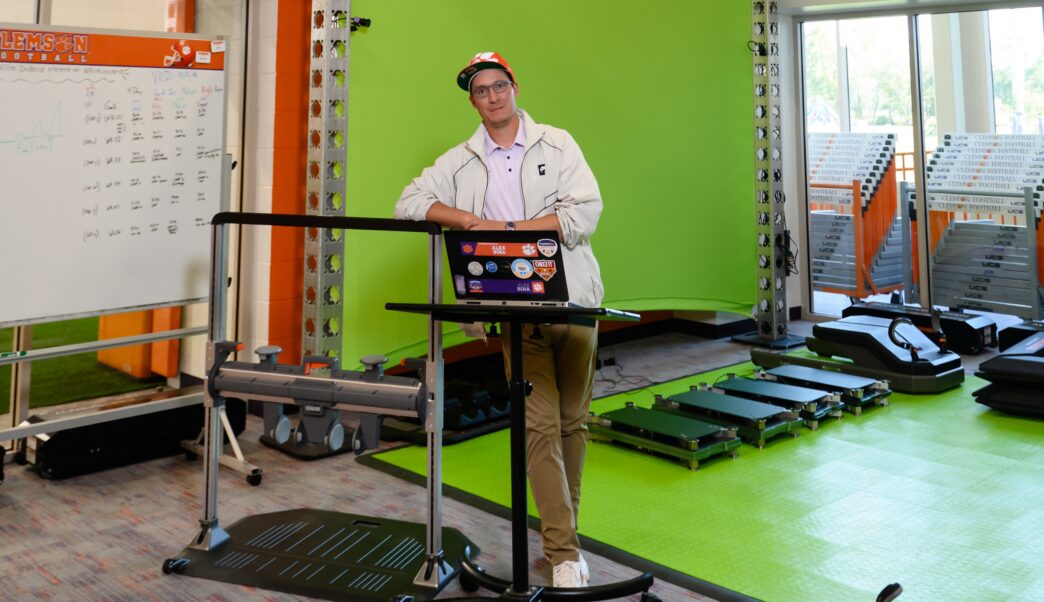
Bina now works with about a dozen undergraduate and graduate students in the Brook T. Smith Clemson Applied Science Lab, or CASL, known as “The Castle” among the players.
The student workers, who are “Knights of the Castle,” help collect and analyze performance data and support recovery services. The player who uses the recovery services most each year wins an award, crowning him “King of the Castle.”
For anyone drawn to both football and applied science, Bina has built something close to a dream job.
His advice to students who hope to follow a similar path is to put themselves in unfamiliar environments, seek out people doing work that interests them and show that they have already made an effort to learn.
Bina said opportunities often come to students who are willing to do more than express interest and can demonstrate that they are ready to contribute.
“For me, this wasn’t what I set out to do when I came to Clemson,” he said. “This was a product of putting myself in environments where opportunities would arise.”