Koti Hubbard is a lecturer in early childhood education in the College of Education, an institution that has defined most of the latter part of her life. Hubbard earned bachelor’s and master’s degrees as well as a Ph.D. from the College in 2010, 2012 and 2018, respectively, before returning to Clemson to serve as a faculty member in 2020.
Hubbard still remembers taking classes in the same rooms where she now teaches; she says this allows her to feel more connected to her students because she vividly remembers sitting in the same seat to learn, ask questions and try to make sense of the content in front of her. She remembers the satisfaction of having it all “come together” and make sense, just as she remembers feeling overwhelmed along the way.
Hubbard feels fortunate to have had a front row seat to the evolution of the early childhood program in the College of Education. We caught up with Hubbard to discuss her lifelong passion for teaching and learning, the educators who have inspired her and how seeing students as “whole people” has benefited her both personally and professionally.
Why do you love teaching?
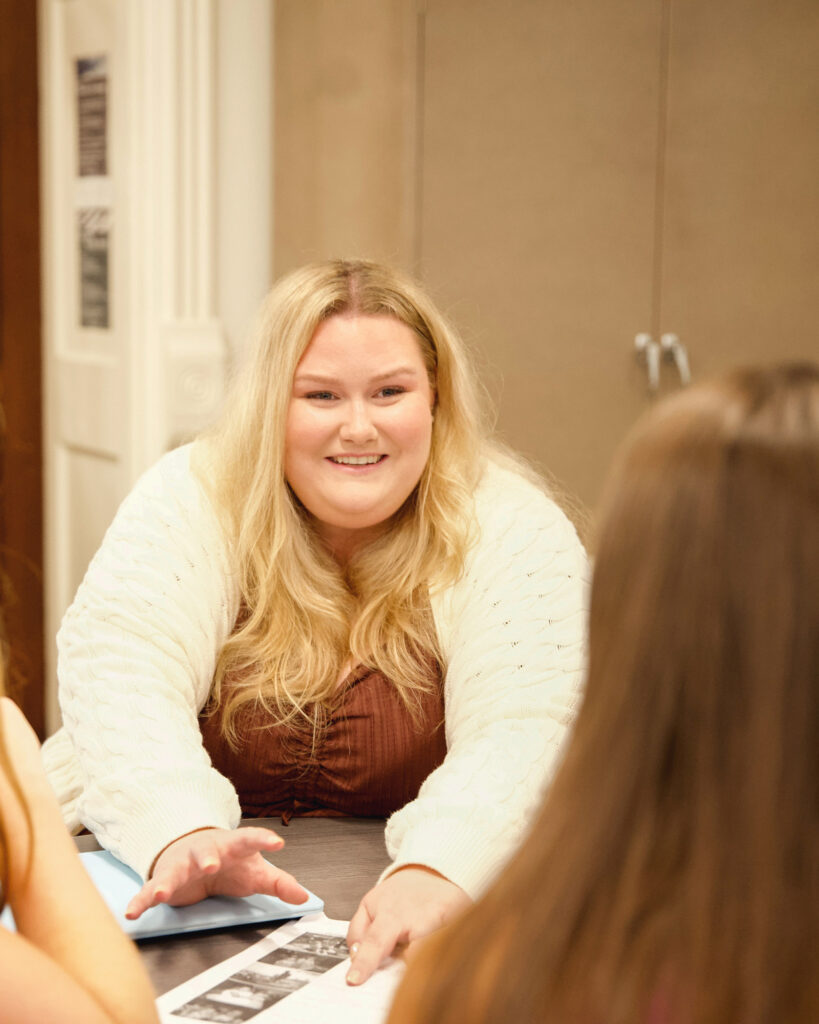
I love watching my students get it! After introducing a new concept, I move around the room, asking questions and encouraging deeper thinking, and I watch students make sense of the ideas in practical ways. They see something in a new way, grasp a new concept or even challenge me to see it differently. In that moment, when we are discovering and learning together, it is exciting. I love sharing that excitement with my students.
I teach a course where students design instructional units for pre-kindergarten through third-grade classrooms. We spend a lot of time workshopping their units; it can be challenging at first to craft clear objectives, align assessments and plan instruction that supports learning goals. As the semester goes on and we continue refining their lesson plans, the process gets easier and I get to see their creativity and innovation come to life. They design playful yet rigorous learning experiences, and their excitement grows alongside their confidence. In these moments, when students get it, it’s exciting!
What is your teaching philosophy?
As a teacher educator, I bring much of the same philosophy I had for teaching young children into classrooms with adult learners. I believe students learn best when we apply concepts in real-world situations, create products that remix and expand on ideas, discuss our thinking with others and engage with content in multiple ways—reading, hearing, doing and discussing. I see learning as a partnership where I hold knowledge, but I am not the holder of all knowledge.
Recently, I have been contemplating what it means to practice compassion in higher education. While this is not new to me in practice, it is new as a conceptual idea that I am learning more about. I see my students as whole people, just as I encourage them to see the whole child in their early childhood classrooms—not only supporting academic development, but also attending to physical, social and emotional growth, and promoting overall well-being.
I strive to approach instruction with compassion, engaging in my work with kindness and care. This perspective pushes me to ask questions. How am I removing barriers to learning? How am I building trust and community in the classroom? How am I creating space for students to bring their own experiences to our learning? This approach does not diminish the rigor of the course; rather, it challenges me to maintain high academic expectations while considering the students — the people — at the heart of my classroom.
When did you know that the field of education was for you?
I am the oldest of six siblings, so nurturing children has always been a natural part of my life. As a kid, I was “playing teacher,” gathering my younger siblings and cousins for lessons in my makeshift classroom. In the last few days of the school year, my fifth-grade teacher gave me some teaching supplies to take home that she no longer used. That summer I taught many lessons. One that stands out is a riveting lesson on grizzly bears with information I pulled from an old encyclopedia. From early on, I knew education was where I belonged.
When I started my undergraduate program, that feeling only grew stronger. I enjoyed my classes and professors, and I was especially inspired by the passionate teachers I observed and learned from in the field. During my senior year, I worked with Mrs. Joni Mize in first grade and Mrs. Lisa Durham in kindergarten. They cared so much for their students and their learning. I learned so much about integrating play in instruction, guiding behavior, trying out new ideas, and being in-the-moment with your students. Watching them at work confirmed what I had always felt—that teaching was the path I was meant to follow.

Name an educator that inspired you to teach.
When I look back, I can name many PK-12 teachers that made me feel capable and seen—Mr. Watson (third grade) brought humor into learning, Mrs. Simpson (fifth grade) was so nurturing and made me feel special, and Dr. Burkett (sixth grade) inspired me to inquire and think creatively. But when I think of the person that most inspires me, it’s Dr. Susan Fullerton. I worked with Dr. Fullerton, a literacy educator, during my undergraduate and graduate work. She helped me wrap my head around supporting readers and writers, especially those experiencing challenges. She made me want to be better and do better and made me feel like I could make great change in the lives of young children. She was a deeply committed educator, and I strive to inspire my students in the same way.
What do you like about the Clemson University?
I completed both my graduate and undergraduate work in the College of Education here at Clemson University. I fell in love with walking across the crunchy leaves on cool fall mornings, seeing students picnicking and playing games on Bowman Field in the spring and hearing Disney music drift from the Tillman Hall bell tower. Most importantly, I have cherished the connections I have built with faculty and students, both as a student myself and now as a teacher educator.
At Clemson, I have formed lasting friendships with others who share my passion for teacher education and built relationships with students who deeply care about advocating for young children and their families and who have gone on to do just that. Clemson University and the College of Education have shaped me into the educator I am today, and I am forever grateful.