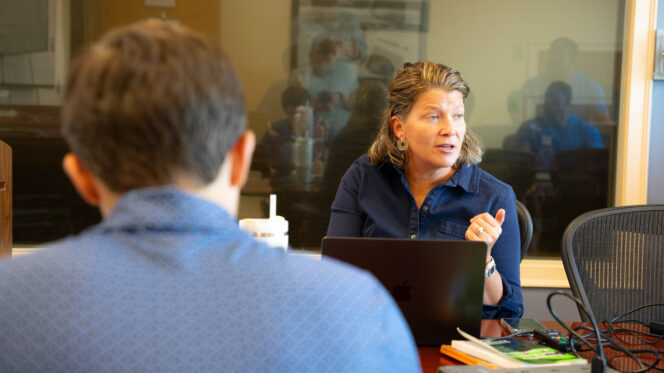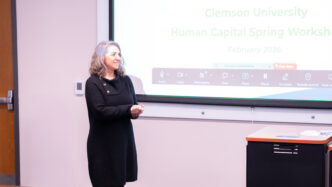
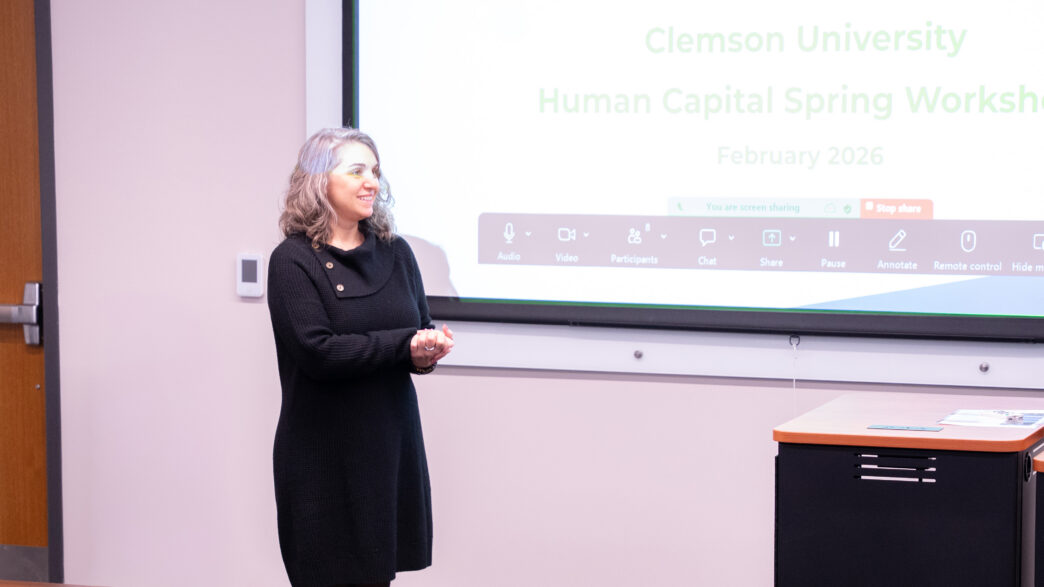
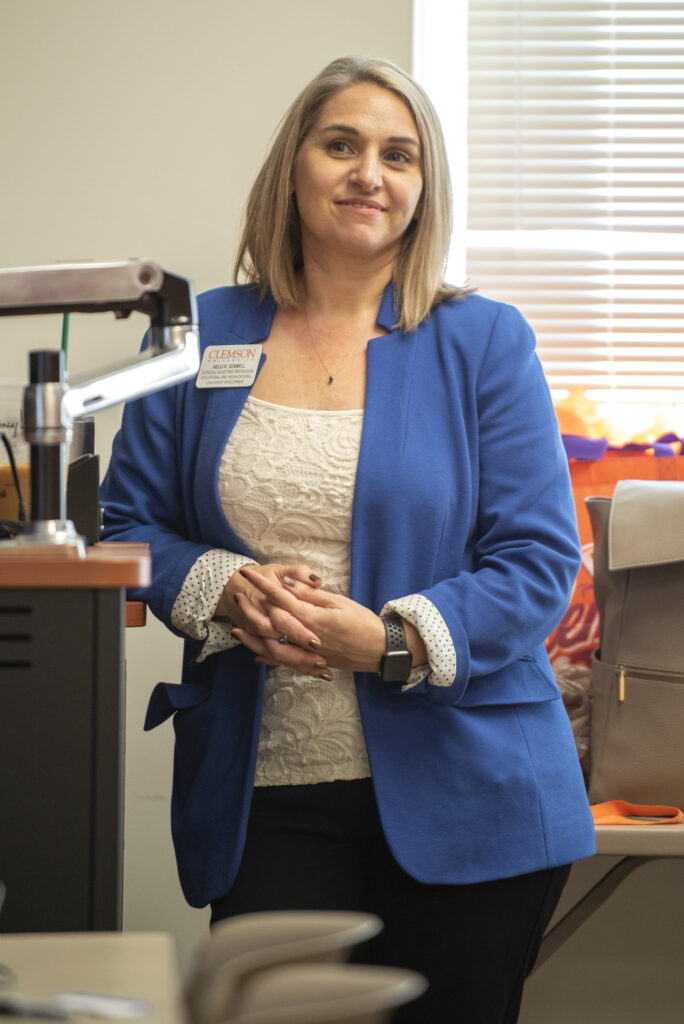
Kelli Seawell is many things. Clinical assistant professor. Program coordinator. Avid Harry Potter fan and proud Ravenclaw. She was on the ground floor of the human capital education and development program, the College of Education’s first non-teacher preparation program, when it began in Fall 2021.
Seawell’s classroom is sometimes asynchronous, sometimes not and always filled with one of the most diverse student populations. Human capital majors are interested in applying their degrees to an almost endless list of industries, from manufacturing and nonprofits to health care and the tech industry. Classes are also made up of “traditional” college students and those coming to an undergraduate degree after years in the workforce.
We caught up with Seawell to discuss how she works with these various students in a single class, how she sees human capital fit into the College of Education and, of course, why Hermione Granger represents more than a character from a book to her.
What is your teaching philosophy?
The courses I design and teach are shaped by a few core values that matter deeply to me: creating meaningful connections, student centeredness, staying responsive to student needs and preparing for life after graduation. Teaching primarily online — and being an online student myself — I know how easily students can feel disconnected, so I’m intentional about building a sense of community where students feel seen, supported and genuinely part of a learning community.
I try to create a student-centered environment for all students by offering multiple ways for students to engage with content and participate in the learning process. I also respect different comfort levels and learning preferences and let them know that my classroom is a supportive, judgment-free space.
I love seeing those “light bulb moments,” but I also care deeply that students can take what they learn and apply it beyond the classroom, especially as they prepare for life and work after graduation. For that reason, my assignments emphasize practical application, reflection and real-world relevance. I encourage my students to have agency over their own learning process and request feedback throughout the semester so that I can make adjustments in order to meet them where they are. I feel that this helps to create learning experiences that are personal, relevant and human.
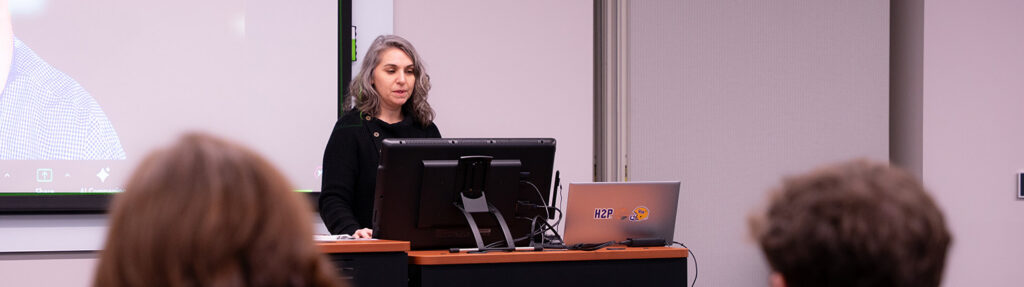
Why do you think the human capital program fits into the College of Education?
Our program is centered on learning and educating others, only our graduates do that in workplaces rather than K-12 classrooms. Our students are interested in leadership, training, talent development, organizational learning and career mobility, and that work is grounded in how adults learn and develop in real-world settings. What makes our program distinctive is our focus on industry and adult learners. Many of our students are balancing jobs, families or returning to school after time away, so flexibility and access matter. We’re preparing people to support learning and improvement across organizations, and to me, that feels very much aligned with the heart of education.
How do human capital’s required internships enrich coursework and vice versa?
Our students come to the program with incredibly different interests and life experiences, and that diversity really shows up in the classroom. Some are just starting out, others have spent years in the workforce and many are aiming for entirely different industries. That mix shapes the conversations we have and the way students think through real organizational problems. I find that students who have some work or internship experience bring their lived experiences to class, and the course content ends up having a whole different meaning to them as compared to a student who is just starting out. It’s fun to see the interactions and the peer-to-peer learning that happens as a result of these conversations.
In their final semester, students typically complete an internship or a “stretch project” in their full-time roles, and they also tackle their senior capstone projects. They take the skills and frameworks they’ve built across the program and apply them in a real workplace setting to address a key performance issue for an organization. I love teaching both of these classes because it’s one of the most rewarding semesters. I get to see them take all of the skills and knowledge they’ve gained in the program and bring them to life in the workplace. It’s awesome to see that kind of growth in students, and it’s a very proud moment for me as they shift from student to working professional.
How do you tailor instruction to both college-age students and those already in the workforce in the same class?
It’s all about meeting people where they are. I always try to build flexibility into my courses and offer virtual or asynchronous options when possible because I know life looks different for everyone. I also love intentionally creating mixed student groups for projects. Watching traditional-age students learn from and bond with classmates who are working professionals is one of the most rewarding parts of teaching in this program. Those moments of connection and shared learning are exactly what we hope higher education can be, especially in a primarily online environment where it’s easy to feel disconnected.
Why do you love teaching?
Teaching at the undergrad level gives me a chance to share my knowledge and experience in a way that truly matters in that I’m preparing them for the workforce. I learn as much from them as they do from the course material! I teach both juniors and seniors in the program, so I get to watch their confidence, skills and knowledge grow through the years. It’s so rewarding watching them take the steps from being a student focused on schoolwork to entering their final semester, which is focused on applied work experiences and completing real-world work projects they can add to their resumes. I also love watching them walk across the stage at graduation and seeing where the next steps take them in their careers!
What tips do you have for students in the College of Education who are preparing for life after college?
Network early and often! Don’t be afraid to reach out to working professionals and ask them to share their career story with you. So much can come from a single conversation that could pave the way to a potential internship or a full-time job opportunity.
What do you enjoy doing when you are not teaching?
Spending time with family,reading fiction (specifically horror and thriller novels), hiking, kayaking and riding rollercoasters.
What’s the latest and or best horror/thriller novel you’ve read?
I just finished “The Other Emily” by Dean Koontz. I wouldn’t say it’s the best novel (it’s hard for me to have favorites of anything), but it was sufficiently creepy. Definitely set my imagination into overdrive, and the ending was fun and unexpected, which I always enjoy in a novel. Two that I could read (listen to on Audible) over and over again are “The Haunting of Hill House” by Shirley Jackson and “Something Wicked This Way Comes” by Ray Bradbury.
You must explain your Harry Potter fandom. Please.
I am a proud Ravenclaw. I’ve reread the series more times than I can count, and I’m a Universal Studios passholder who makes it down there whenever I can. I even have an entire wall in my home filled with Harry Potter–themed running medals from a former Hogwarts Running Club that sadly shut down in 2022.
I think part of the appeal is the themes around friendship, belonging, celebrating your weirdness and, of course, learning. So many of the characters are trying to figure out where they fit, and I’ve always loved that idea of finding your people, especially when you feel a little out of place. I identify strongly with Hermione Granger (“When in doubt, go to the library”), with a little bit of Luna Lovegood thrown in for her unapologetic quirkiness.