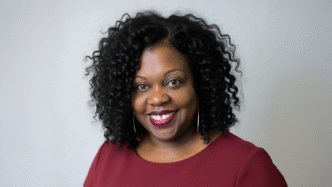
Melissa Hullett is proud to celebrate 20 years as a school psychologist in 2026, but she’s just as happy to reap the rewards she has received for the three years she has spent as a doctoral student at Clemson University. Hullett’s time teaching undergraduates through an assistantship as a special education Ph.D. student and her work as a researcher and scholar have earned multiple awards and grants in a short time.
Along with an interdisciplinary research fellowship award from the graduate school, Hullett has earned a stipend award from the Midwest Symposium for Leadership in Behavior Disorders (MSLBD) and the 2026 Carl Fenichel Research Grant from the Council for Exceptional Children Division Emotional and Behavioral Health (DEBH).
After years of wanting to pursue a Ph.D. and finally becoming a doctoral candidate, Hullett sees the recognition as a sign that she is where she needs to be.
“The recognition definitely validates the life choice, and validation came in the form of faculty support before there were any awards,” Hullett said. “I’ve felt very encouraged here, especially coming back to school after being in the field for so long.”
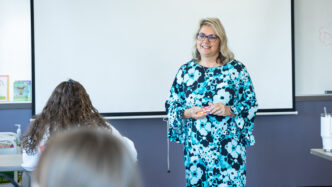
Hullett said that earning an assistantship and teaching have allowed her to combine the research she has always wanted to engage in with her practitioner experience. She enjoys the challenge of transitioning from working with children to teaching adults, and she has learned to draw more on her own experience to bring concepts to life for pre-service teachers in her classroom.
Another exciting transition has been moving from writing lengthy reports for families as a school psychologist to writing in dense scholarly language for academic journals. Hullett said she has enjoyed writing about topics she has become passionate about on the job, such as school policy, the effects of Supreme Court decisions on policy, and specific issues, such as student restraint and seclusion.
Hullett is the first author of “Restraint and Seclusion: A Persistent Challenge,” a manuscript accepted for publication in Intervention in School and Clinic. She will present this research at the MSLBD Symposium in March 2026 in Kansas City, Missouri, where she will also receive a stipend award publicly.
Hullett also co-authored a manuscript on effective behavior management strategies, which is currently under review, and used that research to lead a session for special education teachers at South Carolina’s CEC Conference in Greenville in February 2025. She is excited to present at the same conference again this year because so many teachers in the field attend it.
“Scholarly writing is important, and I’m allowed to contribute to knowledge in that way, but many educators don’t have access to academic journals or the time to really dig into them,” Hullett said. “I prioritize conferences and presentations just as much as writing because these presentations allow me to disseminate research to educators who can immediately put that knowledge to work in the field.”
Antonis Katsiyannis, Alumni Distinguished Professor in the College of Education, serves as doctoral advisor and mentor to Hullett. He pointed out that Melissa has shown an impressive work ethic and ability to incorporate feedback to improve her skills, particularly in writing and presenting.
Katsiyannis praised her “enviable progress” in academic writing during her time at Clemson, particularly in organizing and synthesizing literature succinctly. He said Hullett’s background in schools empowers her research, and vice versa, which will only benefit her in whatever direction she chooses to take her career.
“Our program has given her teaching opportunities and allowed course-related and independent research endeavors in class and independently,” Katsiyannis said. “Her skill set in both college teaching and research productivity will enable her to be competitive in the job market. Additionally, her vast experience in the public schools allows her to have a distinct perspective on any practice involving students with disabilities!”
Hullett said faculty such as Katsiyannis, more than anything, want students to succeed not just as students but as professionals. She said she has felt respected as a practitioner who is applying her experience and knowledge in the classroom and in academia.
“I’ve had mentors in the College of Education who push me in the best way,” Hullett said. “They see what you’re capable of before you see it yourself.”