

Using the same fertilizer plan everywhere just isn’t serving growers anymore.
Bhupinder Farmaha, Clemson University soil fertility specialist
A new Clemson University study finds that many South Carolina cotton farmers may be applying more nitrogen fertilizer than their fields need.
The findings come from a three‑year, 50-trial study led by Clemson soil fertility specialist Bhupinder Farmaha. The results point toward “site‑specific” nitrogen planning.
The scientists examined cotton fields across the Coastal Plain, Flatwoods, Sandhills and Piedmont regions. They tested four nitrogen rates at each farm. They tracked differences in soil, crop history, tillage system, irrigation and long‑term conservation practices, such as cover crops and poultry litter use.
Study suggests some fields may need less nitrogen
Current statewide guidelines recommend 70–120 pounds of nitrogen per acre, with lower rates recommended under low-yield potential environments (dryland) or following legume rotations and higher rates recommended for higher-yield potential environments (irrigated) following non-legume crops.
The study found that 68% of the fields studied needed less than the current statewide guidelines.
“We found major differences from farm-to-farm, and even region-to-region,” Farmaha said. “Using the same fertilizer plan everywhere just isn’t serving growers anymore.”
Soils make a big difference
The study demonstrated the effect soil type has on nitrogen fertilizer needs.
For example, sandy soils are the most prevalent soil in the Coastal Plain Region. Leaching causes a loss of nitrate nitrogen in this region. Of the fields studied, about two‑thirds often required less fertilizer than the amount currently applied.
Soils in the Sandhills are mostly sandy and drought‑prone. Just about half of the study fields needed nitrogen.
With more organic matter and natural nitrogen release, study fields in the Flatwoods Region often required little to no fertilizer.
In the Piedmont Region, where clay soils are prevalent, all five study sites showed zero response to nitrogen fertilizer. Many of these farms had years of poultry litter use, which had already built up plenty of nitrogen.
Long-term conservation practices boost yields without extra nitrogen
One of the biggest takeaways was that farms using cover crops or poultry litter for 10 or more years produced more cotton with little or no added nitrogen.
Fields with long-term cover crops averaged 1,160 pounds of lint per acre with zero nitrogen, compared to just 690 pounds on fields without conservation practices.
“That’s about a $350‑per‑acre difference in lint value,” Farmaha noted. “And that’s before fertilizer savings are counted.”
Farmaha says that long-term adoption of conservation practices such as cover crops, reduced tillage and residue retention can increase soil nitrogen pools.
As soil nitrogen levels increase, farmers can reduce fertilizer applications without sacrificing crop yield.
However, continued use of conservation practices, along with an appropriate nitrogen fertilizer rate, is essential to maintain soil nitrogen levels and prevent nitrogen depletion.
Adjusting rates
Nitrogen currently costs around $1 per pound. Cutting rates from 90 to 45 pounds per acre saves $45 per acre. Adjusting rates could mean saving tens of thousands of dollars for larger operations.
For example, reducing 90 pounds to 45 pounds across 500 acres could save $22,500 without hurting yield in many fields.
What growers can do now
Based on the study, the scientists suggest several practical steps growers can take to personalize nitrogen plans. These are:
Know the region
Soil type alone narrows the optimum nitrogen range.
Track field conservation history
Fields with long‑term cover crops or poultry litter need far less nitrogen.
Test soil nitrogen before planting
Send soil samples to the Clemson Agricultural Service Laboratory.
Consider last year’s crop
Soybean and peanut leave more nitrogen behind than cotton.
Adjust based on tillage
No‑till fields needed much less nitrogen than strip‑till fields in this study because no-till soils had more soil nitrates available.
Split applications on sandy soils
Splitting applications on sandy soils reduces nitrogen loss and helps crops access nitrogen when needed.
A preseason nitrogen (nitrate and ammonium) test isn’t perfect, but it’s helpful when combined with other information. Farmaha recommends collecting soil from the top 0–12 inches for nitrate and ammonium testing and sending it to the Clemson University Agricultural Service Laboratory.
Shannon Alford, director of analytical laboratories, said the lab offers the nitrate-nitrogen test. Ammonia testing can be conducted for an additional fee. Fees and additional information are available on the Clemson University Agricultural Service Lab Soil Testing webpage.
Regional implications
Because soils across Georgia, North Carolina and Alabama share characteristics similar to those of South Carolina, the findings likely apply to much of the Southeast. Modern cotton varieties also use nitrogen more efficiently than older ones.
What’s next
Clemson Extension is working toward providing practical tools to help growers estimate field‑specific nitrogen needs. These include developing simple online nitrogen rate calculators, providing on‑farm demonstration sites and expanding check‑strip trial networks.
“We want growers to feel confident reducing nitrogen when the data says it’s safe,” Farmaha said. “This study shows we have a tremendous opportunity to improve profits while protecting our natural resources at the same time.”
Read Cotton lint yield responses to nitrogen fertilization are diverse in South Carolina for more information.
Post-doctoral scientist brings global perspective to Clemson nitrogen research
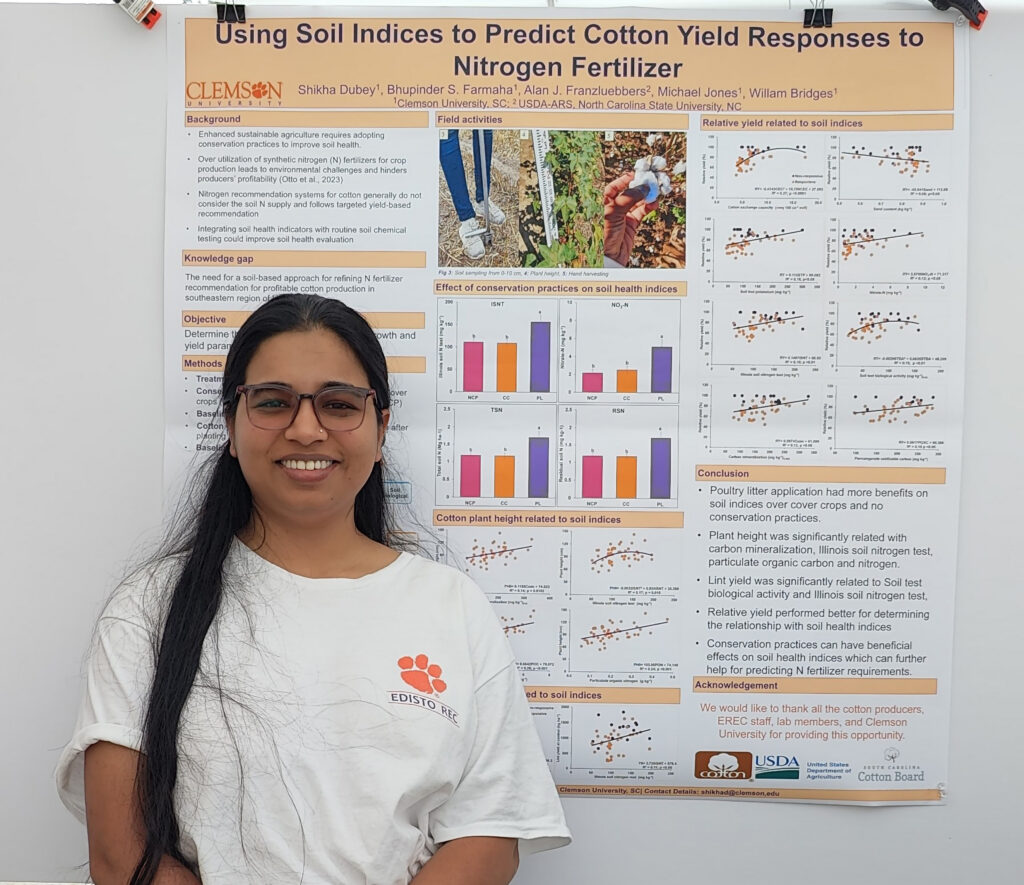
As Clemson researchers work to help South Carolina cotton growers fine‑tune their nitrogen fertilizer use, one member of the research team brings both scientific expertise and an international perspective to the project.
Shikha Dubey, who recently completed her doctoral degree at Clemson, has spent the past several years digging into one of agriculture’s biggest challenges – determining how much nitrogen a crop really needs.
Dubey said the project has given her valuable, hands‑on experience that goes far beyond the classroom.
“This project was great because it provided me with an opportunity to work as a soil nutrients specialist and an Extension worker,” she said. “It allowed me to gain experience in real‑world scenarios.”
As part of the multi‑year effort, Dubey focused on improving nitrogen recommendations for cotton. Her work helped identify problems with existing fertilizer guidelines. In addition, it contributed to the development of approaches that account for differences in soil type and management practices.
“I have worked on refining the current nitrogen recommendations,” Dubey said. “It provided a broader picture of issues with the current nitrogen fertilizer recommendations for cotton and how those recommendations can be modified based on soil properties and management practices.”
Dubey came to Clemson in January 2021, drawn by a research project that closely aligned with her interests in soil fertility and nutrient management. Originally from India, she said Clemson offered both the academic environment and field‑based research opportunities she was seeking.
“It was a great project related to my research interests that helped me join Clemson University,” she said.
Dubey completed her doctoral degree in December 2025. She plans to continue her career in academia and research. She hopes to expand her work into emerging areas such as precision agriculture while continuing to strengthen her expertise in soil science.
“I plan to work as a postdoctoral researcher in soil science, gaining more experience in other fields, including precision agriculture,” she said.
-END-
Project funded by: Cotton Incorporated, SC Cotton Board and USDA-NRCS.