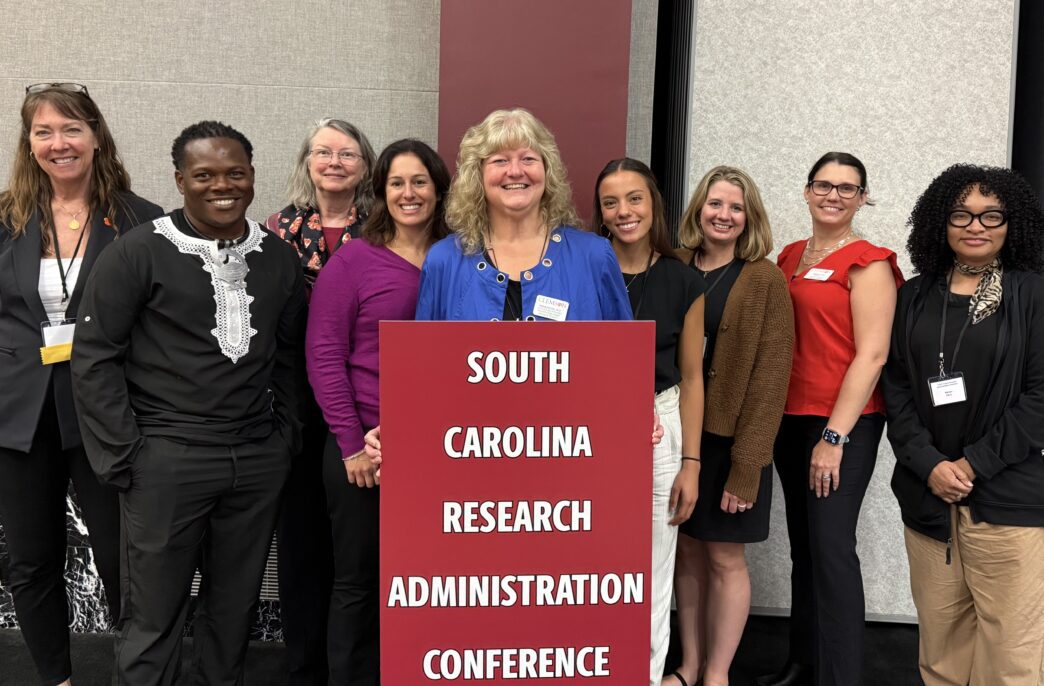
More than 180 representatives of colleges and universities across South Carolina gathered last week to lay the foundation for increasing academic research and innovation.
The inaugural South Carolina Research Administration Conference brought together representatives from 28 colleges and universities in South Carolina who are working to strengthen the administrative infrastructure that advances research. The two-day conference was hosted by the University of South Carolina in collaboration with Clemson University, Claflin University and the College of Charleston through REACH-SC, a research-capacity building initiative funded by the National Science Foundation.

“As this was our first year of the conference, we were hoping to have 50 people attend. To have close to 200 research staff and leaders from across the state of South Carolina attend shows the need for this initiative to enhance research infrastructure and support for the state as a whole,” said Shelia Cotten, Clemson University associate vice president for research development and principal investigator for the REACH-SC project. “From the opening until the closing session, attendees told me how much they appreciated our efforts and that they were looking forward to additional meetings in the future.”
Conference discussions covered administrative workforce training and retention and research capacity building to boost research and innovation across South Carolina, among other topics. One of the highlights was a panel discussion on the state of university research with Susan Anderson, assistant vice president for research at the College of Charleston; Julius Fridriksson, vice president for research at the University of South Carolina; Tanju Karanfil, senior vice president for research, scholarship and creative endeavors at Clemson University; and Jonathan T. Smalls, associate vice president of research at Claflin University.
“I think this is something that has been sorely needed in South Carolina,” said Elaine Marshall, director of sponsored programs at the University of South Carolina Upstate. “This is a great way, I think, to start building that so that we can have more collaboration going forward, to be more competitive for dwindling resources.”

The conference serves as a springboard and cornerstone of the REACH-SC initiative (Research Administration Capacity Heightening in South Carolina). A collaboration between Clemson, College of Charleston and Claflin, REACH-SC received a $2 million investment from the National Science Foundation to support strengthening the administrative workforce across the state’s institutions of higher education.
University research nurtures innovations that improve health care, boost farm profitability, enhance manufacturing efficiency and productivity, modernize transportation systems, grow the state workforce, increase sustainability and much more. The work requires funding that is accompanied by a bevy of rules and requirements. Universities have varying levels of administrative support staff to help researchers identify funding opportunities, develop proposals, properly account for grant spending and comply with various regulatory requirements, such as conducting research with clinicians, handling hazardous materials or protecting sensitive data, for example.
“At smaller institutions, one or two people could be handling all of these aspects of the research process, and it limits the amount of research these schools can conduct,” Cotten said.

Historically, universities have struggled to fill research administration positions, and the acceptance of remote working arrangements has made the job market even more competitive for employers looking to fill needs. The National Academies identified lack of research administration infrastructure, including staff, as a significant barrier to “emerging research institutions,” commonly considered institutions with less than $50 million in research expenditures per year. This barrier is particularly pronounced at primarily undergraduate institutions and historically black colleges and universities.
REACH-SC is working to address this barrier in South Carolina through three primary objectives:
- Implement and refine the statewide Research Enterprise Knowledge and Mentoring Network (KnowNet);
- Conduct a needs assessment with emerging research institutions (ERIs) to identify strengths, challenges, opportunities for enhancing infrastructure, and resources needed to enhance research administration; and
- Conduct skills mapping to identify other occupations where research administration skills are prevalent.
Learn more about REACH-SC at clemson.edu/research/projects/reach-sc.