Clemson University faculty, students and staff are invited to join their colleagues during a virtual lecture series this fall that highlights health research and innovation.
Offered by the Clemson University School of Health Research (CUSHR), The CHAT: Clemson Health Advancement Talks series features health innovators from across disciplines who provide short talks on their research.
Each CHAT features two speakers. Sessions are held on Zoom from 4 p.m. to 4:30 p.m. All are welcome to join. Details on each CHAT are below along with links to attend.
Thursday, Sept. 17
Human-Centered Healthcare Facility Design

Anjali Joseph, professor of architecture and Spartanburg Regional Health System Endowed Chair in Architecture + Health Design
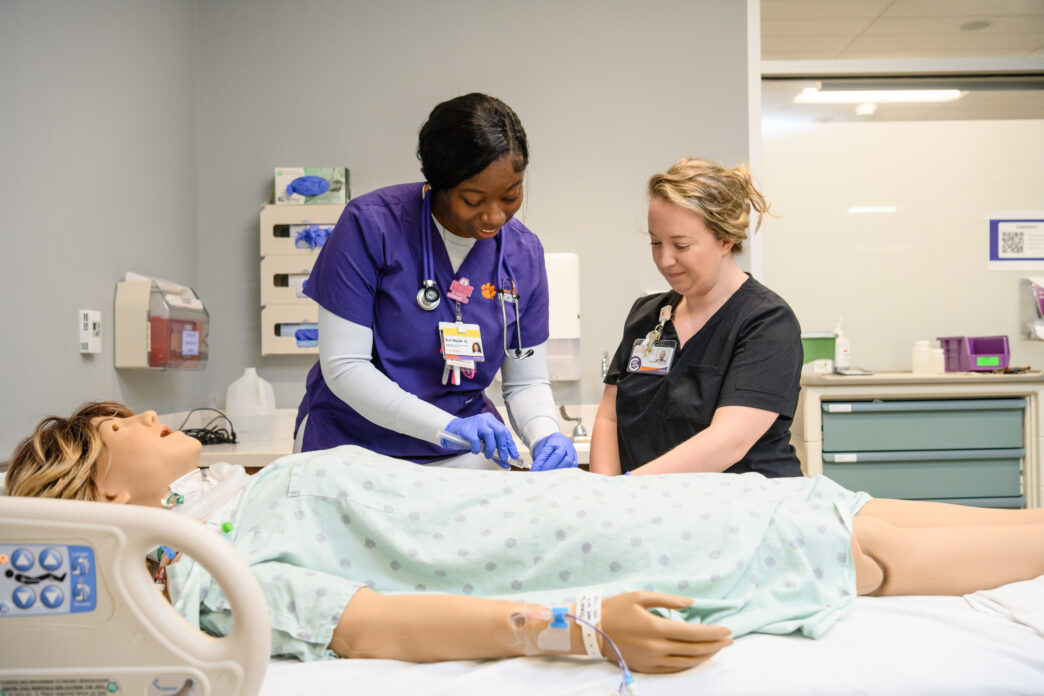
Human-centered healthcare facility design integrates evidence-based design and human factors to create environments grounded in healthcare work. Through simulation-based mock-up evaluations, healthcare professionals, patients, and care partners evaluate critical care spaces in the context of everyday work to address latent risks, improve workflows, enhance safety, and improve the patient experience.
Multiscale Modeling of Biological Transport: From Mechanistic Insight to Health Translation

Zhen Li, associate professor of Mechanical Engineering
From blood flowing through capillaries to a therapy moving through tissues, biological transport shapes both health and disease. This talk will show how computational models connect transport processes across scales, reveal underlying mechanisms in blood disorders and guide the development of personalized diagnostics, treatments and innovative biomedical technologies.
Thursday, Oct. 15
From 2D to VR: Designing Conversational Agents for Behavior Change and Speech Practice

Matias Volonte, assistant professor, School of Computing
Volonte’s research designs and evaluates AI-driven virtual humans that hold natural conversations with people to support health, education and communication practice. Through studies in VR and 2D environments, he examines how embodiment, multimodal design and immersion shape engagement, trust and behavior change, translating findings into deployable systems for real clinical and educational settings.
Bridging Species, Tracking Disease: Surveillance of Vector-Borne Pathogens Using a One Health Approach

Lidia Gual Gonzalez, assistant professor of public health sciences
This talk explores how a One Health approach can strengthen surveillance of vector-borne diseases by examining connections among pathogens, vectors, animal hosts, humans and their environments. Drawing on field epidemiology and cross-species surveillance, it highlights how integrating these perspectives can improve understanding of disease transmission and emerging health risks.
Thursday, Nov. 19
Why BirdBreak? How a Digital Bird Feeder Can Support Staff Satisfaction and Well-Being

Olivia McAnirlin, research assistant professor of parks, recreation and tourism management and co-director of the Virtual Reality and Nature Lab
This talk explores how virtual access to birds and birdsong may support healthcare staff satisfaction and well-being. Drawing on evidence linking human-bird interactions to positive mental health outcomes, McAnirlin will introduce BirdBreak and discuss how digital bird feeders can bring restorative experiences of nature into healthcare work environments.
Engineering Multifunctional Polymer Composites for Biomedical Applications

Lihua Lou, assistant professor of mechanical engineering
This presentation discusses functional polymer composites, including their fabrication, techniques and applications in bioengineering. These hybrid systems optimize mechanical properties, electrophysiological signal propagation and portable fabrication, thereby delivering significant structural and functional maturation in engineered cardiac tissues and enabling point-of-care wound treatment.