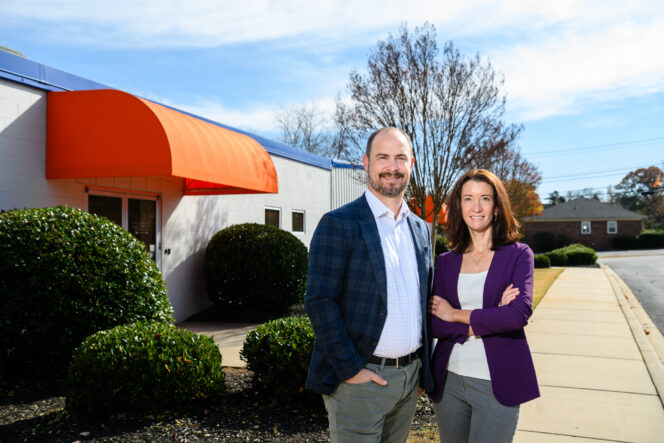
Jessica Larsen of Clemson University has secured nearly $4 million from the National Institutes of Health to launch two separate research projects, including one funded by the highly prestigious and competitive NIH Director’s New Innovator Award.
The awards solidify Larsen’s status as one of the nation’s leading early-career investigators. A member of Clemson’s faculty for eight years, she serves as the Carol and John Cromer ’63 Family Endowed Associate Professor of Chemical and Biomolecular Engineering.
The $2.3-million New Innovator grant funds research into developing nanoparticles that can sneak RNA medicines past the brain’s defenses to treat diseases ranging from Alzheimer’s to cancer.
The other grant, a $1.67-million R01, focuses on slipping therapies past the body’s protective blood-nerve barrier to help patients recover from painful and debilitating nerve injuries.
“Dr. Larsen’s outstanding achievements reflect the growing impact that Clemson University is having on global health innovation,” Clemson President Jim Clements said. “Our faculty are committed to excellence and to transforming lives through the power of research. They are asking big questions, pushing the boundaries of what we think is possible and as Dr. Larsen’s most recent NIH awards highlight – our faculty are shaping the future.”
Larsen said the grants show persistence pays off.
“As we all know, research can ebb and flow,” she said. “Sometimes things work, and sometimes they don’t, but by continuing to plug along with your same vision over time, efforts start to pay off.”

New Innovator Award
NIH’s New Innovator Award backs high-risk, high-reward research. Larsen’s project tackles two problems at once: how to make RNA treatments last longer in the body, and how to get them past the blood-brain barrier.
Her team is creating nanoparticles– akin to tiny, benign Trojan horses– that would slip RNA into the brain. Inside these particles would be tiny droplets called coacervates that protect RNA.
The droplets would stay sealed until they sense signs of distress in the body, such as the chemical stress that shows up in many diseases. When those signals appear, the droplets would break apart and release the RNA.
Once released, the RNA would help cells make proteins to fight disease, including Parkinson’s and childhood neurodegenerative conditions.
R01 Grant
For the R01 grant, Larsen is teaming with Professor Jeff Twiss of the University of South Carolina to regenerate nerves after injury. Twiss developed a therapy that showed strong promise but could only be delivered through surgery.
Larsen’s group is working to engineer nanoparticles that can slip past the body’s protective blood-nerve barrier and carry the treatment directly into nerves.
The goal is to turn what now requires surgery into a simple injection, a shift that could speed recovery and improve outcomes for people suffering from painful and debilitating nerve injuries.
Praise from Clemson leadership
David Bruce, chair of the Department of Chemical and Biomolecular Engineering at Clemson, said the two grants are a testament to Larsen’s hard work and creativity.
“Dr. Larsen is not only pushing the boundaries of knowledge but also elevating Clemson’s reputation as a hub for innovation,” Bruce said. “These awards are well deserved, and she is well positioned to lead both.”
Among those offering their congratulations was Anand Gramopadhye, dean of the College of Engineering, Computing and Applied Sciences.
“These recognitions from NIH place Dr. Larsen among the nation’s most innovative researchers,” Gramopadhye said. “Her work underscores Clemson’s role as a leader in health innovation and shows the power of persistence, teamwork and bold ideas.”
The New Innovator Award is associated with project number 1DP2NS148060-01, and the R01 is associated with project number 1R01NS142877-01.