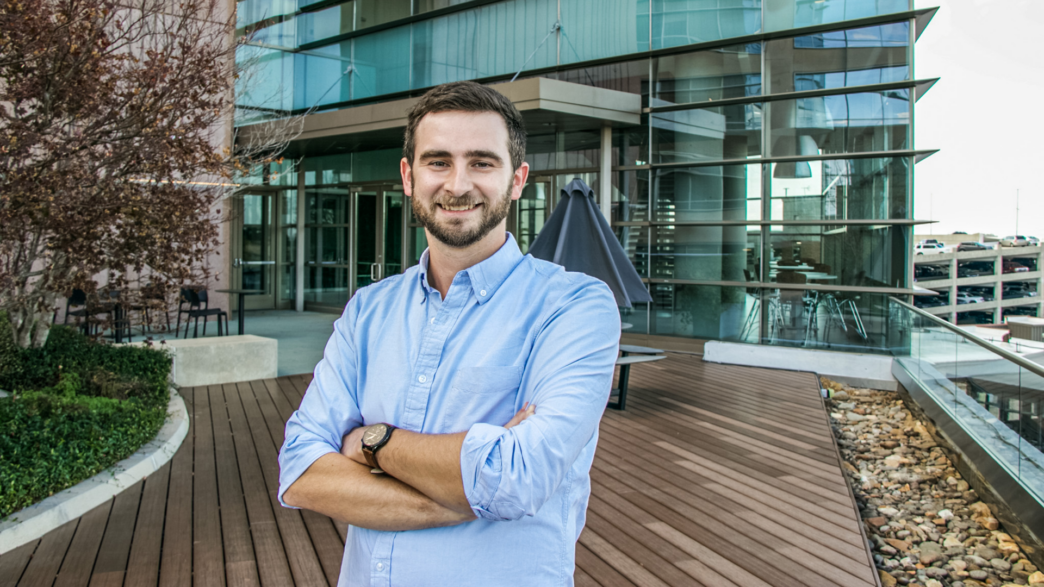
A few weeks before Jake Coplin began a summer Python course, a 50-mile bicycle ride showed him how much a conventional route map could leave out.
Significant stretches took him along a country highway with speed limits of at least 45 mph, with little shoulder and heavy traffic. The route also placed him on White Horse Road, requiring him to cross it before returning to roads he considered more appropriate for cycling.
Coplin, who cycles to stay active and explore the Greenville area, had encountered the problem before. Unless he was riding with people who knew the area, he often followed routes he had designed or found online. He sometimes sampled unfamiliar roads through Google Street View, but the process was slow and provided only a partial picture.
The experience gave him a problem to pursue during a five-week Python course at Clemson University: Could he build a better way for cyclists to examine unfamiliar routes before riding them?
His answer was to develop a route reconnaissance prototype that combines map data, street-level imagery and AI in a single planning report.
Coplin is pursuing a Master of Business Administration as a full-time student in Clemson’s Corporate MBA program and expects to graduate in December 2026. A native of Granville, Ohio, he graduated from Denison University in 2020 with a self-designed major combining physics, computer science and studio art. He earned a Master of Science in Innovation and Leadership from Furman University in 2025.
Building a virtual route preview
For his final project in MBA 8990: Introductory Python for Business Analytics, taught by Travis Box, Ph.D., associate professor of finance, Coplin built Scout to gather information a cyclist might otherwise have to find through several separate tools.
A rider begins by uploading a route file. Such files are generated by bike computers and contain dense data that is not designed for people to read directly. Coplin wrote functions that extract the coordinates, elevation and direction of travel needed to reconstruct the route.
Scout then checks OpenStreetMap, a crowdsourced geographic database, for available information about the roads. At selected checkpoints, Scout retrieves Google Street View panoramas and, using Google’s Gemini model, points the virtual camera toward the cyclist’s expected direction of travel and analyzes the imagery.
The report includes overall route scores displayed as gauges, a breakdown of road types, an elevation profile and a color-coded map of speed limits. Riders can also open the Street View panoramas that Scout reviewed, allowing them to examine the imagery rather than relying only on the AI-generated interpretation.
Coplin has described the concept as a virtual cyclist that previews the route and returns with a report.
During Coplin’s final class demonstration, Scout processed a real 47.5-mile route from the original file through the completed report. The demonstration showed that Scout’s components could operate as a connected workflow.
“I wanted to build something I’d actually use,” Coplin said.
Going beyond the course material
Scout required Coplin to solve problems beyond the course’s regular scope, according to Box.
“What makes it special is not just what it does but how he built it,” Box said. “Most of the machinery goes well past anything we teach: binary file parsing, parallel processing and a class-based architecture designed so the whole thing can become a web app.”
One of the difficulties that Coplin encountered involved connecting coordinates in the route file to the correct roads in OpenStreetMap. Coplin initially matched each coordinate with the nearest mapped point. Because the points defining some roads can be spaced far apart, that method sometimes selected the wrong road.
He replaced it with an approach that compares each coordinate to the line representing the road. In practical terms, Scout stopped looking only for the nearest map marker and began determining where the cyclist’s position fell along the road.
Coplin also designed Scout to add checkpoints when the map data indicates that a location may deserve closer examination. A small back road crossing a major highway, for example, could receive a checkpoint even if it falls between the regularly spaced review points.
As the project grew, Coplin reorganized what had begun as one long script. He separated the code into modules responsible for reading route files, retrieving information, performing calculations and creating visualizations.
That structure allows him to update one component without unnecessarily changing unrelated parts of the program. It also supports his work to develop Scout as a web application.
Knowing when AI is not enough
Coplin used ChatGPT early in the project to troubleshoot syntax, work through smaller problems and develop the initial prototype. As Scout became more complex, he began using Claude Code for tasks that involved several files or required more knowledge of the project’s structure.
The tools did not always provide a workable answer.
When Coplin needed to retrieve information through an OpenStreetMap application programming interface, ChatGPT could not construct a functioning request.
Coplin stopped relying on the assistant’s unsuccessful suggestions and consulted OpenStreetMap’s official documentation.
Once he had built a functioning query himself, he gave that verified example to ChatGPT and used the assistant to help expand it.
“I try not to vibe-code,” Coplin said, referring to the practice of accepting AI-generated software without understanding how it works. “Having code you don’t understand is not an effective way to learn.”
Coplin said AI tools can produce complicated, well-structured code faster than he can write it independently. However, he still reviews their output to understand what each part does rather than checking only whether the program runs.
That review has helped him identify problems the AI tools did not catch on their own. While connecting Scout to a Supabase database, for example, Coplin encountered a failed request caused by a permission setting. Granting broader access could have weakened a restriction he had established intentionally. Instead, he investigated the request and found a one-line change that solved the problem without expanding access.
This experience reinforced the distinction at the center of the course: AI could help Coplin move faster, but he remained responsible for understanding, questioning and verifying the work.
“The lessons on when to lean on AI and when to work through a problem myself were what helped to make Scout possible,” Coplin shared.
Box explained that this division of labor was exactly what the course was designed to teach.
“When the AI assistants could not help him with an obscure mapping API, he learned it from the documentation himself, then used the AI to strengthen what he had built,” said Box.
Jane Layton, interim MBA director, also highlighted Coplin’s decision to use AI as an aid to learning rather than a substitute for it.
“The value of AI depends on the knowledge and judgment we bring to it,” she said. “In our MBA program, we help students deepen that expertise and use emerging tools to solve problems and develop new ideas. Jake’s project illustrates how AI can extend what students are capable of when they draw on their experience and apply what they are learning.”
Continuing beyond the class
Eventually, Coplin would like to make the application available to other cyclists.
“I’ve continued developing Scout since Dr. Box’s course ended,” explained Coplin. “I’d like to eventually open it up to other cyclists, which would mean adding user accounts and integrating with services like Strava, so people don’t have to manually upload ride files.”
Coplin had initially expected to continue developing Scout for his own use, but when Box shared the project with the interim MBA director, it validated the work he had put into it.
“This is something I definitely plan to keep working on, so I am excited to see where it goes,” he said.
The course also changed how he approaches unfamiliar problems.
“The Python course specifically taught me how to push past the boundaries of what I thought I understood and take on a problem that felt bigger than what I thought I could actually tackle,” Coplin said. “I didn’t come into the course thinking I’d walk out with something like this.”
Scout began with a difficult bicycle ride and a five-week assignment. Building it required Coplin to learn more than how to ask an AI assistant for code. He had to recognize when the technology was useful, when its answers were inadequate and when the next responsible step was to learn the system himself.