


Growing up on his family’s farm in Punjab, India, Simardeep Singh learned firsthand the challenges and rewards of agriculture. Watching farmers navigate issues such as weeds, pests and limited resources sparked his interest in finding practical, sustainable solutions to help growers succeed.
That passion eventually led him to Clemson University, where he will graduate with a doctorate in plant and environmental sciences this August. His research shows how anaerobic soil disinfestation (ASD) can help organic sweet potato growers reduce weed and soil pest populations without relying on synthetic fumigants.
Coming to Clemson
Singh chose Clemson because of its emphasis in connecting research with programs that directly benefit growers.
“Clemson offered the opportunity to work alongside leading scientists while gaining hands-on experience solving agricultural problems with real-world impact,” he said.
Inspired to pursue agricultural science, Singh earned a bachelor’s degree in agriculture from Punjab University in Chandigarh in 2018 and a master’s degree in agronomy from Punjab Agricultural University in Ludhiana in 2022.
During his studies, he became increasingly aware of the challenges facing agriculture, including declining groundwater supplies, herbicide-resistant weeds, crop residue burning, and the overuse of fertilizers and pesticides. Those experiences motivated him to pursue advanced research to develop practical solutions that improve farming systems.
Research with grower impact
At Clemson, Singh worked with Matthew Cutulle, associate professor of vegetable weed science, at the Coastal Research and Education Center in Charleston, South Carolina.
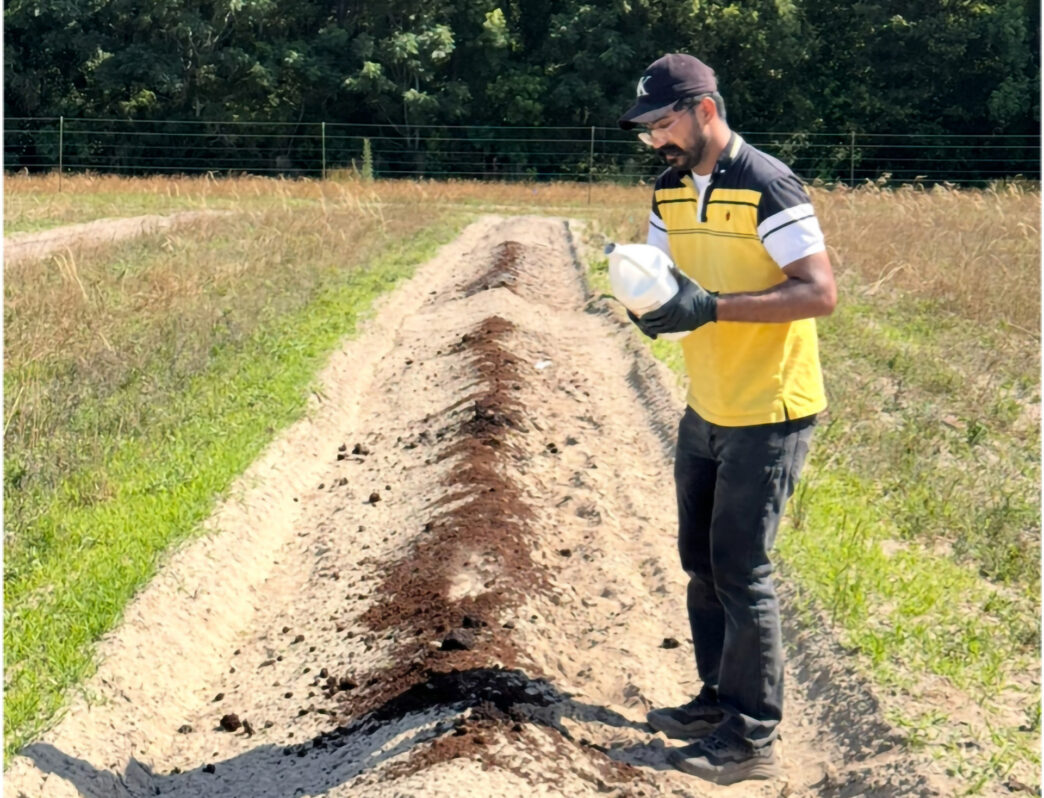
His research focused on helping organic sweet potato growers manage weeds and soil pests using more sustainable methods. He studied the use of pest-resistant sweet potato clones and the soil treatment ASD.
Sweet potato clones are individual plants grown directly from the vegetative parts of a parent plant, such as vines or root slips, rather than from seeds. This vegetative propagation means every new plant shares the exact same genetic makeup as the original source.
ASD uses natural biological processes to reduce harmful soil pests. It is an alternative to using chemicals. This method involves adding carbon to the soil, covering it with plastic mulch and saturating it with water.
Singh also worked with Cutulle and scientists at the U.S. Department of Agriculture Vegetable Laboratory in Charleston to develop insect-resistant, weed-tolerant sweet potato germplasm.
They found that ASD reduced root-knot nematodes, microscopic worms that damage plant roots, by up to 90% and reduced weed pressure by nearly 80%. The results show the practice could provide organic growers with an effective alternative to synthetic soil fumigants.
“Dr. Cutulle’s commitment to addressing growers’ needs and balancing research with Clemson Extension work demonstrates the importance of producing science that farmers can readily adopt,” Singh said.
Cutulle said Singh’s doctoral research has prepared him for a career in academic and applied research by strengthening his expertise in weed management and providing opportunities to collaborate with researchers, specialists and growers.
“Simardeep is an exceptional graduate student who consistently demonstrates a high level of motivation, intellectual curiosity and a genuine passion for solving complex research problems,” Cutulle said. “I am confident he will continue to make meaningful contributions to agricultural research throughout his career.”
Information about Singh’s sweet potato research can be found on ResearchGate.
Cultivating knowledge across the globe
Comparing his experiences in India and the United States, Singh said Clemson’s close connection with the Extension Service gave him opportunities to work with specialty crops, collaborate with researchers from diverse backgrounds and better understand how research can be translated into practical solutions for growers.
Now a postdoctoral fellow at the University of Missouri, he is building on that experience by expanding his work on sustainable weed management in soybean and corn production systems.
“Coming to Clemson from India was both a personal and professional journey that allowed me to grow as a researcher while experiencing a different agricultural system and collaborating with outstanding scientists,” he said.
A foundation in farming
Growing up, Singh’s father took him to agricultural fairs, where he met researchers and saw how science and innovation could help farmers solve everyday challenges. Those experiences strengthened his interest in agricultural research and reinforced his desire to develop practical, sustainable solutions for growers.
His parents, Bhupinder Singh and Jaswinder Kaur, still farm in India today.
“Farming is a part of our identity,” Bhupinder Singh said. “We see ourselves as caretakers of the land, responsible for leaving it in better condition for future generations.”
Singh said working alongside his parents taught him patience, resilience and the value of continuous learning. Those lessons continue to shape his approach to scientific research and problem-solving.
That foundation continues to guide Singh as he develops science-based solutions that help growers produce crops more sustainably.


