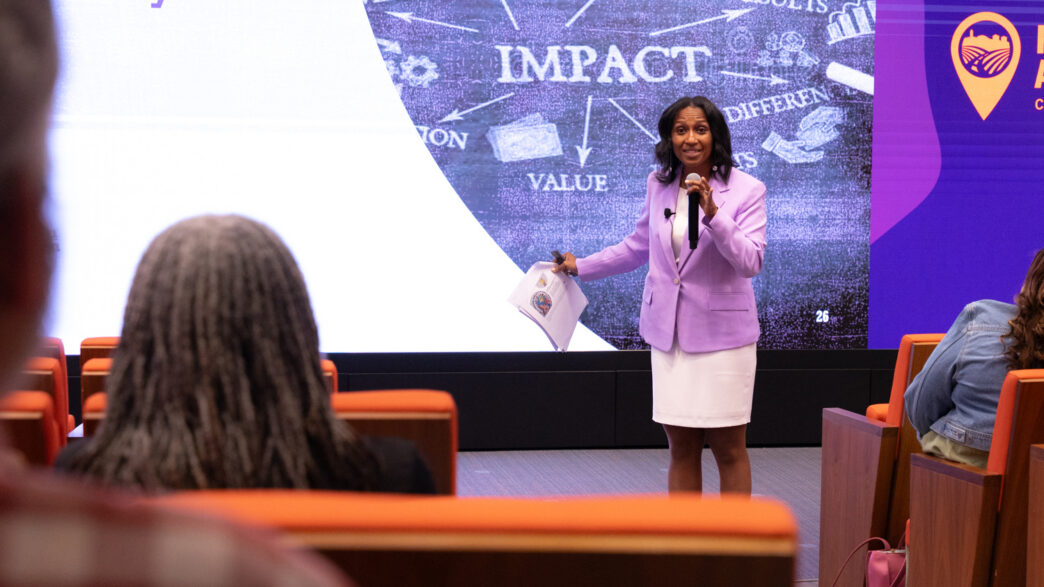
On April 1, the College of Education held a Rural Community Well-Being Summit featuring a keynote speaker and panel discussion that brought together faculty and staff experts in rural education, outreach and health. Organized by Darris Means, professor of educational leadership and Dean’s Fellow for Rural Education in the College of Education, the event attracted faculty, staff and students from across Clemson University.
Loni Crumb, associate professor of counselor education at East Carolina University, discussed her work in counseling in rural areas and highlighted research on social determinants of health and assets and resources in rural communities that can advance community well-being. The event began with opening remarks from Anna Fitch Courie, chief well-being officer at Clemson University.

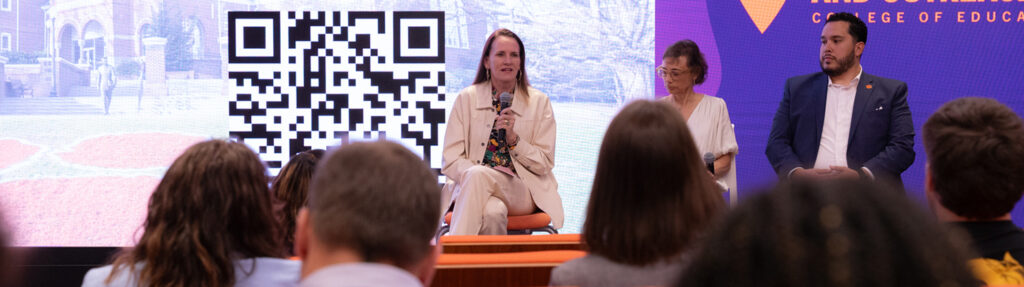
The panel discussion featured Christian Barrientos, associate director for curriculum and assessment for the Clemson University Office of College Preparation and Outreach; Amanda Rumsey, associate professor in the College of Education; Windsor Westbrook Sherrill, Provost Distinguished Professor and senior associate vice president for research; and Phillip Grant, assistant professor in the College of Education.
“The goal of the event was to continue a cross-disciplinary conversation on rural well-being,” Means said. “I am really encouraged by the strong turnout across roles at the University and across colleges. This feels like a deep continuation of prior work at TigerSphere, so I’m glad to know it went over well with those who attended.”
Crumb started her presentation by presenting the concept of “rural cultural wealth,” a conceptual framework developed by Crumb and colleagues and grounded in asset-based ideology that acknowledges rural residents’ multiple strengths and resiliency strategies. Crumb argued that while an acknowledgment of what rural communities need and lack is often needed, there is often little-to-no counterbalance to these deficits in the form of a celebration of rural assets, such as resourcefulness, ingenuity, familism and community unity.

Crumb also “zoomed out” in her talk to question the very definition of “rural.” Considering the diversity of rural geography and populations even within a single state, it can be hard to even attribute any universal deficit to rural communities at large when they are so different from region to region.
Crumb said that all of these issues have a bearing on a person or community’s well-being, and it would be a mistake to try to treat them all as individual issues.
“Well-being is affected by education, health and economic development, just to name a few variables,” Crumb said. “Rural outreach must consider all these interconnected domains. I may be preaching to the choir here, but even if you know this to be true, the choir also needs to have this message reinforced.”
The panel discussion included intentionally diverse perspectives, but all panelists agreed that a focus on practical experience and partnerships is as important as research in the area of rural well-being. Means hopes that this discussion helped those in the audience understand that their insight is important regardless of their level of experience or position.
“There were several undergraduate students in the audience, some of whom were first-generation college students,” Means said. “The panelists emphasized the importance of student perspectives. They encouraged students to see their own lived experience as an asset as they enter the workforce and impact rural communities.”
Means was encouraged by the undergraduate turnout, which he said signals interest and relevance among students and the campus community. He plans to host future in-person events and hopes for a larger scale event in Fall 2026 or beyond.