
This is about creating profitable options for organic growers in the Southeast.
Dil Thavarajah, professor of pulse quality and organic nutritional breeding
Clemson University is on the brink of releasing new organic dry pea varieties tailored for winter farming in South Carolina and the Southeastern U.S., marking a significant milestone in the USDA Organic Agriculture Research and Extension Initiative (OREI).
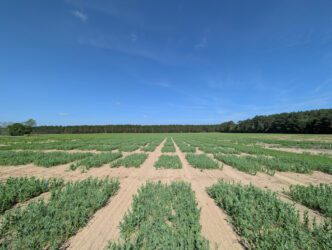
Dry peas (Pisum sativum L.) are primarily grown in Idaho, Washington, Montana, North Dakota and South Dakota. Peas are also grown in California and Oregon. This study focuses on developing biofortified varieties that can thrive as a winter cash crop in the Southeast, replacing acreage typically left fallow or planted with cover crops.
Developed under the leadership of Dil Thavarajah, professor of pulse quality and organic nutritional breeding, the new varieties will be publicly available within a year. Thavarajah and her team are compiling final data from the 2025 trials for submission to Clemson’s College of Agriculture, Forestry and Life Sciences’ Variety Release Committee, after which the Clemson University Research Foundation will file for Plant Variety Protection patents.
A trained sensory panel will evaluate the flavor profiles of the dry peas this month.
“These cultivars are not only productive but also nutritionally superior,” said Thavarajah. “They’re ideal for human consumption, flour production, canning and other food uses.”
The new varieties are USDA-certified organic, requiring no chemical inputs or irrigation. Designed for low-input, rain-fed systems, they have demonstrated yields equal to or greater than conventional crops. Key features include:
- Winter adaptation: planted in January, harvested in May.
- Early maturity: 90–95-day growing cycle.
- High yield: comparable to chemically supported crops.
- Nutritional value: high in protein, sulfur-containing amino acids, resistant starch and total starch.
- Organic breeding: developed through on-farm trials tailored to organic practices managed by farmers.
- Disease tolerance: fungal and bacterial disease tolerance.
Breeder seed production is scheduled for 2026 at W.P. Rawl Farms in Pelion, South Carolina, as part of a broader effort to establish a regional seed system.
Initial trials have shown strong performance in sandy coastal and clay-rich upstate soils. While the breeding pipeline focuses on South Carolina, the scientists expect to expand future testing to other Southeastern states with similar climates.
“These are brand new cash crops for South Carolina,” Thavarajah said. “Our goal is to develop organic cultivars that thrive in winter conditions and meet the needs of organic farmers.”
A $1.2 million USDA grant for dry pea and lentil breeding funds this project, which is part of Clemson’s Pulse Quality and Nutritional Breeding Program. Dry pea crosses began in 2020. Advanced breeding lines are nearing release.
“We’re building the infrastructure to support farmers from seed to harvest,” Thavarajah said. “This is about creating profitable options for organic growers in the Southeast.”
The OREI is a competitive grant program from the USDA’s National Institute of Food and Agriculture. This program funds integrated research, education and Cooperative Extension activities to solve critical issues in organic agriculture.
For information, contact Thavarajah at dthavar@clemson.edu.
-END-