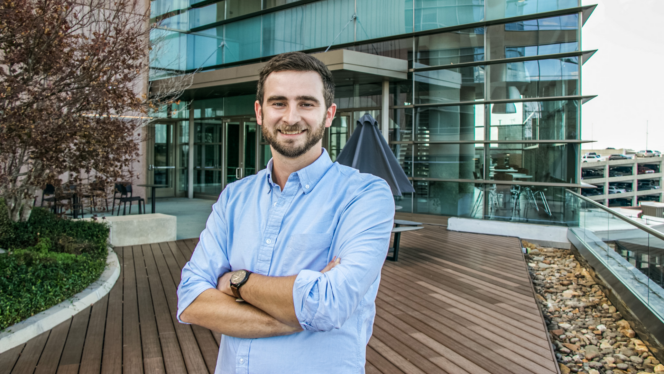

Kara Powder doesn’t think science has to start with a microscope or lab coats. Sometimes, she says, it begins with something as ordinary as the squirrels outside a student’s window.

“It doesn’t have to be fancy,” said Powder, an associate professor in the Clemson University Department of Biological Sciences. “It just has to be something that connects with their world.”
That simple, student-centered approach to science education has earned Powder the 2026 South Carolina Governor’s Award for Excellence in Scientific Awareness, recognizing her impact on how middle school students across the state experience and understand science.
While Powder is a researcher studying the genetics and development of facial variation, the award highlights a different side of her work.
BeakerBox is a program that provides middle school classrooms with ready-to-use, inquiry-based science lessons that meet state education standards. Since distributing the first boxes in 2023, the program has reached more than 40,000 students across South Carolina.
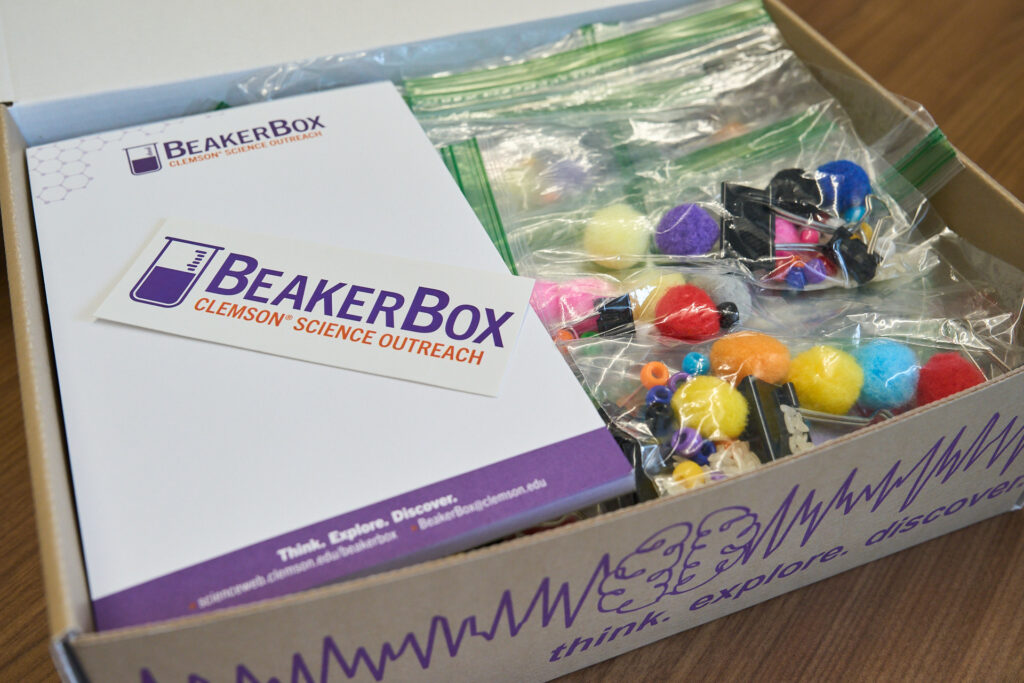
Science in a box
Each BeakerBox contains simple, low-cost materials—magnets, colored plastic discs, paper models, cards and printed activities—designed to help students learn by doing.
One lesson asks students to crush cereal and use magnets to extract iron, making nutrition visible in a hands-on way. Another has students build paper airplanes and introduce design alternations, or “mutations,” using dice rolls, a way to demonstrate how genetic changes can affect traits, or sometimes have no effect at all.
Other activities include analyzing mock medical cases to diagnose anemia and even creating “dating profiles” for organisms to explore reproduction and survival.
If only some classrooms can do science, we’re missing the point.”
Kara Powder
“We try to keep everything accessible,” Powder said. “Not just for our budget, but for teachers’ budgets, too. That way, all classrooms can benefit. If only some classrooms can do science, we’re missing the point.”
Powder said that while advanced lab experiments can be valuable, they often reach students who already have access to strong resources.
“Thinking about the teachers in districts that could use some extra support is really important to me,” she said. “We try to design things so they can work anywhere.”
The boxes are largely reusable, expanding the impact year to year, and digital versions of the lessons are available for free online. As a result, the program has expanded beyond South Carolina and even into Canada.

Inquiry based
At its core, BeakerBox is built around inquiry. Lessons begin with a simple question or observation about something familiar to students and build toward deeper scientific concepts.
“We start with a phenomenon,” Powder said. “Something they can see or something they already know. Then we ask, ‘Why?’”
That approach helps students recognize science is not just a subject in school, but a way of understanding the world.
“You are a scientist, whether or not you call yourself that,” she said.
Bridging research and outreach
Powder joined the Clemson faculty in 2016 and became an associate professor in 2025. Her research focuses on craniofacial development, examining how genetics and evolution shape facial structure, particularly in cichlid fishes.
Her work has been supported by major grants, including the National Science Foundation through a CAREER award and the National Institutes of Health through the South Carolina Translational Research Improving Musculoskeletal Health (SC TRIMH) group. BeakerBox was created as part of her NSF CAREER grant, and it is also supported by the Clemson Creative Inquiry program.
Powder has also authored numerous scientific papers.
Part of her path
Education and outreach have always been part of Powder’s path.
As a high school student, she worked in a science museum and performed chemistry demonstrations for young visitors.
Powder said she thinks of science as a puzzle.
“It’s about figuring out how the pieces fit together,” she said.
Powder said that BeakerBox’s success stems from many pieces fitting together.
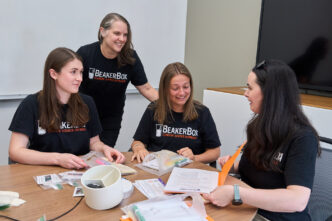
BeakerBox is supported by graduate students in education, who help ensure lessons align with best teaching practices, and by more than 60 undergraduate students who help design and build materials for the boxes. Students have come from many disciplines, including science, engineering, education and even marketing.
“BeakerBox really takes a team, which is fitting because education is a team effort. It really takes a village,” Powder said.

A broader goal
When Powder learned she won the Governor’s Award, her reaction wasn’t focused on personal recognition.
“I read the email again to make sure I didn’t read it wrong,” she said with a laugh. “I was just really proud.”
She said she hopes the award will expand BeakerBox’s reach.
She hopes the publicity will cause more teachers to reach out and adopt the materials, giving more students the opportunity to engage with science in meaningful ways.
“Any impact is a success for me,” she said.
Sometimes it is as simple as sparking a moment of curiosity, a student noticing something in their world and asking why.
“That spark is what drives me,” Powder said.