
Findings could help predict when future wild songbird salmonella outbreaks are likely to happen
When Ben Tonelli noticed an unusually large number of pine siskins showing up at the bird feeders at his home in Seattle during the first winter of the COVID-19 pandemic, he didn’t realize he was witnessing the beginnings of a multi-year research effort.

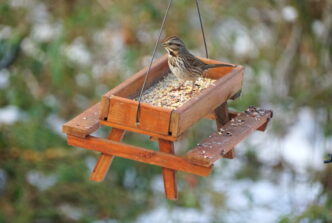
Tonelli had just started his Ph.D. program at UCLA but was working remotely. He had a bird feeder on the window next to his desk. Pine siskins, members of the finch family with small, slender bodies that are streaky brown all over, showed up by the hundreds.
“There was just tons of them. The sheer volume was abnormal,” said Tonelli, who is now a postdoctoral fellow at Clemson University.
Then, Tonelli noticed the birds began getting sick and dying. He wondered not only what was causing the deadly outbreak but why it happened when and where it did.
Following the ecological chain
Tonelli said the research showed early warnings could make a real difference. During the 2020-21 outbreak, thousands of pine siskins across the United States and Canada and dozens of people were hospitalized after handling feeders or infected birds.
Pine siskins are an irruptive species that abandon conifer forests at high elevations during some winters when their primary food source, pine cones, are scarce. During irruption years, this species often ends up at backyard bird feeders in suburban areas. The abundance of birds in small areas makes feeders perfect hotspots for transmission of salmonella. That can put birds, pets and humans in danger of getting sick.
“I wanted to go up the ecological chain of events to try to figure out the ultimate cause of these outbreaks and to figure out if we could predict where and when the outbreaks would happen,” Tonelli said.
The first aspect he looked at is why pine trees produce heavy cone crops one year and almost none the next.
“The forest is truly diabolical. One year, the trees will produce tons of cones, so many that the seed predators can’t keep up with eating them all. The next year, they’ll produce very few pine cones and seeds and that will cause a lot of the seed predators to die because there’s not enough food.”
Ben Tonelli, Clemson University biological sciences postdoctoral fellow
“The forest is truly diabolical. One year, the trees will produce tons of cones, so many that the seed predators can’t keep up with eating them all,” Tonelli said. “The next year, they’ll produce very few pine cones and seeds and that will cause a lot of the seed predators to die because there’s not enough food.”
Recent studies suggest one cue to this phenomenon, known as masting, is the difference in temperature between consecutive summers during the cone maturation process. A cold summer followed by a hot summer tends to produce bumper pine cone crops, while a hot summer followed by a cold summer leads to a scarcity of cones.
Climate linked to sick birds
Using four decades of data on climate patterns, tree cone production, irregular bird migrations and zoonotic outbreaks of salmonellosis, the disease caused by salmonella, the researchers built a model that links climate signals to sickness in wild birds.
The researchers used United States Geological Survey data for disease outbreaks in wild animals to estimate how many songbirds were sick with salmonella. The Audubon Christmas Bird Count provided winter species population sizes. An academic study of masting provided information about pine cone production in different North American forests. And finally, NASA’s Daymet project provided estimates of daily weather and climatology variables.
The link between climate, tree pinecone production, sudden winter migrations and salmonella outbreaks was true both east and west of the Rockies, Tonelli said. Irruptions and disease outbreaks were milder and more localized in the East. In the west, they were more intense and widespread.

Important predictors
“We can take recent climate data and forest data and predict whether we’re likely to see big pine siskin irruptions. If it looks like a high-risk year, agencies could alert the public early, before sick birds start showing up, to take down their feeders,” he said.
While the researchers concentrated on pine siskins — the species most reported to be involved in the salmonella outbreaks — Tonelli said the model could apply to other birds that are similar in their ecology. The model they developed included irruptions of seven other bird species: evening grosbeak, redpoll, purple finch, pine grosbeak, red crossbill, red-breasted nuthatch and the white-winged crossbill.
Casey Youngflesh, an assistant professor in the Clemson Department of Biological Sciences, said as ecologists, the goal is to understand how the natural world works.
“This is a complex task. As this research demonstrates, many components of the natural world interact to produce the phenomena that we observe (such as sick birds in our yards). The natural world is like a machine with many, many moving parts. We want to understand how those parts are put together and how they interact to develop an understanding of the natural world and how it’s changing over time,” he said. “These models have important implications for understanding not only how the ‘natural’ components of the world are changing, but also how these changes impact humans as well.”
The research was published in the Proceedings of the National Academy of Science.