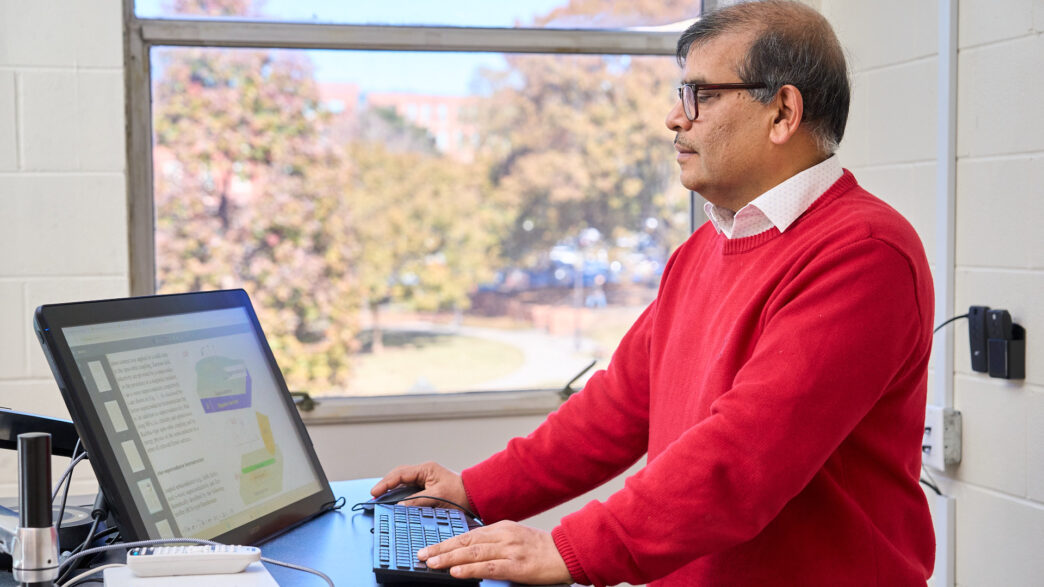
Clemson University physics professor Sumanta Tewari has been elected a fellow of the American Physical Society (APS), an honor recognizing his pioneering theoretical contributions to quantum condensed matter physics that could lead to fault-tolerant quantum computers.
Tewari was honored in the Division of Condensed Matter Physics, where fewer than 0.5% of members receive the honor annually.
“I am honored and humbled by this recognition,” said Tewari, who joined the Clemson faculty in 2008.

Tewari is widely recognized for his work on a new type of quantum particle called Majorana fermions. Majorana fermions are theorized to be their own antiparticles, making them a possible candidate for qubits, the basic element of a quantum computer.
“Since Professor Tewari joined the Clemson faculty, I have witnessed him paving the way for topological phases in condensed matter physics and their use in quantum computing — a frontier topic of tremendous importance for modern science and technology,” said Apparao Rao, the R.A. Bowen Endowed Professor of Physics and founding director of the Clemson Nanomaterials Institute. “He has earned worldwide acclaim for himself and Clemson University.”
Solving problems
Classical computers use a binary system of ones and zeros, called bits, to represent and process all information. Quantum bits, or qubits, can represent zero, one or both simultaneously. This would allow quantum computers to solve problems that are beyond the reach of even today’s fastest classical supercomputers. Tewari said quantum computers could solve problems involving prime factorization, a mathematical puzzle that underpins the security of many digital systems.
The challenge is stability.
“The biggest problem for quantum computers is how to protect these qubits from their environment,” Tewari said. “Even tiny interactions can cause them to behave classically again.”
Landmark contribution
That’s where Majorana fermions and Tewari’s landmark contribution come in.
In 2010, Tewari and collaborators from the University of Maryland proposed using a semiconductor-superconductor heterostructure to realize Majorana fermions. Today, Tewari’s system is the most widely studied system for research on Majorana fermions.
Tewari also studies Weyl fermions and their anomalous transport properties, which have been experimentally confirmed and provide insight into quantum materials.
During his time at Clemson, Tewari received the University Research, Scholarship and Artistic Achievement Award in 2018. The award recognizes Clemson faculty who have received rare career milestones such as receiving the highest level of national or international recognition in their field, authoring a paper that has received more than 1,000 citations or expending more than $1 million on research in a fiscal year.
He has published more than 130 papers. He has graduated four Ph.D. students and is currently advising three others.
Prior to arriving at Clemson, Tewari served as a research assistant at the University of Oregon and the University of Maryland, College Park. He earned his master’s degree from the Indian Institute of Technology in Kanpur, India, and his Ph.D. from the University of California, Los Angeles.
Tewari acknowledged his long-time collaborators Jay Sau at the University of Maryland, College Park; Tudor Stanescu at West Virginia University and Roman Lutchyn at Microsoft Research, as well as his parents and his wife, Chitrita, for enabling him to devote the past decade and half to proposing and developing the platform for topological quantum computation.