
Two men spent years as strangers only miles removed from one another. A life-saving medical procedure connected them forever. In this season of selfless giving, here is a story about giving of oneself – literally.
When Jim Westerhold ‘97 announced he was going to donate one of his kidneys to a stranger earlier this year, many of his friends asked him why. Donating a kidney is a serious procedure, and if he didn’t even know who would receive it, what was in it for him? He says it’s hard to pinpoint, because countless meaningful moments accumulated over his lifetime leading up to the decision, but in the end, it all boiled down to one thing:
“I’ve just been overly blessed, and I couldn’t come up with a reason not to,” Westerhold, 55, explains during an interview from his office at Boone Hall Plantation and Gardens, where he’s been the general manager for the last six years.
The word “blessed” comes up a lot when speaking with Westerhold. He says his blessings began in his childhood, being brought up on a grain and livestock farm in the Midwest. He was the youngest of five children raised by his father, who ran the farm and supplemented his income as a rural mail carrier, and his mom, a homemaker.
He credits the family farm environment with giving him a great start in life, but it’s not where he came of age.
“One of my biggest blessings is that I’m a Clemson graduate,” he says. “I always tell people I grew up in Clemson because I did my growing up while I was there.”
Westerhold came to Clemson in 1994, lured by the school’s wildlife management and biology programs, which would keep him rooted in his agrarian heritage. He graduated with a master’s degree in forestry and wildlife management.
The minister
While Westerhold was steering through his formative years on a bucolic Midwest farm and on the Clemson campus, another boy named Gene Pitts was experiencing a much-different-in-ways-but-very-similar-in-ways life growing up in the small railroad town of Pickens, South Carolina, the son of a father who was a deacon and a mother who was a singer.
Pitts, 66, says his parents were no-nonsense southerners who expected their children to conduct themselves with proper manners and dignity.
“They raised us to be well-respected,” Pitts says during an interview from his home in Easley, adding with a warm chuckle: “As my daddy and granddaddy told me: ‘We’ve got a good name, so don’t you come along and destroy it!’”
Pitts followed in his father’s footsteps and moved to Connecticut when he was 17 to become a minister. It was an audacious move for someone so young, but he stayed there for 20 years, preaching in churches and caring for the unhomed in Hartford. In 1989, he convinced his wife to move back to South Carolina to raise their three daughters.
Just stopping by
Back in the Upstate, Pitts found his calling as a prison minister, counseling inmates in the Tyger River Correctional Institute, the Broad River Correctional Institute, the McCormick Correctional Institute, and the Kershaw Correctional Institute and Reentry Center, among others.
“I was able to serve on death row twice,” Pitts recalls. “That meant going in and giving last rites. I didn’t know if I was worthy, but a door opened, and I was able to do that. It was a life-changing experience.”
Pitts ministered at Upstate prisons for 28 years, until he got some strange news from his doctor after an accident in 2017.
“I was working on some ceiling tile and the roof kind of fell in on me,” he explains. “I ended up going to the hospital to get checked out, and I was shocked when the doctor told me I had kidney failure.’”
He hadn’t felt any symptoms and had just passed his yearly physical, but the tests were undeniable.
“They told me I had stage three, so I could still turn it around if I changed my diet and everything,” explains Pitt. “I did everything they asked me to do, but the numbers were still dropping. That’s when the doctor called my wife and told her, ‘If he doesn’t get on dialysis, he’ll be dead in two years.’”
He went into dialysis treatment shortly after that, but he never accepted that it would be a permanent thing.
“I told people when I first went on dialysis, ‘I’m just stopping by! God just wanted me to check in with you all,’” he laughs.
Pitts had dialysis treatment three times a week, four hours at a time, for three years before he was put on the list to receive a kidney transplant. He endured that treatment schedule for another four years before he got the miracle he’d been praying for.
It was early 2025, and Pitts and Westerhold’s paths finally crossed when Westerhold signed up on the other side of that list.
Fresh starts and new friends
“When they called me and told me that they thought they had found somebody, I said, ‘Listen, you better be serious about what you’re telling me, because I ain’t up for no joking,’” recalls Pitts. “She said, ‘From all the tests we’ve run, we think we got you a match.’ And I was over the moon, man.”
The two men reported to separate rooms in the Medical University of South Carolina in Charleston on March 5 for their respective surgeries, each of which took just a few hours.
Westerhold says the surgery itself was relatively painless. He was home the next day and walking and in his office the day after. After two weeks, it was as if nothing had ever happened.
Pitts, on the other hand, felt different as soon as the anesthesia wore off.
“One of the things kidney disease does is take away your energy,” he explains. “As soon as I came out of rehab, I had energy. I felt like I could run!”
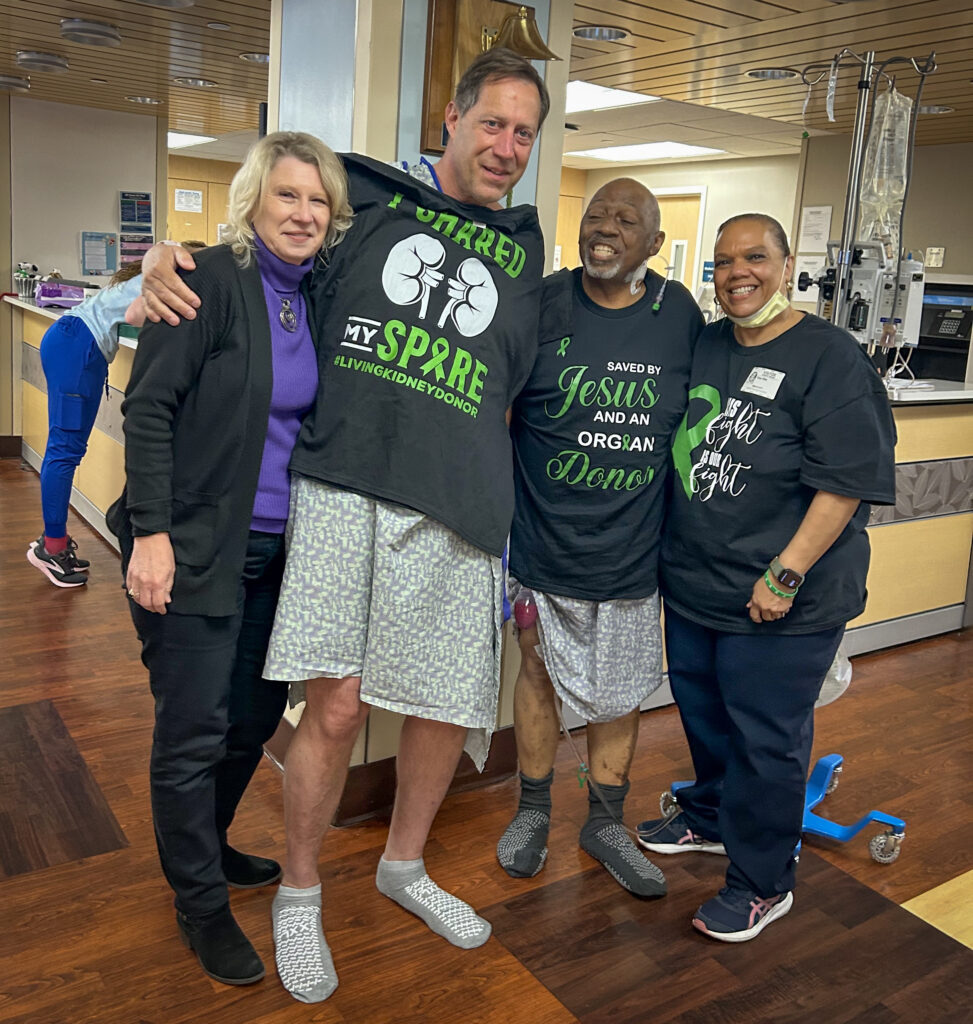
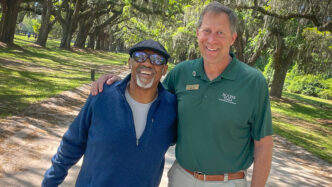
Whether or not an organ recipient meets their living donor is solely up to the recipient, and that was never a question for Pitts. He wanted to meet his donor as soon as he could. The day after the operations, the two men and their wives met in a hallway of MUSC, where Pitts and Westerhold rang a bell together to celebrate the successful surgery, and a fresh start for Pitts.
At first glance, the two men could not be more different, but they quickly discovered several profound parallels in each other’s lives, including a love for Clemson. While not a four-year graduate like his donor, Pitts grew up just down the road, and he and one of his children have taken classes at the University.
Brothers in life
Nine months after meeting in that hospital hallway, Westerhold said Clemson is just the beginning of what the two men share.
“We share our Christian faith, wonderful supporting families, an appreciation for education and good work ethic, and a sense we have been blessed with wonderful lives before the transplant and even more so after,” says Westerhold.
“He’s like a brother,” says Pitts. “I thank God for him. We have an amazing relationship. Before we rang the bell together, I told him that he doesn’t know what he’s got himself involved in — because I’m a motivator, and I’m going to take you on a roller coaster ride!”

“People say giving a kidney is a big sacrifice, but whatever I gave up has already been returned to me ten times over,” says Westerhold. “My many blessings that I know of, and those yet to come, are more reasons I’m glad I donated. I have one more blessing to add to the list, and that is Gene and his health. My right kidney may miss its co-worker, but my body as a whole will not.”
Pitts has to take it easy for a year to let his immune system build back up but plans to get right back to helping people around the Upstate as soon as he can, which means that untold more lives will be lifted thanks to Westerhold’s selfless gift.
“That’s what life is all about,” Says Pitts. “The Bible says to honor one another, and thanks to Jim, that’s what I aim to keep doing.”
Learn more about organ donation at Donate Life South Carolina.