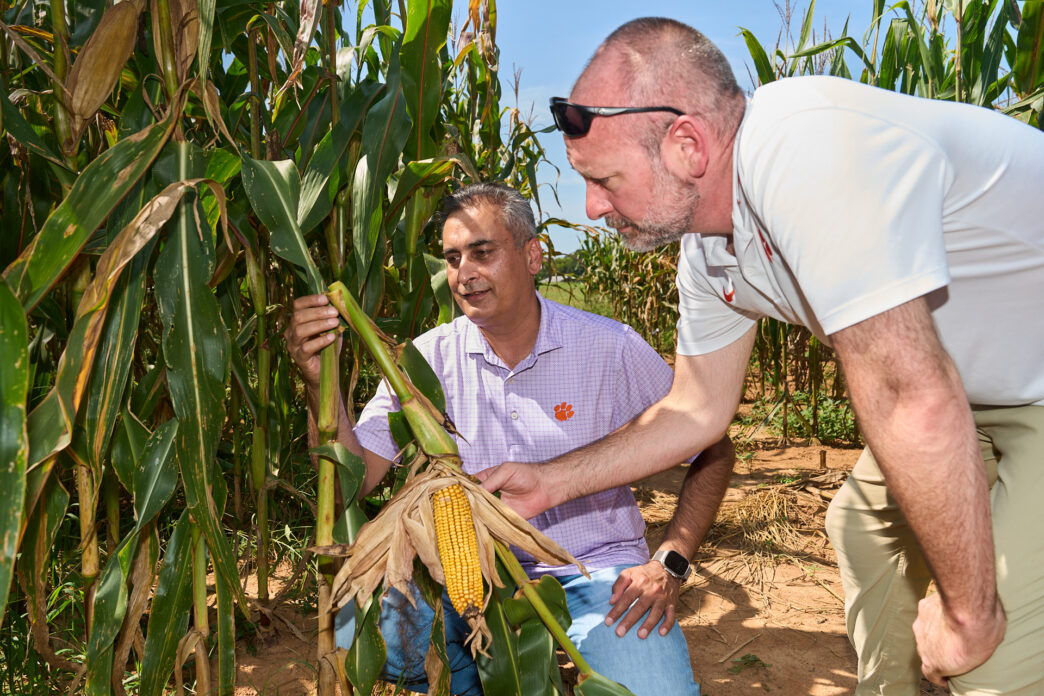
A new national research project will put Clemson University at the center of an effort to develop corn plants that are less likely to bend or break before harvest, a problem that costs farmers billions of dollars a year.

The work is part of a four-year, $6 million National Science Foundation grant that brings together plant geneticists, engineers, statisticians and artificial intelligence researchers from Clemson, the University of Nebraska Medical Center and the University of Idaho, which is leading the project. Rajandeep Sekhon is the project’s principal investigator at Clemson, which will use its $2 million share of the award to fund work on the genetic and biological drivers of stalk strength.
Together, the researchers will develop a new way to study complex crop traits by tracing them from DNA to the physical performance of the plant.
Major agricultural problem
Stalk lodging is a major agricultural problem. Stalk lodging causes global maize yield losses exceeding $6 billion annually, according to a peer-reviewed study by Clemson researchers and collaborators. When mature plants fall over because of high winds or other environmental stressors, they become more vulnerable to pests and disease and often cannot be harvested, impacting farming operations and reducing food production and crop quality.
Clemson researchers will study what happens inside a corn plant before it falls.
The Clemson team will search for the many genetic variants that contribute to stalk strength and determine how those variants affect the plant at several levels. The work will begin with DNA, then move through plant chemistry, cell structure, cell geometry and mechanical strength.
“It’s almost like reverse engineering the strong plant versus the weak plant back to the DNA, so we can identify the genetic and biological factors that allow a plant to remain standing,” said Sekhon, an associate professor in the Department of Genetics and Biochemistry.
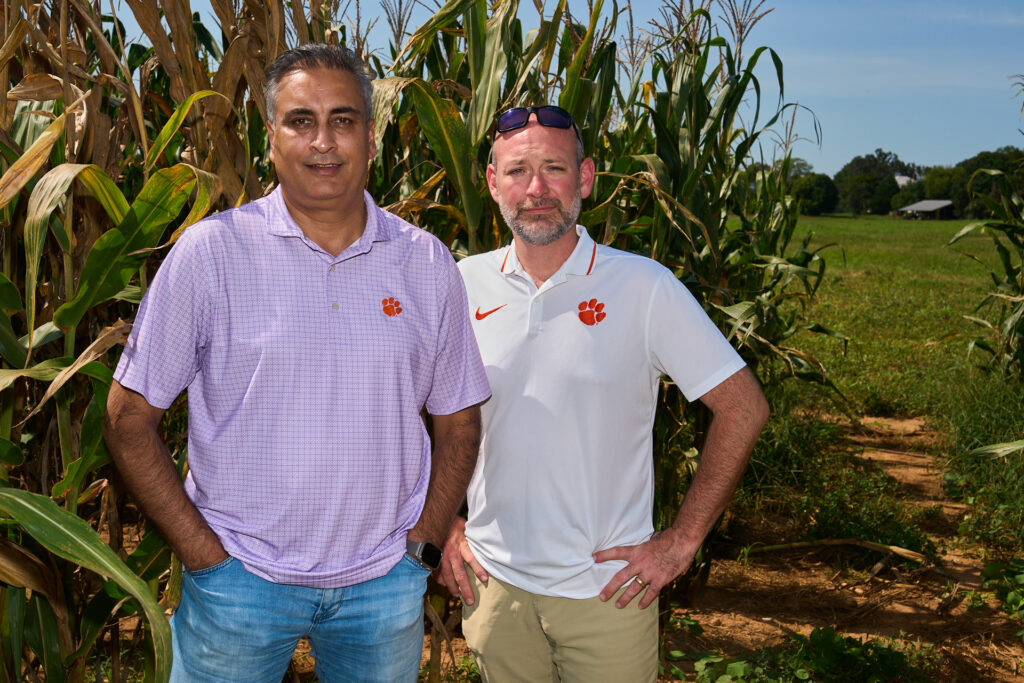
At Clemson, Sekhon will direct the systems genetics and maize biology research, focusing on how genetic variation shapes the biological and structural traits that determine stalk strength. Chris McMahan, a statistician and professor in the Clemson School of Mathematical and Statistical Sciences, will lead the development of statistical and machine-learning models that will combine the project’s many data sources. Clemson researchers Nishanth Tharayil and Trevor Rife, faculty members in the College of Agriculture, Forestry and Life Sciences, will contribute their expertise in plant metabolomics, cell-wall chemistry, high-throughput phenotyping and phenomics.
Researchers will grow and study about 1,000 maize inbred lines in South Carolina field trials. They will compare plants with strong and weak lodging histories and measure their stalk strength, stiffness, diameter, rind thickness and cellular characteristics. They will also track changes in stalk chemistry as plants develop.
“Lodging is not controlled by a single gene or a single feature of the plant,” Sekhon said. “By linking DNA with plant chemistry, cell structure and mechanical performance, we can begin to explain why some plants remain standing while others fail.”
Tharayil said that while a corn stalk may look simple, its strength depends on both its design and materials.
“Metabolomics and cell-wall chemistry help us study these features together and explain why some plants remain standing while others break,” he said.

McMahan compared the challenge to understanding human height. Height is not usually controlled by a single genetic difference. It results from many factors working together. Stalk strength is similar. Dozens or hundreds of genetic effects may combine to produce a plant that stands or falls.
“Here we have an entire spectrum of things that can occur,” McMahan said. “We’re trying to understand what’s causing that difference.”

McMahan will work with the Nebraska researchers to build models that use biological knowledge to decide which genetic markers deserve the most attention.
The University of Idaho team will develop automated sensing systems, including technology that could eventually be integrated into plot combines. By collecting mechanical data during harvest, researchers hope to measure far more plants than possible through manual testing.
The project could also create a research model that extends beyond corn and lodging. The same approach could eventually be used to study other crops, agricultural traits and biological problems in other species, the researchers said.
“The more minds we bring, the better we are as a scientific community,” McMahan said. “This is a culmination of a very long collaboration.”
The goal is to identify roughly 500 validated alleles that can be used by breeders to select for stronger, more lodging-resistant corn.
“Our goal is to turn the genetic markers and biological insights we identify into practical tools breeders can use to develop stronger, more lodging-resistant corn. Ultimately, that could mean fewer losses in the field, more reliable harvests for farmers and more resilient food production,” Sekhon said.