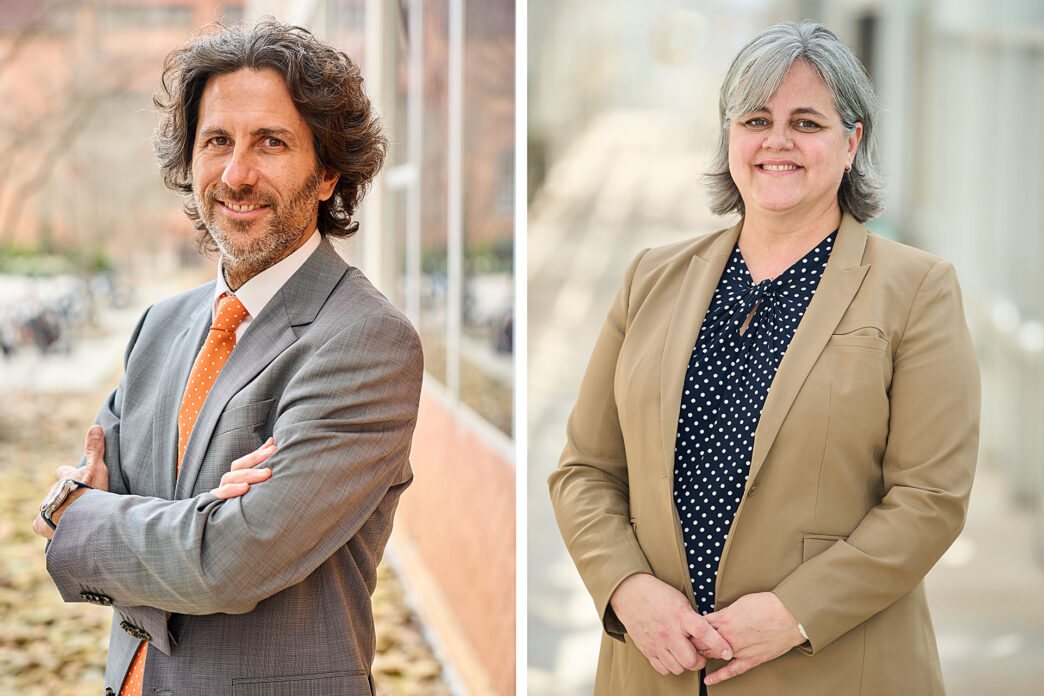
Two Clemson University College of Science professors have been named 2025 Fellows of the American Association for the Advancement of Science (AAAS) — one of the highest honors in the scientific community.
Amy Lawton-Rauh, senior associate provost and professor in the Department of Genetics and Biochemistry, and Marco Ajello, a professor in the Department of Physics and Astronomy, were selected for their exceptional research and leadership in their fields. The lifetime distinction was conferred on March 26 by the AAAS, the world’s largest general scientific society and publisher of the Science family of journals.
With their election, Lawton-Rauh and Ajello join nine other Clemson University faculty members who are current AAAS Fellows, according to a listing on the society’s website.
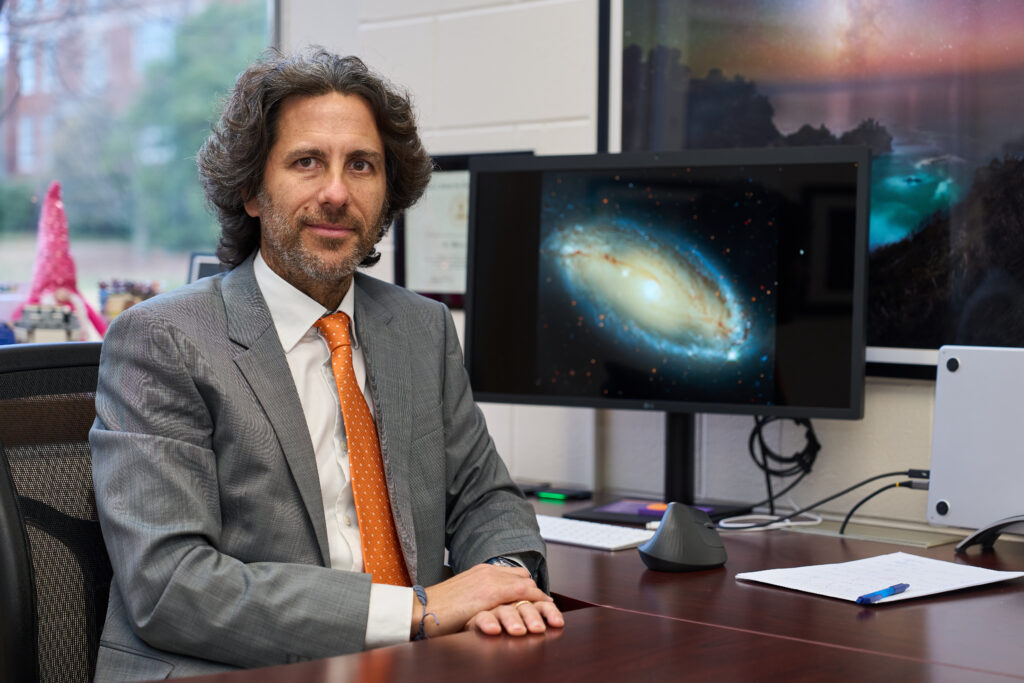
Marco Ajello
The signs that Ajello would become an astrophysicist were there early.
Ajello received a microscope from his father when he was about 6 years old and promptly removed its base and pointed it to the sky.
“Of course, I didn’t see anything since it was meant to focus on the nearby rather than the universe,” said Ajello, a professor in the Clemson Department of Physics and Astronomy.
Later as a teenager with an actual telescope, he spent many cold, frigid nights observing the sky and mapping constellations. He read articles in astronomy magazines about scientists using NASA satellites to explore the universe, never dreaming he’d meet some of those researchers decades later.
Not a straight path
But despite the signs, Ajello’s path into astrophysics wasn’t straightforward. He first enrolled in engineering, unsure of the difference between the technology and the science.

“Once I understood that what really fascinated me were the physical laws underlying things, I switched to physics,” he said. “Eventually, I moved to astrophysics. I still like to look at the sky and wonder what is out there. We’ve made great progress in understanding our place in the cosmos, but there is still so much we don’t know. It’s a field where you can genuinely discover new things.”
At Clemson, his research centers on high-energy phenomena around supermassive black holes at the centers of galaxies. These objects can go through active phases in which they gorge on surrounding gas and dust, releasing so much energy that a compact region roughly the size of our solar system can outshine an entire galaxy stretching tens of thousands of light-years across. By studying the extreme light and particles produced in these environments, his lab studies how matter behaves under conditions impossible to recreate on Earth.
Measuring starlight
His most notable achievement is a landmark measurement of how much starlight has been produced over the history of the observable universe. Rather than estimating a single number, his group reconstructed the buildup of stellar light at different cosmic epochs, from the first starts to the present day. The result offers key insights into how many stars formed over time, how quickly the universe expanded and whether there might be additional, more exotic sources contributing to the cosmic glow.
He is now helping lead Clemson’s role in a NASA mission called COSI, short for Compton Spectrometer and Imager, scheduled to launch in 2027. The project will explore an energy range in the electromagnetic spectrum that is largely uncharted.
Ajello said he’s also proud of the students and postdocs who have worked in his lab, some of whom are now his collaborators. “If I’m here today, it’s because of them, too,” he said.
“Through rigorous inquiry and bold scientific exploration, Dr. Marco Ajello’s research has positioned Clemson at the forefront of astrophysical discovery,” said Cynthia Young, dean of the College of Science. “His election as a fellow of AAAS is a testament to the impact and continued momentum of his research, the national and international significance of his scholarship, and his sustained contributions to expanding scientific knowledge.”

Amy Lawton-Rauh
Lawton-Rauh did not spend much time in crop fields before her sophomore year in college, when she landed a research internship in a lab at the University of Missouri that studied mitochondria in maize.
Now, she is being recognized by the AAAS for her contributions to the field of plant evolution.
Her graduate work focused on how gene duplications and divergences produce new functions and dramatic differences between populations and species. By studying plants in the same family as broccoli and cauliflower, Lawton-Rauh showed that duplicated genes involved in flower development can follow different evolutionary paths: they may be lost entirely, develop new functions or duplicate further to form larger gene families.
How genes change over time
Her Ph.D. research took place during the same period that the first fully sequenced genomes of plants were being developed. Her work focused on testing population genetics models to understand how genes and genomes change over time to produce striking differences — simple versus complex floral structures and growth forms ranging from small shrubs to large trees. By studying species that are genetically very similar yet look dramatically different, her research helped clarify the relative roles of genetics and environmental factors in shaping biological diversity.
As a postdoctoral research fellow at the Max Planck Institute for Chemical Ecology in Germany, Lawton-Rauh’s work involved newly sequenced plant genomes in wild relatives of Arabidopsis thaliana (the first plant genome sequenced) and environmental adaptation. She focused on empirically testing genetic models that others could use to answer applied questions, connecting theory and practice for broader impact to address immediate challenges.
When Clemson launched a new genetics program in 2005–06, Lawton-Rauh joined the faculty as a population and quantitative geneticist. Her lab studied fundamental population genetics in Arabidopsis wild relatives and the domestication and population genetics of rice and its wild relatives.
Agricultural challenge
Lawton-Rauh’s research later expanded to address a rapidly growing agricultural challenge: herbicide-resistant Palmer amaranth (pigweed) invading cotton and soybean fields. By tracing how these plants evolved resistance to glyphosate, her work showed how population genetic processes drive genome changes that rapidly increase resistant populations. This research also advanced understanding of resistance mechanisms across many organisms, including pathogens and invasive species.
Even as her research gained international recognition, Lawton-Rauh remained deeply committed to innovation in teaching and laboratory training. She structured her research lab around the idea that students are emerging colleagues. Central to this philosophy was a “learn-do-teach” approach.
Leadership role
Since 2022, Lawton-Rauh has served as senior associate provost for faculty and academic affairs. In this role, she works to create positive student experiences by removing barriers encountered by the administrators, faculty and staff that provide them.
She also focuses on strengthening the effectiveness and visibility of faculty as principal investigators while supporting them in balancing research, teaching, service, extension and librarianship.
Lawton-Rauh sees her election as an AAAS as an honor and a responsibility. She aims to keep her own scientific spark and creativity while creating an environment at Clemson where students, faculty and staff can find and cultivate theirs.
“Dr. Amy Lawton-Rauh’s election as a fellow of AAAS recognizes not only her important research contributions, but also her exceptional leadership at Clemson,” Young said. “She has cultivated excellence in scholarship, empowered colleagues and students, and helped shape a collaborative environment where scientific innovation thrives in meaningful and lasting ways.”