Megan Curto is still months from her bachelor’s degree in biomedical engineering, but her credentials sound like they could have come from a graduate student’s resume.
The Clemson University senior has more than two year’s lab experience, three conference presentations, an internship and a long-term goal to help find pain-relieving alternatives to opioids.
Curto is among the more than 72,000 undergraduates who have gained hands-on research experience through Creative Inquiry since its launch in 2005. If everyone who has ever participated in the program formed a city, it would be roughly the size of Greenville.
The celebrated program is preparing to charge into its 22nd year with a plan to expand its number of projects, increase industry partnerships, expand mentoring capacity and integrate more deeply into academic departments.
Curto and students like her are the reason why.
“I never would have gotten to where I am without this program,” she said. “It was very much the gateway to what I have learned. It’s given me a lot of confidence in my skills and abilities to become a scientist and a researcher.”
Creative Inquiry has grown into an important way for undergraduates to contribute to faculty research while gaining the skills and experience that prepare them for careers and graduate school.
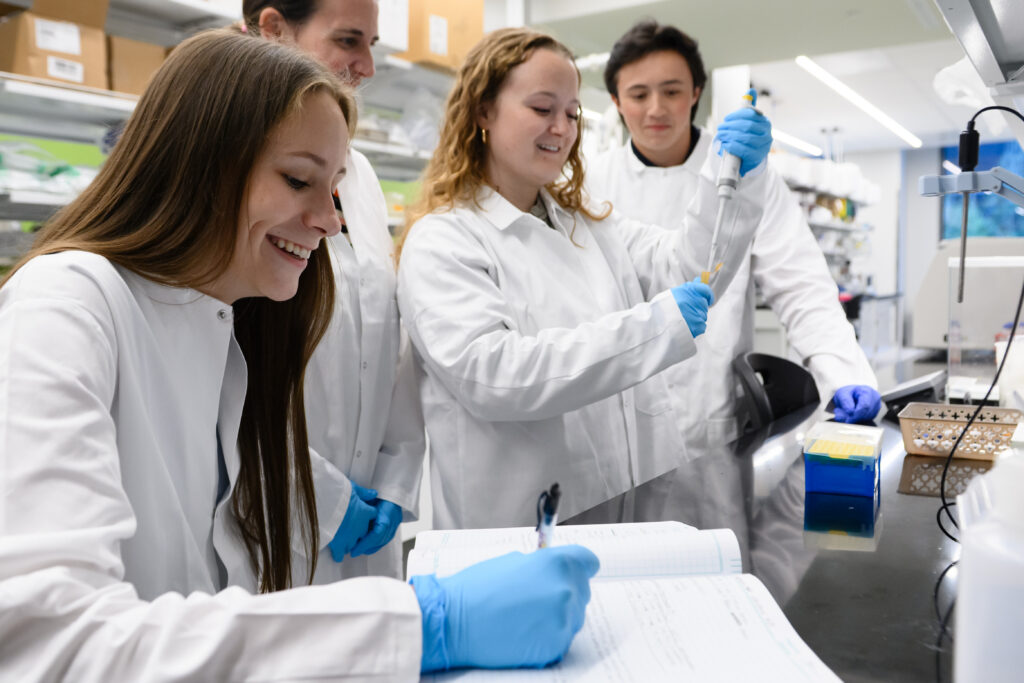
Creative Inquiry gives Clemson undergraduates opportunities to work alongside faculty mentors, gain hands-on experience and develop skills that extend beyond the classroom.
About 4,500 undergraduates each year work on about 400 projects in a wide range of disciplines across the University.
Students collaborate in small teams with faculty mentors, often over multiple semesters, giving them opportunities to tackle real-world problems, develop their own research questions and build on the discoveries of students who came before them.
One of Creative Inquiry’s most enthusiastic supporters is Jessica Larsen, the Carol and John Cromer ’63 Family Endowed Associate Professor of Chemical and Biomolecular Engineering.
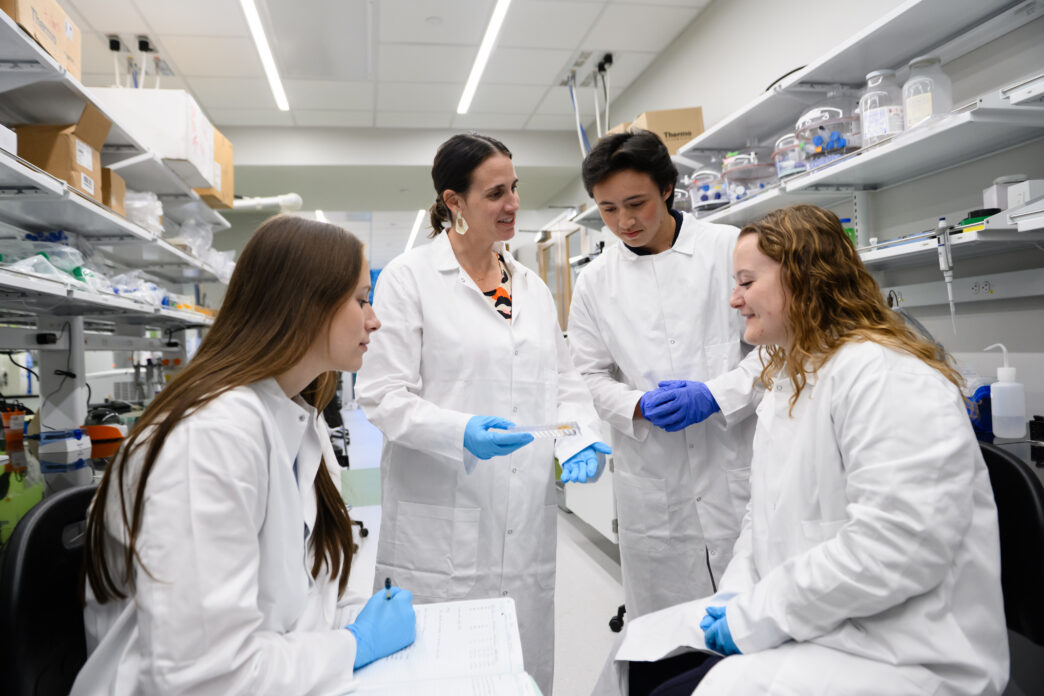
She oversees 24 undergraduates across four projects. Their work focuses on how nanoparticles deliver drugs, including treatments for pain and cancer.
Students learn how to approach problems scientifically, from forming hypotheses and designing experiments to analyzing results and refining their approach, Larsen said.
“I view undergraduate research as a perfect opportunity to train more people to go out and do good science,” she said. “It’s a way to ensure that more of the world’s problems can be solved.”
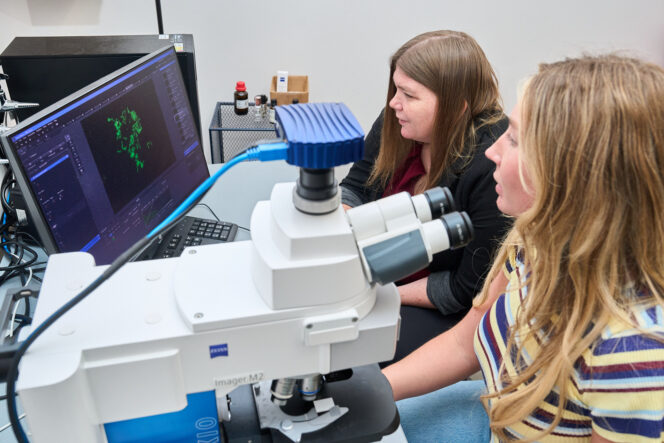
Among those problem solvers is Abigail Pomeroy, a junior biomedical engineering major. Pomeroy is using Creative Inquiry along with her work as a certified nursing assistant at a Greenville hospital to lay the groundwork for medical school.
“Not only do I learn about different scientific experiments, I get to actually work with them hands-on,” she said of her Creative Inquiry work. “I get to run my own experiments without someone being by my side the whole time, which is fun.”
Pomeroy and Curto are part of the Larsen-led team working to find new ways of using nanoparticles to slip therapies past the body’s blood-nerve barrier to help patients recover from painful and debilitating nerve injuries.
The project’s funding has roots in Creative Inquiry. Students in the program generated the preliminary data that led to a prestigious $1.67-million R01 research grant from the National Institutes of Health, Larsen said.
One focus for the future is bringing Creative Inquiry to more students in disciplines such as business and the liberal arts, where undergraduate research opportunities have traditionally been less common.
To support that growth, program leaders are exploring ways to give faculty credit for mentoring students and working with the Graduate School to train graduate students as mentors.
“Creative Inquiry already provides unique research experiences on a scale few universities can match,” said Creative Inquiry Director Barabara Speziale. “Our goal now is to build on that success and bring those opportunities to even more students. We want to prepare the next generation of researchers, innovators and problem-solvers while helping Clemson deliver the nation’s No. 1 student experience.”
More than two decades after its launch, Creative Inquiry continues to welcome new students, including Christopher “Parker” Howe, a sophomore biochemistry major who joined one of Larsen’s projects in August.
Howe, who has Type 1 diabetes, is interested in pursuing a career in the pharmaceutical industry and helping others who live with the disease.
“I’m exploring my options right now,” he said. “This opportunity has been great to really get hands-on in the lab and learn what research looks like on a day-to-day basis.”