On a busy day at Clemson, the Forest is easy to overlook.
It’s there on the drive to campus, along the edge of a neighborhood and at the end of a trail where the noise of the workday gives way to birdsong. It’s where a faculty member walks in between classes, where a staff member rides a bike on the weekend, where families gather for an afternoon outdoors.
For nearly a century, the Clemson University Forest has been part of the landscape of University life. Today, research suggests it may also be part of the value of their benefits.
A study involving more than 5 million people in Northern California found that those living in the greenest residential areas had lower average health care costs than those living in the least-green areas. Clemson researchers and Nature’s Message for Health Hub co-founders, Olivia McAnirlin and Matthew Browning, have used those findings to estimate what living near the Forest could mean for employees and their households.
Their estimate, published on the Clemson University Forest Blog: approximately $752 in annual health care cost savings per nearby employee household. Across roughly 2,900 Clemson employees living in communities around the Forest, that amounts to an estimated $2.18 million a year.
The numbers offer a way to think about a resource that rarely appears in a conversation about compensation. Health insurance helps employees pay for care. Paid time off gives them time to rest. Access to a healthy, green landscape can contribute to the conditions that help people live well.
A benefit beyond the benefits statement
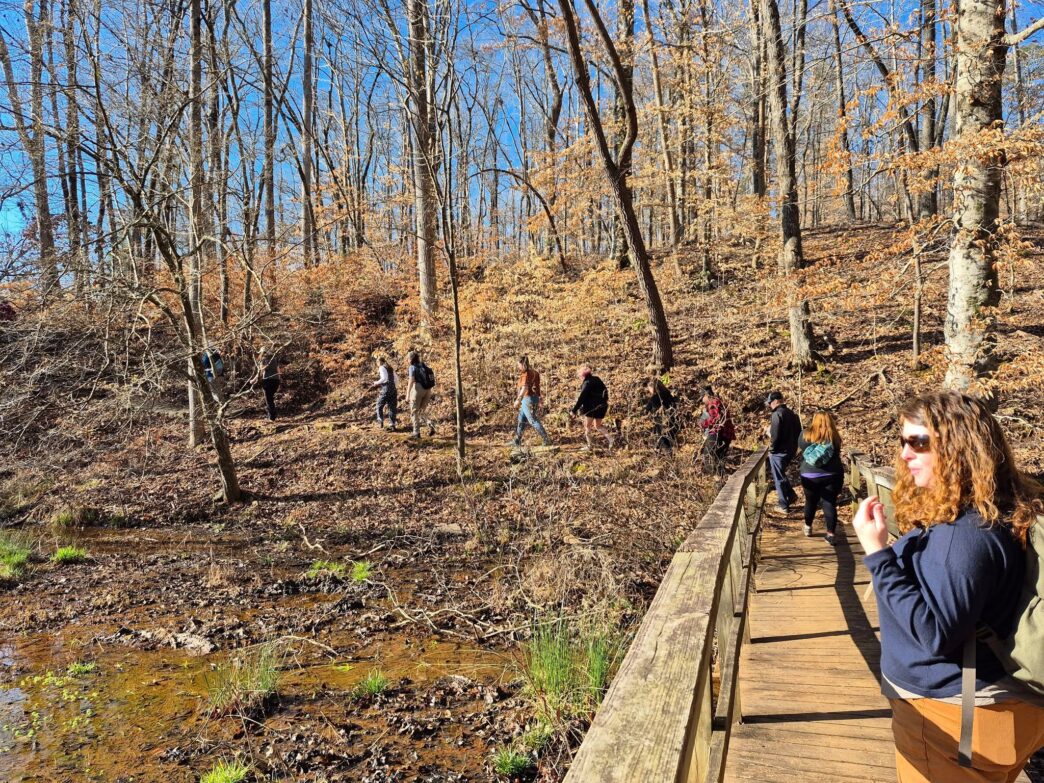
The Clemson University Forest spans 19,200 acres of woods, waterways, trails, farms and historic sites surrounding the campus. It is a place for research, teaching and outreach, with a history of restoration that transformed degraded farmland into thriving ecosystems. It is also a place where people hike, bike, ride horses, fish, watch birds and spend time outside.
For employees, its value can be woven into ordinary routines: a walk before work, a lunch break under the trees, an evening run or a Saturday on the trails with family. The Forest is close enough to become part of daily life, and large enough to give that life room to breathe.
That proximity matters to how researchers think about the relationship between green space and health.
“We are more apt to spend more time outdoors and in nature when it is easy for us to implement into our everyday lives, like an easy to keep up with habit of walking a dog on CUF land near your home, or ingrained into our establish routines, like taking your children fishing on the weekends or for meet ups with their friends and playing in Wildcat Creek,” McAnirlin said.
The 2022 study, published in Environment International, used satellite imagery to assess vegetation around participants’ homes and linked that information to health care cost records. After accounting for a range of demographic and neighborhood factors, researchers found that people in the greenest areas had adjusted direct health care costs about $374 less per person per year than people in the least-green areas. Much of the difference was associated with hospitalizations and emergency department visits.
The study found an association; it did not establish that green cover caused the difference in costs. It also did not measure Clemson employees or isolate the effect of the Clemson University Forest. The Clemson figures are estimates applying the broader research to the local population, rather than savings recorded in Clemson health plans.
“This research shows that in addition to the many Forest values we enjoy, the Forest provides real, quantitative benefits to Clemson employee health and budgets.”
Rob Baldwin, Executive Director, Clemson University Forest.
Even with those distinctions, the findings give substance to an experience many people recognize: where we live, work and spend time can influence how we feel and how we care for ourselves.
A reason to stay and a place to do the work
The Forest’s contribution to employee well-being reaches beyond a health care estimate.
According to a summary of the Clemson Forest analysis, faculty and staff rated the Forest as twice as important in their decision to stay at Clemson as in their decision to come.
That distinction tells a story of its own. A job opportunity may bring someone to Clemson. Over time, the places and relationships surrounding that job become part of the reason for building a life here.
“I walk or bike the trails nearly every week,” Browning said. “With young kids at home, I rarely have time to drive very far away, so having the Forest nearby is a major part of why my family and I came to work and live in Clemson. And it’s why we still love raising our family here. In fact, I’ve had some of my most creative ideas for grant proposals and funded research during long, contemplative walks in the Forest.”
A favorite trail becomes a familiar route. A walk with a dog becomes a daily ritual. An afternoon in the Forest becomes time with children, friends or a neighbor. Those experiences are personal, but together they help make Clemson a place where employees can see a future.
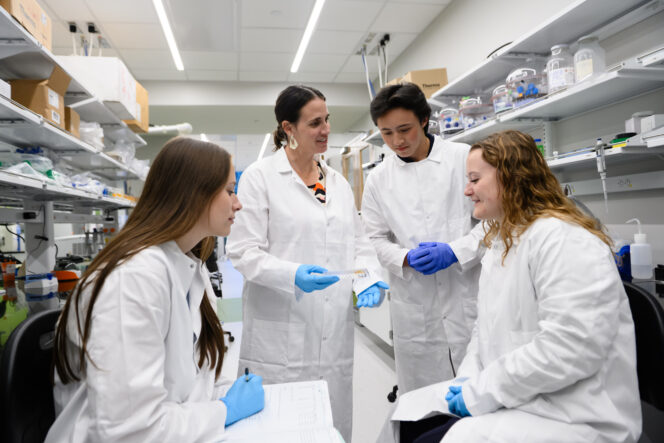
For some faculty members, the Forest is also part of how they work. A Clemson Faculty Senate study documented its importance for teaching and research, as well as recreation and quality of life. In an Inside Higher Ed essay, five Clemson authors described faculty who use the Forest to think through research questions, find inspiration and regain perspective between teaching days. insidehighered.com
The reach extends across disciplines. The authors reported that faculty from all 13 colleges and schools, as well as the library, use the Forest for teaching, research or outdoor recreation. For some, it is a field site or an outdoor classroom. For others, it is a place to walk, think or spend time with students and colleagues.
For an institution that depends on talented people, those connections have value. Employees bring their skills and commitment to the University; the surrounding community supports the lives and careers they build here.
An asset worth protecting
Clemson’s Forest is part of a broader tradition of university forests that have helped shape fields of study and generations of scholars. In their Inside Higher Ed essay, the Clemson authors argued that these landscapes deserve a long-term view: they support research, education, conservation, recreation and the well-being of the people who live and work nearby.
The Clemson story shows what that long view can make possible. In the New Deal era, land around the University was acquired for restoration, education and recreation. Clemson faculty member George Aull helped lead the effort, seeing an opportunity for a land-grant university to demonstrate how damaged land could be restored and managed. Generations of students have since learned in the Forest.
The Forest’s future has also depended on people recognizing its value. Around 2004, a proposal to substantially alter forestland for development drew concern from faculty and community members; the University ultimately abandoned the project. Later, a Faculty Senate committee examined the Forest’s role in teaching, research and quality of life. Clemson subsequently strengthened its management and protections, including the development of a guiding land ethic.
Protecting the Forest requires continued investment. Trails and research infrastructure need care. The landscape itself requires thoughtful stewardship. Those costs support benefits that accumulate over time for employees and students, for research and learning, and for the surrounding community.
Some opportunities depend on that continuity. Researchers are using the Forest’s permanent plot network to study soil carbon, drawing on observations that require land to remain forested over decades. At the same time, the same landscape offers a place for a family walk this weekend or a few quiet minutes after a demanding day.
A living investment
The Clemson University Forest serves many purposes at once. It supports discovery and hands-on learning. It provides habitat, protects natural resources and gives the broader community a place to connect with the outdoors. Clemson manages the landscape with ecological, recreational and commercial priorities in mind.
Its role in employee well-being adds another dimension to that work. The health care estimate offers one way to express the Forest’s potential value in dollars. Its influence on the experience of working and living at Clemson is also felt in quieter ways: a place to move, a place to think, a place to gather and a place to return to.
For Clemson employees, the Forest is part of the University’s investment in the people who make its mission possible. Caring for it preserves that benefit for the employees, students and neighbors who will make Clemson their home in the years ahead.