
Approval of four new programs, upcoming facilities improvements, and first report from President Ayers highlight two-day meeting
Clemson University’s Board of Trustees met on main campus Thursday and Friday, Oct. 15-16 for its Fall Quarterly Meetings. Trustees received updates from University administration on ongoing and upcoming initiatives and approved several projects and program modifications before attending the dedication of the Harvey S. Peeler Jr. College of Veterinary Medicine.
In his first report to the Board, President Ben Ayers reflected on his first two-plus months in the role, a period focused on understanding Clemson and its opportunities. He pointed to the University’s momentum, including the opening of the college of veterinary medicine and a new forestry and environmental conservation building, and outlined several priorities: student success, research and innovation, and operational excellence. Ayers also announced $750,000 in targeted support for research seed funding, and faculty and staff professional development. He said the University’s next steps should build on its strengths, invest in its people and grow with purpose to serve South Carolina for generations.
ACADEMICS AND EDUCATIONAL POLICY
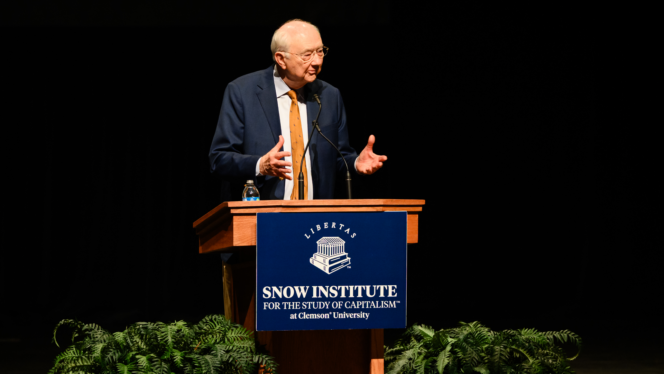
Trustees approved four new programs including a new Clemson Center for the Study of the American Founding in the Snow Institute for the Study of Capitalism. The program will expand teaching, research and public programming on America’s revolutionary founding, meeting demand for historically grounded civic education while preparing future scholars and educators.
The Board approved the merger of the Department of Biological Sciences and Department of Genetics & Biochemistry into the School of Biology, Genetics, and Biomedicine. The new structure, which will take effect May 2027, will strengthen faculty collaboration and coordination across academic programs, research, partnerships and administrative services while making efficient use of existing resources.
Also approved were two new programs and one program modification in Management, creating standalone degrees in Entrepreneurship and Corporate Innovation and Management Information Systems and Supply Chain. The change refocuses the B.S. in Management on leadership, talent management, organizational effectiveness and global management.
A new online modality for the M.S. in Food, Nutrition and Culinary Sciences was approved in an effort to expand access for working professionals in food production, culinary sciences, nutrition, healthcare, and dietetics.
Additionally, as part of its consistent review of offered programs and certificates, the Board approved the termination of thirteen certificates and one program, each of which did not meet criteria established to continue being offered.
Provost Cole Smith provided the Educational Policy Committee an update on the University’s emphasis on experiential learning, highlighting Clemson’s continued leadership in hands-on experience and career-ready skills development.
FINANCE AND FACILITIES UPDATE
Interim CFO Kelly Collins provided an update to the Finance and Facilities Committee and reported on Clemson’s continued strong financial position in FY26. During the past fiscal year, University revenues rose 2.9 percent, supported by growth in tuition and fees, state appropriations, and gifts and grants, while expenses declined by 0.3 percent. Collins credited campuswide expense management and planning with helping Clemson preserve resources for its academic and public-service mission.
External credit analysis reinforces Clemson’s strong financial position. In its most recent ratings analysis, Moody’s cited Clemson’s “ongoing growth in liquidity and total cash investments of $2.6 billion with sound prospects for continued support” as a factor in its rating affirmation.
Based on FY26 performance, the total cash investments have grown to $2.8B, the University’s net position grew by $263.7 million in FY26, and cash balances grew by $98.1 million. Across the broader enterprise, including the Clemson University Foundation and IPTAY, the net position grew by $440 million, and enterprise cash grew by $101.8 million. Together, these results provide Clemson with financial flexibility to sustain its core mission and pursue strategic investments.
The presentation also highlighted early benefits from Workday, including stronger financial planning and position budgeting, improved payroll accuracy, better access to real-time data and improved audit performance. The University will keep refining the system with input from faculty and staff, with the goal of improving processes and user experience.
The committee provided Phase 1 approval for a new residence hall project in the location of Johnstone Hall. The estimated timeline would have construction begin in summer 2028, with a targeted completion date of 2030.
The board also approved several other projects under the $10 million threshold for capital improvements to support Clemson’s facilities and future growth. These include renovations to the Livestock Poultry Health Facility and a new ICAR Flex One lab.
STUDENT AFFAIRS
Vice President for Student Affairs Doug Hallenbeck shared the Division of Student Affairs’ work to create a welcoming, connected campus community. Orientation and move-in brought thousands of students and families to campus, while Weeks of Welcome, expanded to the first six weeks of the semester, offered multiple opportunities to meet classmates and build a sense of belonging.
The committee also received an update on major investments in places where students live, learn, dine and gather. Over the past two decades, Clemson invested over $600 million in campus spaces including residence halls, dining facilities, and recreation and reflection spaces.
RESEARCH AND ECONOMIC IMPACT
Tanju Karanfil, senior vice president for Research, Scholarship and Creative Endeavors, informed the board of Clemson’s continued ascension in research, with proposal submissions eclipsing $1.2 billion in FY26, the highest in school history. Clemson has also been awarded 150 research projects of at least $2 million since 2015, worth over $900 million.
The University has also been awarded 89 early career awards over the past decade.
Senior Vice President for External Affairs Angie Leidinger shared an update on the University’s President’s Industry Council. Established in 2021 to maximize collaboration between industry and Clemson University to address untapped opportunities, the group has helped develop student experiential learning opportunities, research and innovation and talent preparedness for success in today’s global marketplace.
In the past year, the group has driven $1.69 million in direct research investments, hired 90 recent alumni to full-time positions with 85 additional internships and 245 co-op placements.
UPCOMING MEETING
The Board’s next scheduled meeting is Feb. 4-5, 2027.