As development and land-use changes put pressure on South Carolina’s wetlands, Clemson University scientists are building a tool to help identify which Carolina Bays offer the greatest ecological value and should be prioritized for conservation.
Jim Anderson, director of Clemson’s James C. Kennedy Waterfowl and Wetlands Conservation Center at the Baruch Institute of Coastal Ecology and Forest Science in Georgetown, South Carolina, is leading the U.S. Environmental Protection Agency-funded project. Now in its second phase, the work received $491,000 in new funding, following a $322,000 award in 2024 for Phase I.
The project is designed to give landowners, conservation organizations and government agencies reliable science to guide decisions about which wetlands to protect, restore or monitor.
Over the next three years, the team plans to evaluate about 60 wetlands across the state’s Coastal Plain. Doctoral student Scott Binger will help oversee field operations and work with researchers from Francis Marion University in Florence. Clemson master’s student Stuart Robertson will conduct most of the fieldwork. Wildlife biologist Crystal Anderson is also a co-investigator.
Plans include a geospatial inventory of wetlands, standardized monitoring protocols and the GIS-based conservation tool, which is expected to be available by 2030.
“Many Carolina Bays have been altered, drained or developed over time,” Binger said. “The wetlands that remain provide critical habitat for wildlife and important environmental benefits for surrounding communities.”
Distinctive wetlands with broad benefits
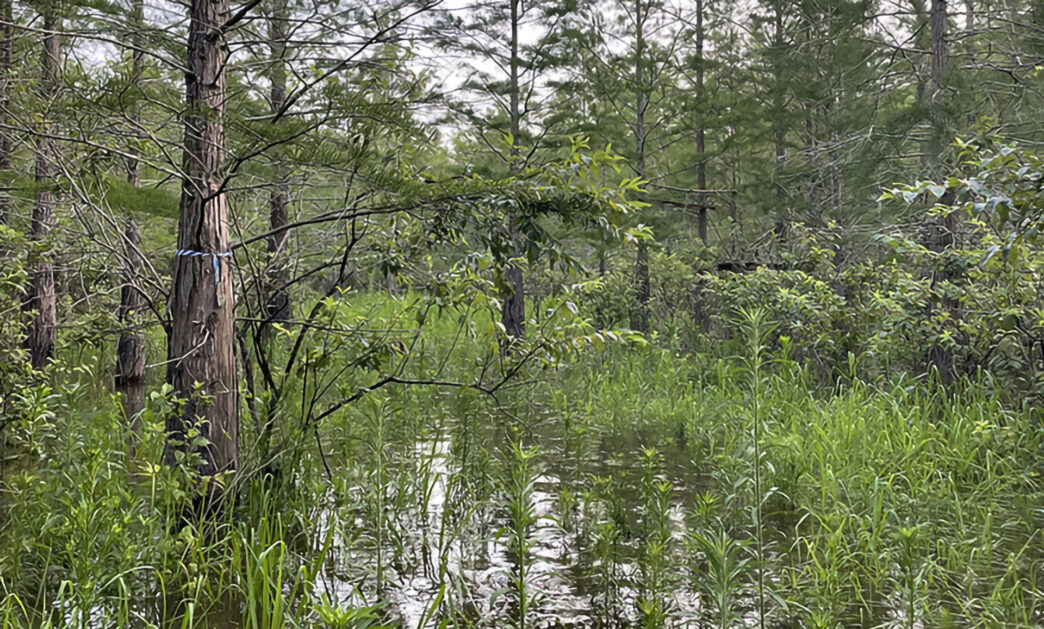
Carolina Bays are oval-shaped, rain-fed wetlands found throughout South Carolina’s Coastal Plain. They support a wide range of wildlife, help improve water quality, store carbon and can reduce flooding.
The Clemson team is developing a way to compare wetlands based on their overall condition. Scientists are assessing habitat quality and the plant and animal communities at each site. They are surveying frogs, birds, aquatic invertebrates and wetland plants. The presence or absence of a particular species can offer clues about how well a wetland is functioning.
Field observations will be combined with acoustic monitors that record wildlife sounds and geographic information systems (GIS) to analyze landscape conditions and environmental patterns. The findings will be used to develop an interactive decision-support tool for comparing wetlands, assessing their condition and tracking changes.
Putting research to work
Once developed, landowners can use the information to support restoration projects, conservation easements or grant applications. Conservation organizations and land trusts can identify wetlands with high ecological value, while state agencies can use the results to guide conservation investments and management.
“One goal is to provide users with reliable scientific information that can support conservation efforts and funding decisions,” Anderson said.
The approach will help South Carolina communities safeguard Carolina Bays for wildlife and people and could eventually inform wetland conservation elsewhere in the Southeast.
South Carolina is home to a variety of wetlands shaped by its coastal plain, rivers and climate, including salt, brackish and freshwater marshes along the coast to inland swamps, bottomland hardwood forests and Carolina Bays. Wetlands make up approximately 23% of the state’s total land area, and half of the salt marsh on the entire Eastern Seaboard of the United States.
South Carolina has lost about 27% of its wetlands, about 1,755,000 acres, including both freshwater and coastal wetlands, since the mid-1700s.
-END-