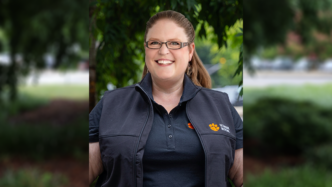

A new book co-edited by Jessica Jenkins, assistant professor in the Department of Sociology, Anthropology and Criminal Justice, explores how human-animal interactions have shaped political systems, social frameworks, ritual practices and daily life in the southeastern United States across thousands of years.
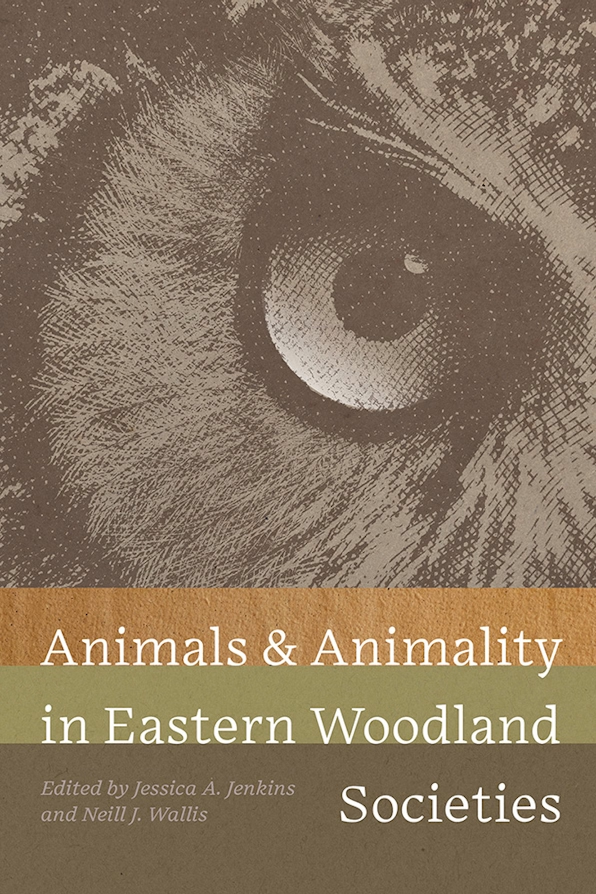
Co-edited by Jenkins and Neill Wallis, Animals and Animality in Eastern Woodland Societies, highlights the significance of animals beyond human diet and ecology, exploring animality as a dynamic, relational construct.
Jenkins is an archaeologist whose research explores the long-term relationships between Indigenous peoples, animals and environments in the Southeast, with a particular focus on oysters and coastal ecosystems. She studies how oysters have participated in social, cultural and ecological relationships and shaped Indigenous communities over thousands of years.
According to Jenkins, in many Indigenous worldviews, humans and animals are not separate categories of beings but participants in shared worlds, influencing each other over generations. Rather than simply adapting to nature, people and animals are understood as co-creators of worlds, shaping one another and the places they inhabit. This relational perspective is the central theme of her and Wallis’ newly published edited volume.
“The volume brings together scholars who challenge familiar Western ways of dividing the world into rigid categories of ‘human,’ ‘animal’ and ‘nature,’” said Jenkins. “Instead, it explores Indigenous perspectives that emphasize relationships, reciprocity and the interconnectedness of living beings.”
Currently, her research spans Florida and Virginia, where she works closely with collaborators to understand how archaeological perspectives contribute to contemporary conversations about stewardship and sustainability. In Florida, she collaborates with Wallis and Kenneth Sassaman at the University of Florida and Martin Gallivan at William and Mary in Virginia. These projects – and her broader research – are not only about understanding the past but also connecting archaeological knowledge with contemporary efforts in ecological restoration, cultural revitalization and environmental stewardship.
The throughline of Jenkins’ work is the importance of relationships. She studies relationships between people and animals, communities and landscapes, and the past and present. Just as importantly, she said archaeological research should be built through meaningful relationships – with Indigenous communities, researchers across disciplines and local stakeholders. By bringing these perspectives together, she hopes archaeology can contribute to understanding the deep history of human-environment interactions, conversations about resilience, sustainability and caring for coastal ecosystems in the present.
“Dr. Jenkins’ edited volume is an important contribution to archaeological scholarship, as it challenges us to think more intentionally about the relationships between people and animals. It also reflects her thoughtful, innovative approach to archaeology and her commitment to advancing our understanding of the complex relationships that have shaped societies over thousands of years,” said Katy Weisensee, chair of the Department of Sociology, Anthropology and Criminal Justice.
Animals and Animality in Eastern Woodland Societies is published by the University of Florida Press.
The Department of Sociology, Anthropology and Criminal Justice is a part of the College of Behavioral, Social and Health Sciences. Established in July 2016, CBSHS is a 21st-century, land-grant college that combines work in seven disciplines – communication; nursing; parks, recreation and tourism management; political science; psychology; public health sciences; sociology, anthropology and criminal justice – to further its mission of “building people and communities” in South Carolina and beyond.