In greenhouses filled with climbing cucumber vines and carefully balanced hydroponic systems, Clemson University scientist Patrick Wechter sees more than a new way to grow vegetables.
He sees a future for South Carolina agriculture.
As traditional farming faces increasing pressure from labor shortages, volatile weather, rising input costs and shrinking profit margins, controlled environment agriculture (CEA) could offer growers a new path forward.
CEA involves a variety of systems that take a technology-based approach to farming. Systems range from simple shade structures and hoop houses to greenhouses to full indoor or vertical farms.
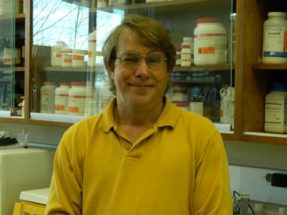
Wechter believes South Carolina is uniquely positioned to lead the CEA movement, but he needs growers to support it.
“I need agricultural entrepreneurs,” said Wechter, director of the Clemson Coastal Research and Education Center (REC) near Charleston, South Carolina. “I need people in the state to look at ‘farming’ in a different, 21st-century way. Bottom line is, if people are not willing, ready and excited about being a player in the field of controlled environment agriculture, then the dream stops there.”
Reducing America’s dependence on imports
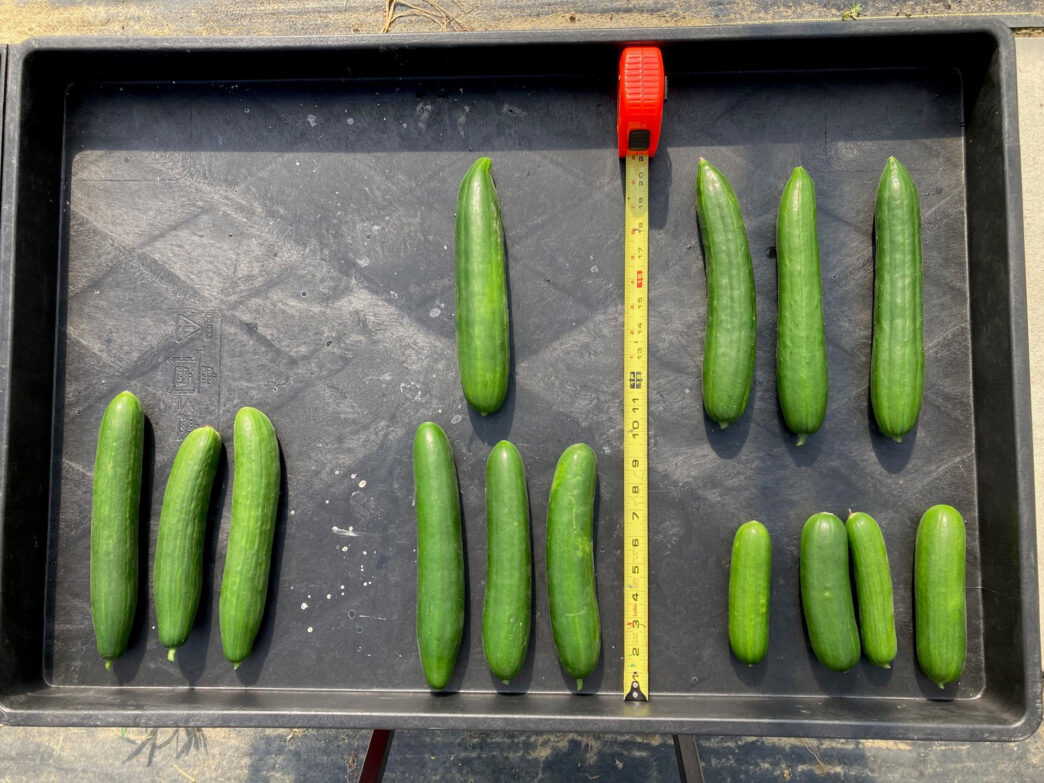
At the Coastal REC, Wechter and his team are developing Asian long cucumbers and Persian-style Beit Alpha cucumbers specifically adapted for high-temperature greenhouse production systems. Beit Alpha cucumbers are premium, Middle Eastern heirloom cucumbers celebrated for their mild, sweet flavor, crisp texture and exceptionally thin, tender skin that requires no peeling.
Other Clemson scientists are using modern plant breeding, genetic engineering and gene-editing tools to develop greenhouse crops that are better suited for controlled environment agriculture.
Using facilities on the University’s main campus, this work focuses on creating plants with the correct shape and growth habits for greenhouse production, while also making them more resistant to diseases such as powdery mildew that can threaten greenhouse crops.

“In collaboration with Dr. Wechter, we have developed a fast and efficient gene-editing system for cucumber,” said Christopher Saski, Clemson systems geneticist. “Think of it as genetic fine-tuning, or making small, precise tweaks to a plant’s own genes so it can perform better in a specific growing environment, such as a greenhouse. This system allows us to move from an idea to a gene-edited cucumber plant growing in a greenhouse in less than six months.
“Importantly, we can do this using our own proprietary approach that leaves no foreign DNA in the final plant, meaning these plants are not genetically modified organisms.”
The goal is ambitious but practical. The project seeks to reduce America’s dependence on imported greenhouse vegetables while creating profitable opportunities for South Carolina farmers.
Supporting the South Carolina economy
Many premium greenhouse cucumbers sold in American grocery stores today come from Canada and Mexico. Wechter believes South Carolina growers could compete in that market and thrive.
“South Carolina has numerous ‘pluses’ associated with entry into CEA,” Wechter explained. “The state has abundant water, a favorable subtropical climate, affordable farmland and an exceptional transportation infrastructure that allows produce to move efficiently up and down the East Coast.”
Hydroponic farming in South Carolina
Hydroponics is a method of growing plants without soil. Instead, the plants are grown in a water-based, nutrient-rich solution.
Unlike conventional agriculture, hydroponic greenhouse systems recycle nutrient-rich water, using up to 80% less water than traditional field production. That efficiency matters in an era where water access is becoming increasingly uncertain in many agricultural regions.
But for South Carolina growers, the opportunity may go even deeper.
“In hydroponic farming, the soil is not what determines production,” Wechter noted. “That creates opportunities for land that might otherwise sit unused or be converted to non-agricultural development.”
Wechter said greenhouse production offers predictability, which is something increasingly difficult to find in agriculture.
“Inside a controlled environment, growers can shield crops from heavy rain, extreme heat, unexpected cold snaps and many disease pressures that devastate outdoor crops,” he said. “Production can continue year-round, allowing growers to target premium markets and maintain more stable supply chains.”

Farming redefined
For younger farmers and agricultural entrepreneurs, Wechter believes CEA could redefine what farming looks like.
“CEA is considered a technology-forward, advanced manufacturing form of agriculture,” he said. “It includes engineering, plant science, water science, plant pathology, logistics, sensors and lighting technology.”
The scale of opportunity is already visible across North America and Europe.
More than 1,000 acres of vegetables are currently grown under glass in North America alone. One Canadian company operates roughly 120 acres of greenhouse cucumbers, with most of its production shipped directly into U.S. markets.
The economics are attracting attention.
Greenhouse cucumbers are considered a premium product, often commanding prices significantly higher than those of traditional field-grown slicing cucumbers. Meanwhile, CEA production systems can dramatically increase output.
“CEA production is 20 to 200 times more productive than the same vegetable crop grown on ground,” Wechter said. “For cucumbers specifically, production can increase 20 to 40 times more than conventional systems.”
The CEA Movement
The work happening at Clemson is part of a larger national movement.
Researchers at Clemson, South Carolina State University and the USDA U.S. Vegetable Laboratory are investing heavily in controlled environment agriculture research. Federal lawmakers have also identified CEA as a critical part of America’s agricultural future, with recent Farm Bill proposals directing major grant funding toward greenhouse and hydroponic research.
Still, Wechter says research alone will not build the industry.
“What happens next depends on whether South Carolina growers are willing to embrace change,” he said.
Contact Patrick Wechter for information related to this study.
Estimated reading time: 5 minutes