Young stars, much like humans, may undergo a late growth spurt — a finding that challenges long-time beliefs about how stars slightly more massive than the sun form and sheds light on the origins of giant planets.
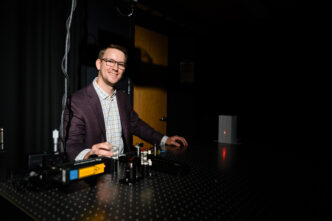
The discovery was made by an international team of scientists led by Sean Brittain, a professor in the Clemson University Department of Physics and Astronomy.

The research reveals that intermediate-mass stars — those with between 1.5 and 4 times the mass of the sun — accrete material much faster in their later stages of formation than at their birth.
“Like people, stars appear to go through an adolescent phase where they eat voraciously,” Brittain said. “They grow faster later in life than we expected.”
Rethinking a classic model
Stars form when clouds of gas and dust grow massive enough to collapse. When it collapses it forms a spinning disk called a protoplanetary disk.
For the past four decades, astronomers have believed star formation was a gradual process. Some of this material falls onto the star, some is blown away, and some of it forms into planets. As the disk dissipates, the rate at which material falls onto the star decreases as well. Ultimately, the star reaches its final mass and further planet formation comes to a halt.
The theory fits stars the size of the sun, but it didn’t hold up for slightly heavier stars. Observations of intermediate-mass stars showed they gained mass at much higher rates than expected.
“When material falls onto a star, a lot of energy is released. Just like when you drop a chair, it will make a noise or even break. In the case of material being accreted, the energy released is much greater. We can see this as extra radiation coming from the system, and this allows us to determine the rate at which the stars grow in mass,” Brittain said.
Decrease with age
The team studied young stars known as Herbig stars that are hotter and more massive than the sun. The researchers confirmed the stars’ accretion rates decrease with age as they reach full maturity.
“This implied that the disks surrounding these stars must start out to be very massive indeed. This would pose a problem because such massive disks would be unstable and break up before planets even have the chance to be formed,” said Rene’ Oudmaijer, a member of the team from the Royal Observatory of Belgium.
But when the scientists studied even younger versions of the Herbig stars, they found the younger stars were actually accreting at a rate 10 times lower than their older counterparts.
“Instead of higher accretion rates, we found values that were up to 30 times lower than those of the Herbig stars. In a way, this would solve the mass problem, as the disk does not need to be so massive to begin with,” said Gwendolyn Meeus of the Universidad Autonoma de Madrid in Spain.
A problem
Brittain said that posed another problem.
“Theory would predict that the stars accrete less material over time, not more. This new finding needs an explanation based on well-grounded physics if we are to change our current thinking,” he said.
To explain the unexpected result, the team developed a model where the accretion rate is driven by the far-ultraviolet radiation of the star, Brittain said. As the stars get hotter, the luminosity of the stars in the far-ultraviolet range increases several orders of magnitude.
The so-called Herbig stars have higher temperatures, but their precursors start out much cooler than their more evolved counterparts. The stellar temperatures affect the disks and determine how quickly they lose their materials to the star. A star that gets hotter will gradually emit much more ultraviolet radiation. This, in turn, ionizes the gas in the circumstellar disks, which then results in an increasingly larger accretion onto the star.
Team member Josh Kern of Clemson said the mystery pertaining to giant planets of around intermediate mass stars appears to be solved.
“The understanding that hotter stars emit more ultraviolet radiation than cooler stars has been known for well over 100 years, and the expectations that the ionization of the disk plays an important role in the accretion process have been around for decades,” he said. “This work epitomizes the relay race of scientific advancement by building upon these core ideas and showing that these systems indeed have an unexpected late growth spurt.”
Detailed findings of the study can be found in The Astronomical Journal in an article titled, “Evolution of the Accretion Rate of Young Intermediate Stars: Implications for Disk Evolution and Planet Formation.”
Parts of this article were adapted from a press release the Royal Observatory of Belgium.