When Sabrina Fernandez first joined Chris Chouinard’s research group, she was interested in becoming a forensic scientist. Heidi Sabatini arrived at Clemson University with an interest in environmental analysis shaped by her growing up on the coast.
Both found opportunities to pursue their interests in Chouinard’s chemistry laboratory.
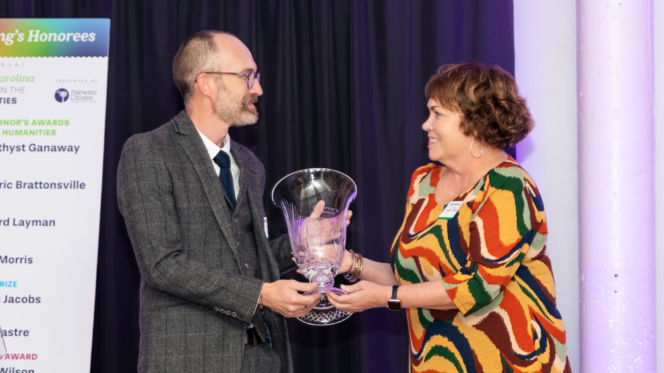
And both have earned national recognition from the American Society for Mass Spectrometry (ASMS) for their research and academic achievement.
Sabatini, a rising fourth-year Ph.D. student, received an ASMS Graduate Student Award. Fernandez, who graduated in May with a degree in chemistry, received an ASMS Undergraduate student award.

Clemson was one of only three institutions represented in both award categories, joining Purdue University and University of California Riverside.
“This is a huge achievement for us as a research group, as a department and as a University,” said Chouinard, an associate professor in the Department of Chemistry and faculty adviser to both students. “These are recognitions where people look and say, ‘Oh, wow, two people from Clemson won these awards. They’re doing really big things down there.’”
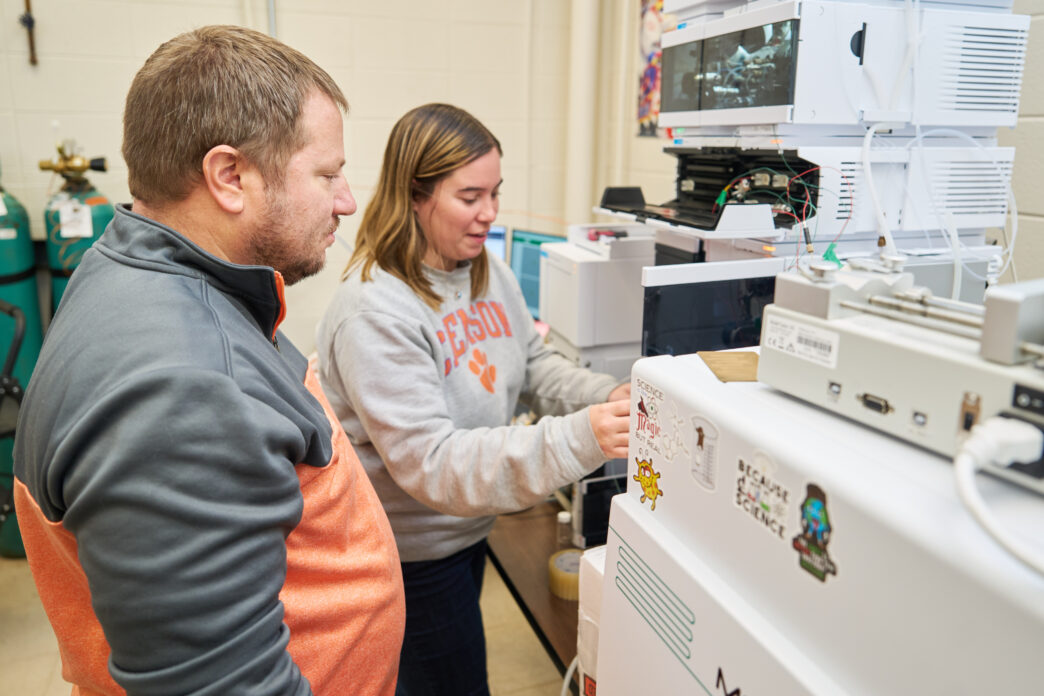
Mass spectrometry is a scientific tool that measures the weight of molecules and helps identify, measure and understand the substances in a sample.
The students’ research shows how mass spectrometry can address scientific questions.
Answer to many questions
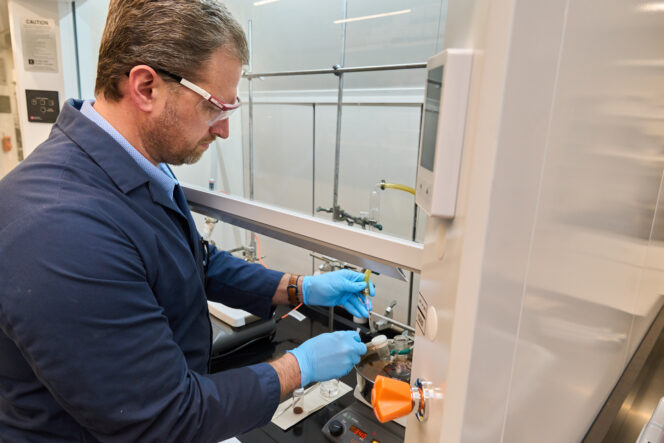
Sabatini met Chouinard at a conference after her undergraduate research advisor was invited to speak at a symposium organized by Chouinard. She joined Chouinard’s lab in 2023 and began developing methods to analyze challenging contaminants in the environment using mass spectrometry and ion mobility. She was first author of a paper on research demonstrating a workflow for characterizing complex PFAS in environmental samples. PFAS are synthetic substances known as “forever chemicals.”

“I love new and impactful instrumentation, but my environmental application stems from growing up on the ocean and wanting to find ways to address environmental pollution issues,” said Sabatini, who grew up in Kitty Hawk, North Carolina.
After earning her Ph.D., she plans to work in industry, where she hopes to continue using advanced instrumentation.
After Fernandez heard Chouinard discuss his work in Clemson’s Introduction to Research course, she sent him an email. She joined his lab and spent three semesters working on a project involving steroid molecules.
Her research focused on finding better ways to distinguish between steroid molecules that are extremely similar in structure. She specifically studied ketosteroids, which are steroids in which a hydrogen atom has been replaced with a ketone.
Expanded interests
The experience expanded Fernandez’s interests beyond forensics, which was her original career plan.
“After joining the lab, my interests began to expand. I became fascinated by the instrumentation itself and what it could tell us about molecules that are otherwise very difficult to distinguish,” she said. “I especially enjoyed thinking about how we could improve an analytical technique or modify a system to reveal differences that we could not see before.”
She said the award gave her additional confidence to continue challenging herself, to ask questions and to grow as a scientist.

“It reminds me that the work I put in can lead to opportunities that I may not have imagined when I first started doing research,” she said.
She is a first-year chemistry Ph.D. student at the University of Georgia. Her goal is to work in industry.
“I’m particularly interested in areas related to clinical applications, pharmaceuticals, or drug development and delivery,” she said.
Both students said the ASMS award provided opportunities to meet scientists, learn about new developments and gain confidence as they move toward professional careers.
Chouinard said that kind of exposure is important to research training. His goal is to give students opportunities to work on questions they care about and develop the independence to pursue them.
“They tend to be more successful when they do that,” he said.