Third-generation craftsman spends summer tuning up instruments for the Band that Shakes the Southland
Things around the Brooks Center for the Performing Arts during the summer months are pretty quiet. The usual cacophony of students hustling to and from rehearsals mixed with the music of every imaginable instrument and people singing echoing down the halls from the practice rooms is replaced by a restless silence, interrupted only occasionally by clicks, footsteps and shuffling as the summer skeleton crews organize the scene shop, reset the fly system over the main stage and do other general housekeeping.
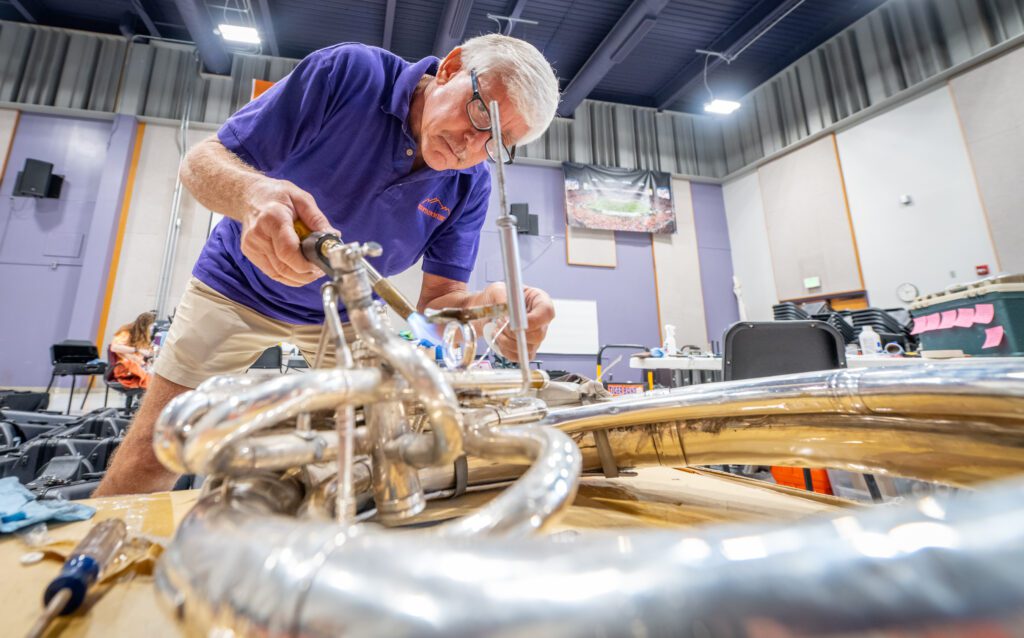
Michael Sutton, a third-generation musical instrument master craftsman and owner of Mountain Music in Seneca, is spending his summer in a cavernous rehearsal room with two members of the Clemson Tiger Band cleaning and repairing Clemson’s stockpile of musical instruments.

“For the last fifteen years, Mike has been attending almost every Tiger Band rehearsal, including game day morning, to make last-minute repairs and keep our instrumentalists sounding their best,” said director of bands and professor of performing arts Mark Spede. “Many times, he can be seen at the back of our practice field, blowtorch in hand, welding a broken sousaphone part! I can’t imagine Tiger Band without ‘Mike from Mountain Music’ being a part of it.”
Sutton transforms the rehearsal space into his workroom for the project. Hard cases holding trumpets, saxophones, piccolos and trombones blanket the white floor in patterns like the black carbon tiles on the space shuttle heat shields. Rows of orange boxes the size of small refrigerators take up one side of the room, each containing a sousaphone, king of the tubas, waiting for a bit of love from Sutton and his two summer apprentices, who are both Clemson students and members of Tiger Band.
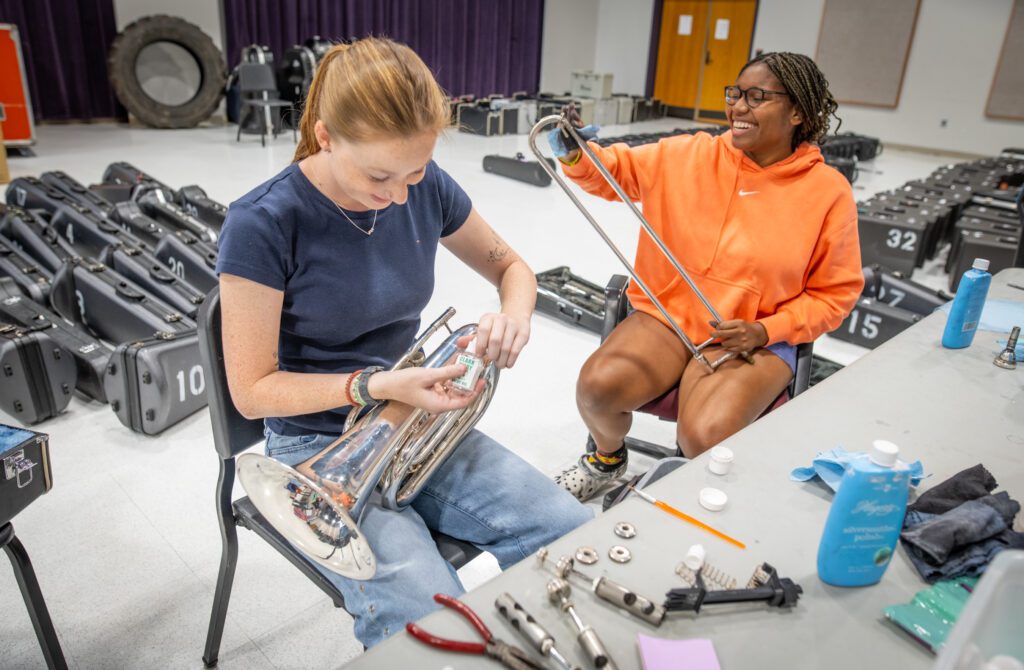
The trio is spending the summer meticulously cleaning, sterilizing and polishing the more than 800 instruments used by Tiger Band and the Clemson chamber and string orchestras. It’s an annual practice that cares for some of the Brooks Center’s most valuable assets. For instance, each sousaphone in those big orange cases is worth about $15,000, and there are 25 of them.
Sutton, whose snow-white hair and easy smile give him the countenance of a kindly wizard, walks down a row of black cases on the floor and delicately picks up the small one at the end.
“This thing here is called an English horn,” he explains. “It’s in the oboe family, and it’s $40,000 in that little case.”
Sutton’s grandfather, Frank, was an Italian immigrant who dropped out of school in the seventh grade after his father died to help support the family. His first job was sweeping up after horse carts in New Rochelle, right outside New York City, but he soon landed a job in the town’s music store.
“He learned how to fix instruments and just took it from there,” says Sutton. “He started his own store, Frank’s Music, and I started learning the craft from him when I was four.”
Sutton still uses tools passed down from his grandfather, including a small wooden hammer that’s more than 100 years old, which he uses to tap out dents. And there are plenty of dents.

“These instruments take a beating every year,” he laughs. “Especially the big instruments like the sousaphones. They get banged around getting on and off buses and planes, bumping into each other, squeezing through stadium tunnels, on the field and in parades. After every practice, ten or fifteen instruments need some kind of repair, so that’s 45 a week.”
Then there are the padded instruments, like piccolos, clarinets and saxophones that use leather-covered cotton pads that must be replaced if they get rained on. Sutton says those instruments are also prone to rust. All that to say, maintaining 800 instruments is a lot of work — plenty to keep Sutton and his apprentices occupied each summer.
One of Sutton’s summer helpers, Alaine Jacobs, a senior studying psychology who plays the saxophone, shared a story about Sutton’s importance to Tiger Band while gently polishing a trombone slide.
“I have a personal instrument, like most saxophonists in the band, and during one of the games last year, my neck strap broke, and my saxophone hit the cement,” she recalls. “It was horrible. I love my instrument. I brought it to Mike, and I was in tears of distress, and he just said, ‘It’s fine! I will fix it.’ He’s so nice, it just made me feel so much better.”
Sutton had Jacobs’ saxophone back in her hands, looking brand new, within a day. And that’s just one example of Sutton’s steady hand helping a student out of hundreds that happen throughout the season.
Jacob’s fellow instrument maintainer for the summer, Avery Robinson, a piccolo player and rising senior studying women’s leadership with a minor in American Sign Language, says Sutton is more than just a repairman to the members of Tiger Band.
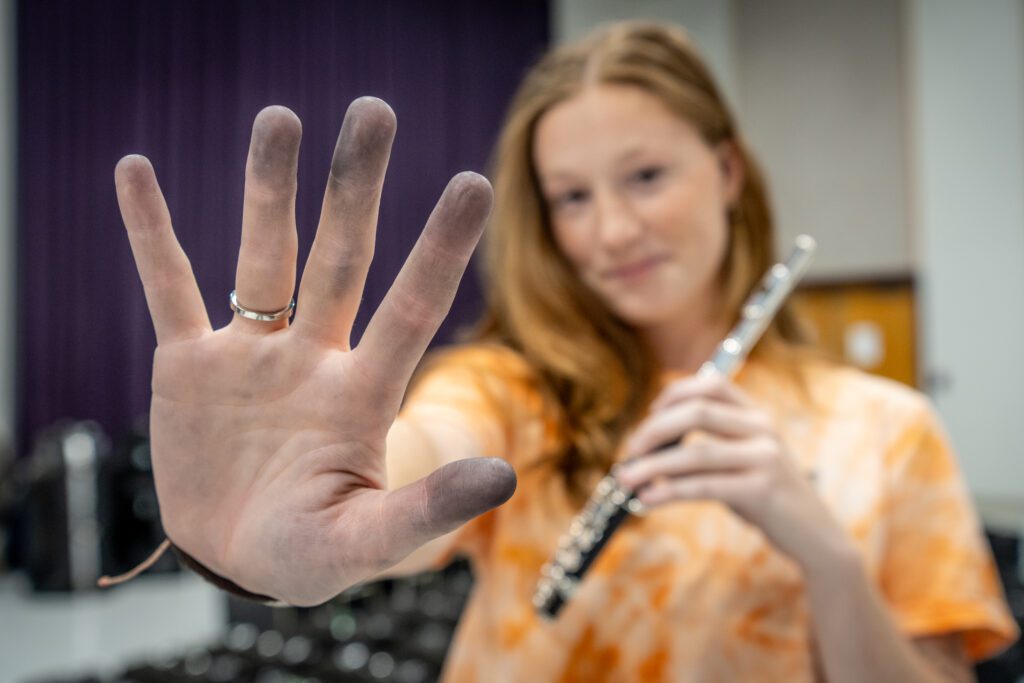
“Everybody should know how much Tiger Band loves Mike,” she says as she polishes a trumpet with a cloth. “He is there for all of us, and if we have a problem, we know Mike will fix it. Tiger Band has a banquet at the end of every year, and he always gets nominated for almost every award.”
Spede says it goes beyond being nominated for awards. Several years ago, Tiger Band established an award in Sutton’s honor, and the name couldn’t be more fitting.
It’s called The Spirit of Tiger Band Award.