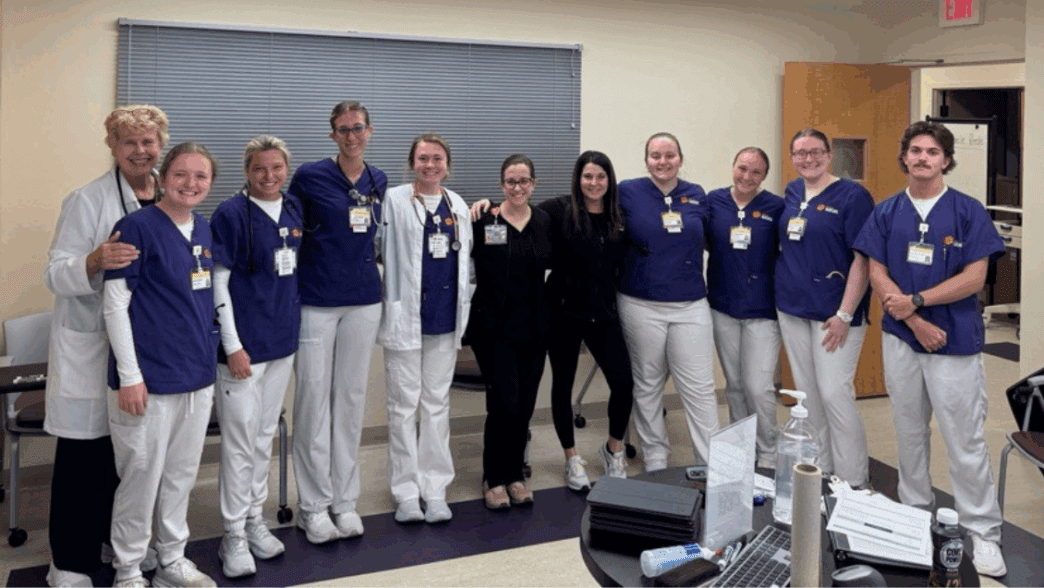
As the College of Behavioral, Social and Health Sciences (CBSHS) continues to amplify academic success and elevate the Clemson Experience through experiential learning, the School of Nursing has integrated innovative simulation technology into its coursework to enhance hands-on engagement opportunities for nursing students.
With the use of new technologies, nursing faculty members have developed focused, well-rounded training programs to equip students with the skills they need to thrive in the workplace.
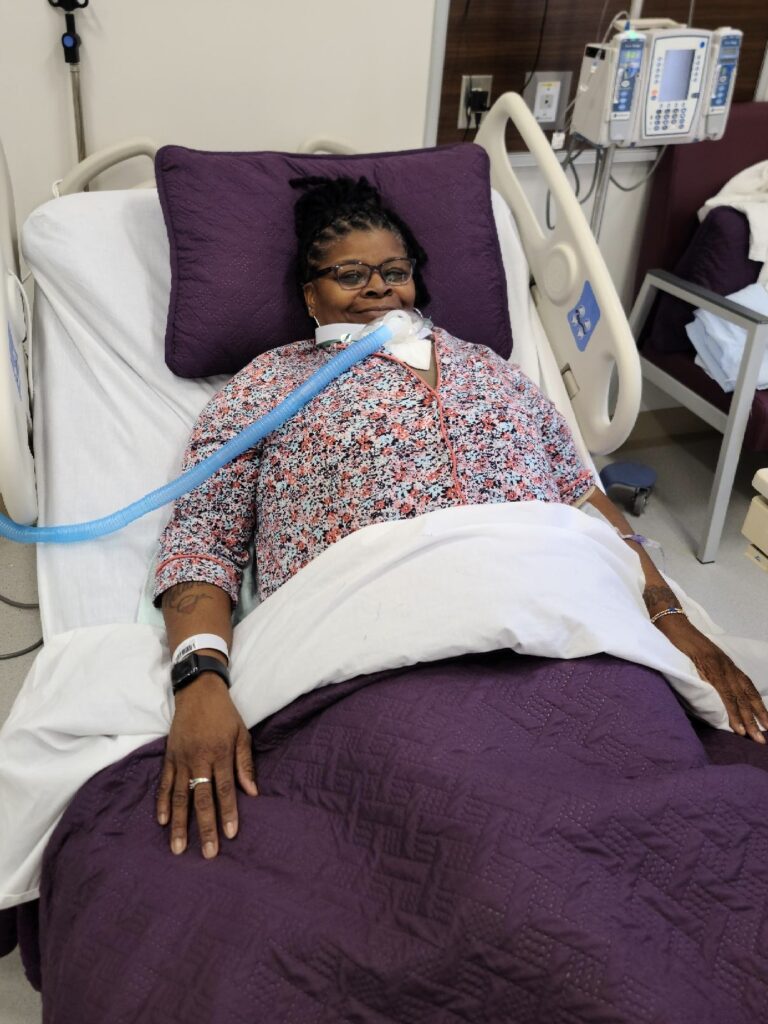
Coursework with the new technology allows students to experience a simulated tracheostomy and childbirth and practice nursing fundamentals from the classroom through virtual reality. The innovative technology also supports new simulation storylines and in-person group activities to familiarize students with the effects of limited access to care on a patient’s health.

Many of these technological upgrades were funded by a $1.5 million grant from the Health Resources and Services Administration (HRSA). This grant, led by John Whitcomb, a professor and the chief academic officer and director of the School of Nursing, to prepare a cohort of nurses to use advanced technology and work in medically underserved and rural communities. However, School of Nursing faculty members have integrated the HRSA-funded technology into coursework to benefit all of Clemson’s nursing students, and they plan to use it long after the grant period has concluded.
“We wanted all nursing students at Clemson to benefit from the HRSA grant, not just a small population,” said Kimberly Kamp Hill, associate director of simulation for the School of Nursing. “All nursing students are able engage in experiential learning with the equipment, simulations and activities we created because our team is committed to mirroring what happens in the real world and providing an exceptional academic experience for our students.”
Each experience has its own function and purpose. For example, the wearable tracheostomy and birthing technology allows students to interact with real people, as volunteer patients follow a scripted story to illustrate symptoms and pain.
Lucia Gonzales, associate director of research in the School of Nursing, taught students with the wearable tracheostomy alongside Leslie Ravan, the School of Nursing’s associate director of undergraduate studies and principal lecturer. Gonzales said interaction with a live person takes the experience from one that helps students build technical skills to one that truly helps them connect with patients.
“Empathy is a result of real conversations with real people rather than mannequins. A live person can answer you and say, ‘This is not helping my breathing,’ or ‘I am feeling choked,’ and suddenly empathy for the patient comes about naturally,” Gonzales said.
Additionally, students use virtual reality headsets and controllers to learn more complex skills in a controlled environment.
“Virtual reality is especially helpful for skills that student nurses do not get to use often. For instance, in clinical settings, students typically see trained professionals trying to resuscitate a patient who may be on the verge of expiring,” said Jason Thrift, assistant nursing professor. “The students, of course, can observe those situations, but they may not get to practice resuscitation. Virtual reality gives them a chance to do so.”
Through the use of innovative technology, the School of Nursing has elevated learning outcomes and expanded experiential learning opportunities for its students. Hill said she intends for Clemson’s nursing program to serve as an example for successful use of simulation in the classroom – and hopes that all of South Carolina’s nurse educators will use technology to prepare students to excel in the workforce.
The School of Nursing is a part of the College of Behavioral, Social and Health Sciences. Established in July 2016, CBSHS is a 21st-century, land-grant college that combines work in nine disciplines – communication; nursing; parks, recreation and tourism management; political science; psychology; public health sciences; sociology, anthropology and criminal justice – to further its mission of “building people and communities” in South Carolina and beyond.