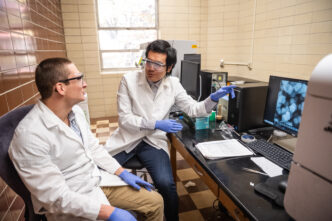

Dong Hou of Clemson University has set his sights on developing next-generation batteries that would be safer, longer-lasting and more sustainable than ones currently in use.
Hou, an assistant professor of materials science and engineering, is focused on advancing solid-state batteries and is particularly interested in a part called the electrolyte.
He and his team want to make the electrolyte out of a new ceramic-based material and ensure it fits tightly against the electrodes.
They will then use advanced imaging techniques and artificial intelligence to study those new materials and see how well they perform.
The work will be done at Brookhaven National Laboratory and in the X-Ray Advanced Imaging of Materials and Structures (X-ray AIMS) Lab at the new Advanced Materials Innovation Complex (AMIC).
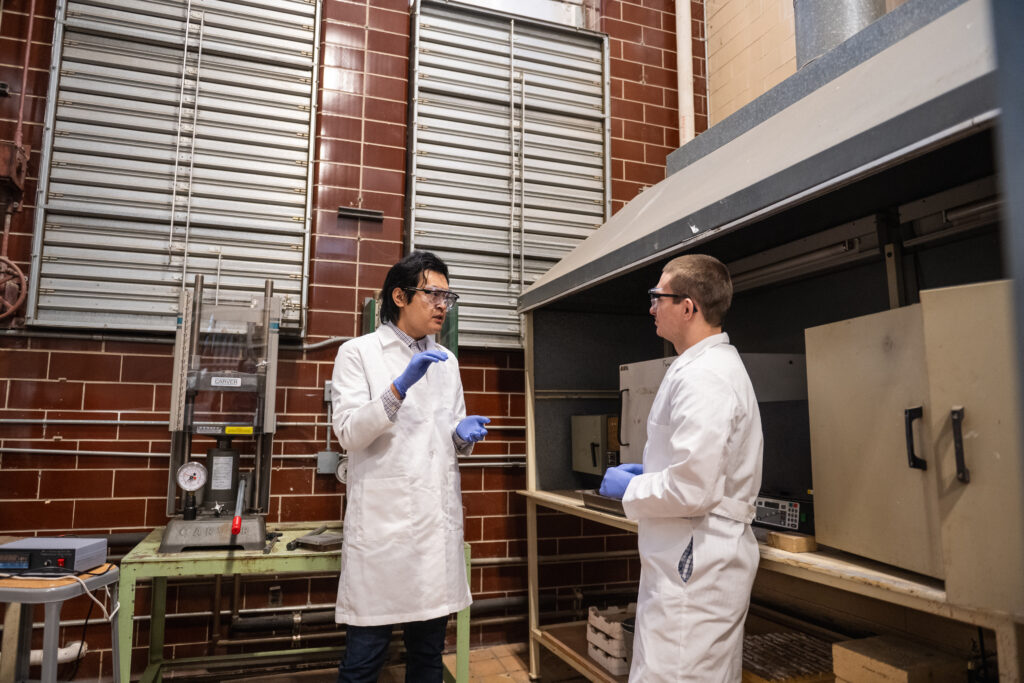
“Batteries in everything from electric vehicles to phones and laptops could become more stable and longer-lasting over their lifetime,” he said. “Because the degradation of the battery will be much lower than a conventional battery, you will not have to worry about overheating from heavy use.”
Hou’s work lays bare the inner workings of batteries, which are layered like a sandwich.
The electrolyte layer in most conventional batteries is made out of polymers and organic liquids, which are susceptible to overheating and sometimes fire. Hou and his team want to instead make the electrolyte out of ceramic, which is more resistant to intense heat.
But the polymer layer’s flexibility gives it a key advantage over ceramics. The polymers make better contact with the electrodes than the more rigid ceramics.
That’s important because poor contact makes it harder for ions to move between the electrodes and the electrolyte, which weakens the battery over time.
For Hou and his team, the challenge is to create a ceramic electrolyte and engineer the interface where the electrolyte and electrodes meet so ions can move more easily.
“How can we design a unique microstructure for this kind of solid-state electrolyte, and how can we change the composition in the interface between the electrolyte and electrodes?” he said. “That, I think, is the key to solve this kind of interface problem.”
The project is funded through the National Science Foundation EPSCoR Research Fellows program, and Hou was one of just 24 researchers nationwide selected for the award. The program invests in collaboration between academics, industry and government.
As part of the project, Hou’s graduate students will gain hands-on experience working at AMIC and Brookhaven National Laboratory.
Bryson Hedrick, a Ph.D. student in Hou’s lab, knows how valuable national laboratory experience can be. As an undergraduate, Hedrick had a chance to conduct research in a separate project at Oak Ridge National Laboratory.
“It always helps in an interview because it’s such a unique experience,” Hedrick said. “There is so much knowledge and experience, and researchers come from all over the world to work at national labs.”
Kyle Brinkman, chair of the Department of Materials Science and Engineering at Clemson, said the project reflects the department’s commitment to high-impact research and hands-on learning.
“Projects like this push our research forward while giving students experience with some of the most advanced facilities in the country,” he said. “It’s the kind of work that strengthens our impact and prepares the next generation of leaders in energy technology.”