
Meghan Keating has always had a love for animals. But it was an ecology class that she took as a freshman at Colorado State University that shifted her attention more on how animals fit into the ever-changing landscape of the world today.
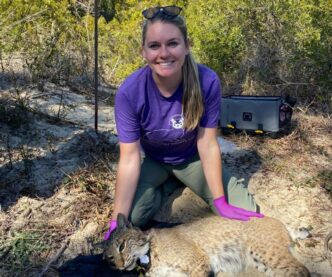
That focus is what led Keating, who is from Modesto, California, to receive her doctorate in wildlife and fisheries biology from Clemson University in August after completing her research study on urban carnivore space use and survival. Her work focused on the long-term effects of human development and rodenticide use on bobcat populations in the Southeast and globally. Most of her research was done on South Carolina’s Kiawah Island, a residential barrier island off the coast of Charleston.
She first learned of the project after completing her master’s degree in natural resources and environmental science at the University of Nevada, Reno. What struck her was seeing how much the people on Kiawah Island cared about their bobcats.
In late 2019 and early 2020, three bobcats were found dead due to rat poisoning on Kiawah Island, including two females that died while giving birth. The bobcat population dropped from an estimated 30 to as few as 10. That led to efforts to curtail the use of poisons on the island while also kickstarting research to understand how rat poisons were affecting bobcats.
“When I saw that they were looking for someone to come in and do some good science and help them solve their problem, I just felt like that was a really cool opportunity to get connected with some on-the-ground conservation and help people with their wildlife management,” Keating said.
Keating worked in the lab with David Jachowski, a Clemson professor of wildlife ecology and director of the Clemson Boone and Crockett University Program, studying anticoagulant rodenticide exposure in bobcats.
To eradicate rodents like mice and rats, residents were using rat poison. It was discovered that the bobcats would in turn eat the mice and rats, thus ingesting the poison, as well.
When the animals consumed the rat poison, the effects included internal bleeding and lesions, lethargy and a reduced immune response, which can make them more susceptible to other diseases. The poisons can take up to a week to fully kick in.
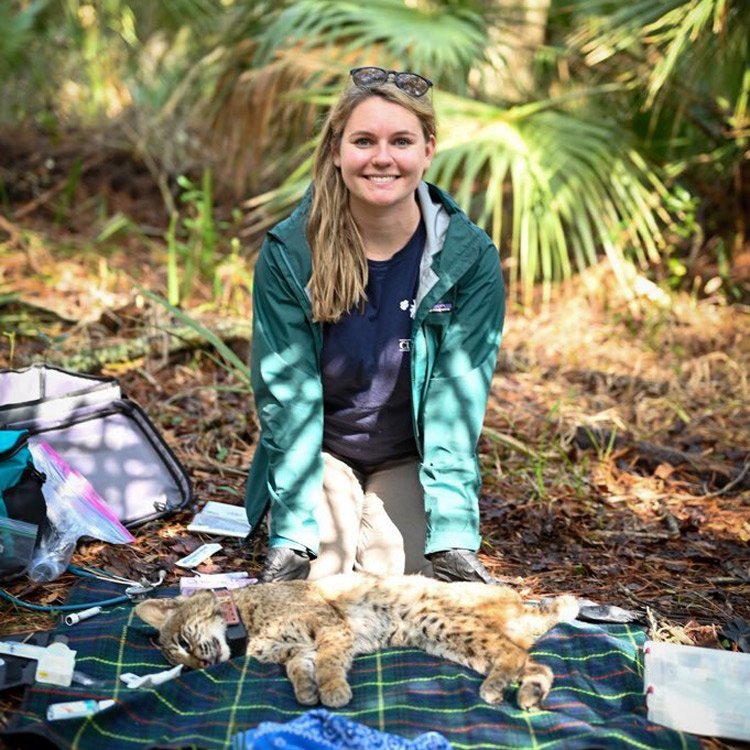
Part of her research focused on understanding how people and building homes affect bobcats. GPS collars were placed on bobcats so researchers could see the kinds of habitats they used.
Keating and the researchers also wanted to see where bobcats were exposed to rat poisons, what happened once they were exposed and how frequently they were exposed.
“I collected a lot of poop and blood from all of the cats, just trying to understand what this problem means for a bobcat,” Keating said. “That ended up being some of my most impactful work.”
While there wasn’t a significant correlation between housing density and bobcat survival, exposure to rodenticides was linked to lower survival.
Keating worked closely with Clemson’s Department of Pesticide Regulation, which classified products containing four second-generation anticoagulant ingredients as restricted-use pesticides in South Carolina. Only licensed dealers may sell the products, and purchases are limited to certified pesticide applicators.
One of the biggest takeaways Keating took from the project was learning how adaptable bobcats are.
“They’re just this cat that people never see,” she said. “They’re very seclusive. But they also are just out and about. They really take advantage of the space that they have. They persist in these areas that we would think a lot of animals wouldn’t be able to live – there are too many people, too many houses.”
Keating also learned how important and powerful people can be. If it weren’t for the islanders’ passion for wanting to help the bobcats, there’s no telling how many would be alive today. Current estimates range from 20-25.
“Science is awesome and it’s my passion, it’s something that I love to do,” Keating said. “The reason that it’s so important to me is because it affects real people and real animals. All these people came together to solve this problem. Without their passion for this animal, we wouldn’t know as much about this as we know today. It was moving to see their passion and their love for it translate into really good science.”
Keating became an animal lover from watching television shows like “Mutual of Omaha’s Wild Kingdom” and “The Crocodile Hunter.”
What fascinated her most while watching those shows was the predatory animals. The way they live and survive piqued her interest.
“I’ve always loved pretty much all animals, but there’s something about a predator that it must always be going out of its way,” Keating said. “It can’t just come and nibble on some grass. It must fight to survive. I find that very interesting. I think the grit that predators must have is something a lot of us can relate to, even if it’s kind of gross.”
She will remain at Clemson as a postdoctoral researcher, where she will expand on continent-wide wildlife ecology and conservation of bobcats and possibly other carnivores.
“She is one of our best and brightest,” Jachowski said. “I would say she has grown in all the key ways successful researchers become primary investigators. She has honed her skills in project management, personnel management, time management and perhaps most importantly, grown in confidence in her ability to do things and lead a research program.
“I am excited that she will continue with her research on coastal bobcats, but particularly excited about how she is building on that work to work across the entire Southeastern U.S. Her postdoctoral work at Clemson will not just advance the conservation of bobcats but help inform conservation of many carnivores across the Southeast that are under threat from rodenticide poisoning.”