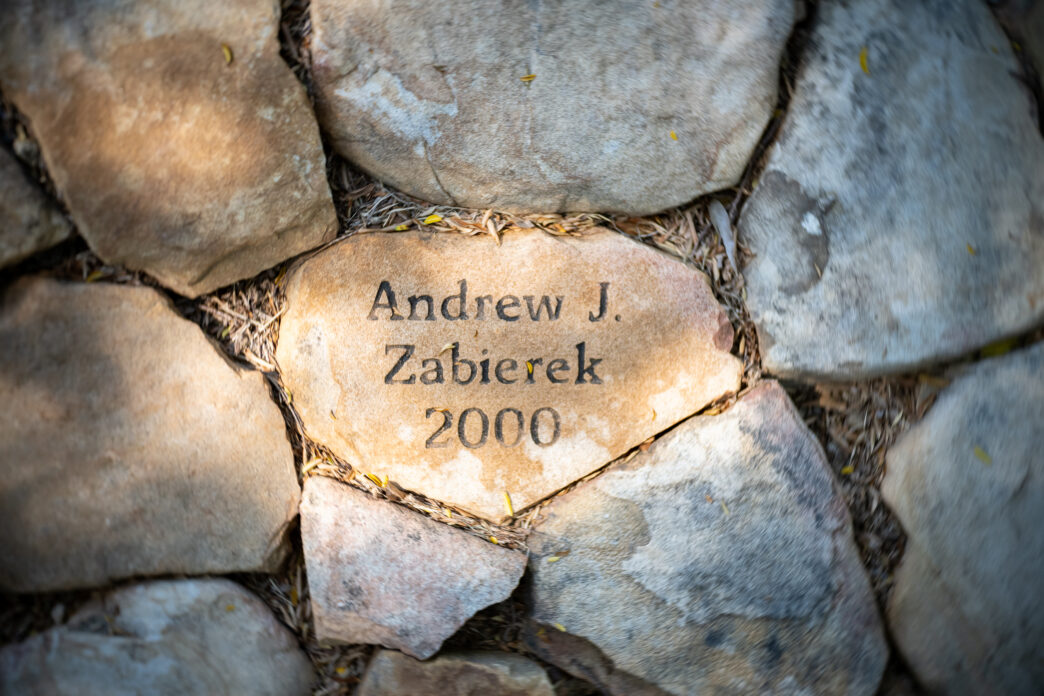
Andrew Zabierek’s name is chiseled in stone in the shadow of Memorial Stadium. It rests permanently among the names of the other 497 known Clemson University alumni who made the ultimate sacrifice — all included in the Scroll of Honor, a grass-topped barrow ringed by the named stones and surrounded by immaculate gardens of Lenten roses, autumn ferns and 14 Chinese elms planted at an angle so that they bow toward the monument at their base.
Meanwhile, 967 miles away in Chelmsford, Massachusetts, tens of thousands of cars pass over and under the Andrew Zabierek Memorial Bridge every day. The edifice spans North Road, the city’s main artery, and Interstate Highway 495, one of the busiest highways on the East Coast. Four metal signs, one at each approach to the bridge, bear Andrew’s name in black letters on a white background, framing a Purple Heart.
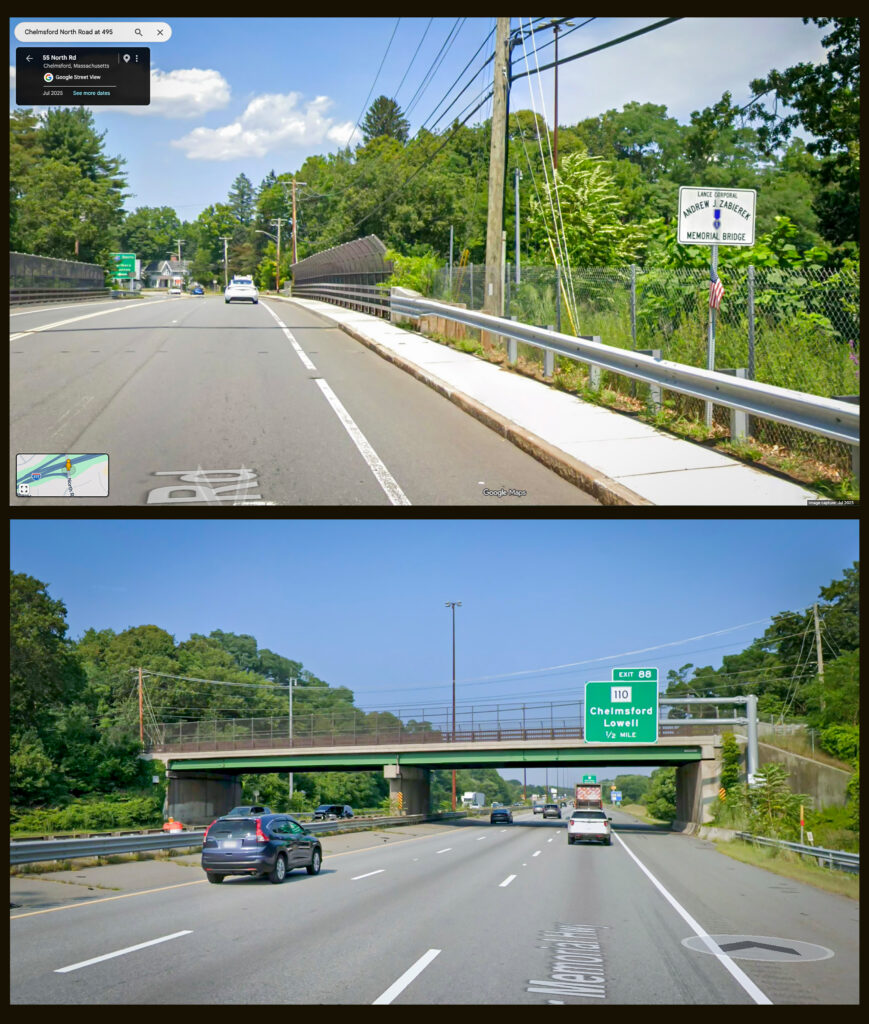
This is how two communities, separated by untold differences and nearly a thousand miles, are bonded in collective grief and gratitude, honoring a man who gave everything and expected nothing in return.
Those who knew and loved Andrew would much rather live in a world where memorials weren’t necessary.
“I tried to talk him out of it,” says Andrew’s father, Steve, referring to his son’s sudden declaration after 9/11 that he was going to join the U.S. Marine Corps. It was a striking announcement, not only because the Marine Corps is considered the most demanding branch of America’s military but also because Andrew wanted to go in not as an officer, which, as a college graduate, he was allowed to do, but as an enlisted infantry rifleman.
“I tried to convince him to join as an officer, or go to the Air Force or Navy, but he wouldn’t have it. He said, ‘Dad, I have to know what the grunts go through before I can lead them,’” Steve recalls.
That kind of integrity is what puts names on stones and bridges.
Warmer winters
A New Englander by birth, Andrew graduated from Chelmsford High School in 1996 and set his sights on the South. Steve says he had only heard of Clemson because of the football program’s 1981 national championship, and he doubts his son had even heard of that. But at 18, Andrew had suffered through enough cold northern weather to last a lifetime.
“He didn’t want to go to school around here. He hated the winter,” laughs Steve. “He wanted to get out of New England to warmer weather.”

Andrew visited the University of Georgia and Florida State University first, but didn’t feel at home at either. He was accepted at the University of South Carolina, but Clemson stole his heart.
“Clemson just suited him perfectly,” says Steve.
“My brother was special.”
Andrew earned a degree in financial management from Clemson in 2000 and landed a job as a certified financial planner at American Express back home in Waltham, Massachusetts. He made his first sale to his parents, investments and insurance policies that still exist today. After a year, he was on track to soar in his profession.
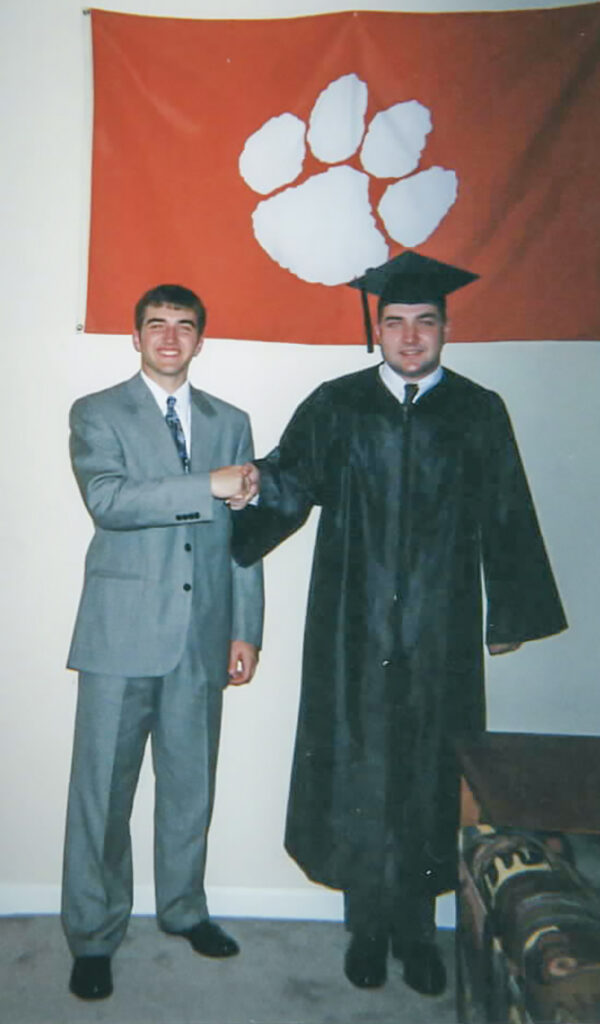
“They say it takes two years to get that career underway,” says Steve, himself a Navy veteran who served three deployments to Antarctica during the Vietnam War. “He was just starting to really enjoy helping his clients and his customers. He was really getting excited to go to work every day. But then 9/11 happened, and it changed everything.”
Andrew was incensed by the terrorist attack in the heart of the country he loved. The Zabierek family boasts a proud military heritage. Andrew’s grandfather was a bombardier in WWII, and three of his uncles (Steve’s brothers) also served in Vietnam. His younger brother, Mark, was a sophomore at the U.S. Air Force Academy in Colorado Springs, Colorado, when the Twin Towers fell.
There was no way Andrew was going to stand by and do nothing. Always well-informed, he read The Wall Street Journal cover to cover every day and knew the United States would go to war while everyone else was still processing the events, Steve says.
In an audacious, Pat Tillman-esque move, Andrew gave up his burgeoning financial career and all the monetary benefits that came with it to join the Marines at the ripe age of 22. It was a choice he knew would all but guarantee he would not just be in the fight but on the front lines.
Despite the family’s rich history of military service, the decision took his parents by surprise.
“Mark and Andrew didn’t play war games when they were boys, never showed an interest in guns,” says Steve. “They loved things like little league football, baseball and skiing. Neither of them ever showed any ambition to join the military. It still amazes me they both wound up going in that direction.”
Mark spoke of the family’s amazement at Andrew’s decision in his eulogy for his brother:
“As he pondered joining the military, my family sometimes didn’t understand why a college graduate so gifted as my brother would want to enlist for a nominal wage and risk losing what would have been such a full life. Simply, my brother was special. He wanted to serve and honor and protect the things that he held dear in life.
“His sense of justice didn’t enable him to accept that others would go to war for him to fight and die in his stead.”
Becoming ‘Zippity’
Like every Marine recruit who enlists from east of the Mississippi River, Andrew attended boot camp at Parris Island, South Carolina, and the School of Infantry at Camp Geiger, North Carolina.
Upon graduation, the now Lance Cpl. Zabierek was assigned to the 2nd Battalion, 2nd Marine Regiment (2/2) “Warlords,” a unit of about 1,000 Marines stationed at Camp Lejeune, North Carolina.
Andrew stood out instantly, at 24, as one of the more “seasoned” Marines among the 18- and 19-year-olds around him.
Retired Marine Col. Giles Kyser was the battalion commander of 2/2 at the time. He remembers the younger Marines gravitating toward Andrew because of that, but more as a novelty than a father figure at first.
“In the Marines, father figures inside formations are not just about age,” Kyser explains. “It’s about experience. Andrew had life experience outside the Marines that gave him a maturity that set him apart, but in the Marines, you have to earn respect.”
Andrew earned that respect during a conditioning hike led by Kyser in the battalion’s ramp-up to deployment. It was a 12-mile trudge up and down over the asphalt roads, training areas and sandy tank trails of Camp Lejeune, weighed down with weapons, armor and backpacks full of water, food and supplies that weighed 70-90 pounds.
“I don’t recall that day as being particularly hot, but it’s North Carolina, and I was never known as someone who was particularly slow,” says Kyser. “The expectation in a Marine infantry unit is that you’ve got some tough, rugged bastards with really hard feet and strong backs.”
After a few sweat-drenched miles, several of his platoon mates noticed Zabierek slowing down and struggling to keep up. A few of them offered to carry his pack, but he refused. By the end, Andrew had hiked the skin off the bottom of his feet, leaving him out of commission for days to come and earning the nickname “Zippity,” or “Zip” for short.
“This is where I think Zip earned the respect of the formation,” says Kyser. “He slowed down, but he never quit. That in and of itself reflects the kind of Marine you truly hope to have the privilege of leading.”

Iraq
As the United States began unleashing its full force in the Global War on Terrorism, the Marine Corps selected 2/2 as the only unit from the 2nd Marine Division to join the 1st Marine Division out of Camp Pendleton, California, on a rotation to Iraq in the spring of 2004.
That March, 2/2 relieved the 82nd Airborne Division in Al Anbar Province, which encompasses more than 53,000 square miles of western Iraq. During their eight months in country, 2/2 Warlords would conduct both combat and humanitarian operations over an area spanning hundreds of miles. Andrew and his brothers-in-arms in 2/2 experienced constant, intense firefights, mortar attacks and improvised explosive device (IED) attacks.
But it was the humanitarian side of the mission where Andrew shined.
After the fall of Saddam Hussein’s regime just one year earlier, the people of Iraq assumed all uniformed forces were corrupt. The Marines were tasked with building trust in a culture of distrust, something that came naturally to Zabierek. Kyser says he marveled that, even in the most hostile regions, Andrew’s humility and charm enabled him to make friends with the local villagers. He especially relished his interactions with Iraqi children and always carried candy or pens to hand out to them.
On March 31, 2004, the Marines’ progress in winning hearts and minds took a giant step backward when insurgents in Fallujah ambushed four American contractors. Their bodies were burned and dragged through the streets before being hanged from a bridge. Video footage of the event quickly spread and sparked outrage among deployed service members and Americans at home.
The incident led to the First Battle of Fallujah, a boots-on-the-ground, highly kinetic campaign that lasted 27 days. Afterward, 2/2 regrouped at their forward operating base, Camp Fallujah.
On the evening of May 21, 2004, Camp Fallujah came under mortar fire from outside the gate while Andrew and the unit’s medic, Navy corpsman Petty Officer 3rd Class Clay Garcia, were on patrol. Looking to catch the enemy in the act, the patrol headed in the direction they believed was the point of origin of the attack.
As the patrol tried to cross a highway, a truck driven by an Iraqi local swerved toward Andrew, striking him at a high rate of speed. “Doc” Garcia recalls the sound of screeching tires and yelling for Andrew as he ran to the front of the patrol to find him lying on the side of the road, mortally wounded. He could not be saved.
“It was an honor and a privilege to serve with him,” says Garcia, in the typically stoic way of a Navy corpsman. “Being with him on his last day is the single most impactful event of my life.”
Honor, Courage, Commitment
Kyser, Garcia and the Marines of 2/2 would remain in Iraq until the fall of 2004, fight in 650 separate engagements, suffer 165 wounded and lose six Marines, including Andrew. Andrew’s parents, Steve and Judy, were there to welcome the Warlords home upon their arrival back to Camp Lejeune. Mark graduated from the Air Force Academy and refused the Department of Defense’s Sole Survivor Policy, a regulation designed to protect families who have lost members to military service by preventing the last remaining child from being assigned to combat zones, to serve deployments in both Iraq and Afghanistan after his brother’s death.
Andrew was laid to rest on May 29, 2004, at Saint John’s Church in Chelmsford, Massachusetts, one day before his 26th birthday. He is one of only four Clemson graduates killed in the Global War on Terrorism and the sole enlisted.
The family created the Andrew J. Zabierek Foundation to help veterans as they transition back to civilian life. It awards two scholarships each year to veterans pursuing a college degree or a technical certificate.
“It’s an honor to be his father, and he’s still my son,” says Steve. “I’m still taking care of him. Two or three times a week, I walk back and forth across his bridge and clean up the litter.”
It’s hard to predict what will define a life. For some, it’s family or faith. For others, it’s the words they’ve written, the monuments they’ve built or the wisdom they hand down. Andrew Zabierek’s life was cut short just as it was gaining momentum, before he could have a family of his own or discover himself outside of his 20s. If he were still alive, he’d likely be a millionaire many times over.
Instead, he gave the last full measure of himself on a dusty road in Iraq, as far from home as one can be, fighting for his country.
That night, he gave us everything he had and everything he was going to have. That selfless act defines him. How we honor him is what counts now.
As the traffic flows in a steady hum over and under his bridge on I-495, and the breezes rustle the trees over his chiseled letters in the Scroll of Honor, his name etches itself in the minds of every driver, if even for a split second, and collects the rain and soaks up the sun as the seasons pass and steady streams of visitors file through the park.
In these ways and more, his name remains, and we never forget.
Editor’s note: This story originated in the American Military History class of Clemson history professor Rod Andrew. In the class, each student is assigned a paper on a Clemson veteran whose name is found on the Scroll of Honor. Political science student Chance Bridwell ’26 chose to write his paper on Andrew Zabierek, and it stood out among his peers for its depth and emotion. Bridwell’s research included locating and interviewing Andrew’s father, several of his fellow Marines, and his battalion commander. Senior writer Ken Scar leaned heavily on Bridwell’s research in writing this feature, drawing directly from his paper at several points. Of note, both Bridwell and Rod Andrew are former active-duty Marines; Scar is a U.S. Army combat veteran.