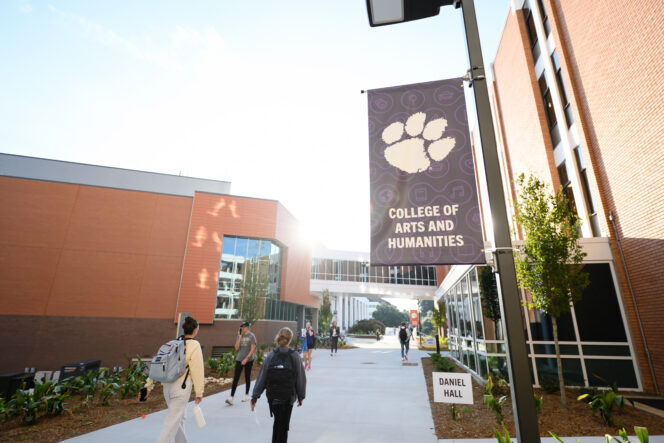
At a recent installment of the College of Arts and Humanities’ Degrees of Success alumni speaker series, Clemson students heard a familiar question reframed: What are you going to do with that degree?
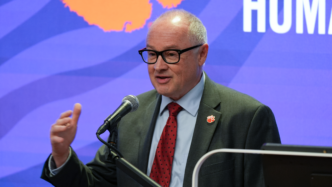
Founding Dean of the College Nicholas Vazsonyi opened the event by acknowledging the long-standing skepticism often directed at arts and humanities majors, then challenged it.
“Some degrees align neatly with a specific profession,” Dean Vazsonyi explained. “But students in the arts and humanities follow a different path, one with more ambiguity, but far greater flexibility and opportunity.”
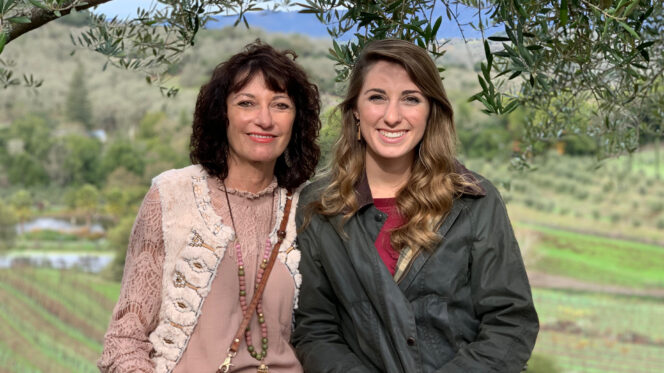
That flexibility was on full display through the experiences of alumni Teresa Catherine ’11 and Elizabeth Anne McNamara ’14, who shared how they built careers by combining creativity with entrepreneurship.
Building opportunity from the ground up
Catherine, a New York–based independent filmmaker, writer, and actress, described a career shaped not by waiting for opportunities but by creating them. After earning her Bachelor of Arts in performing arts and completing a Master of Fine Arts in classical acting from The Catholic University of America, she initially pursued stage work; however, limited opportunities led her to pivot.
“I realized I could create my own opportunities,” Catherine said. “And shape the kind of work I wanted to do.”
That realization led her to found her own production company, Maid and Prince Productions, and begin making films independently. She started with projects shot on borrowed equipment and even an iPhone. Each project, she explained, became a strategic step forward.
“Every project needs to move your career forward,” Catherine advised. “What do you need next, and how can you build something that gets you there?”
Her work has since grown in scale and recognition, with award-winning short films and feature projects currently in development. Along the way, she has also built a mission-driven company focused on increasing representation.
“All of my projects are female-led,” she said. “It’s about creating space and telling stories that aren’t always prioritized.”
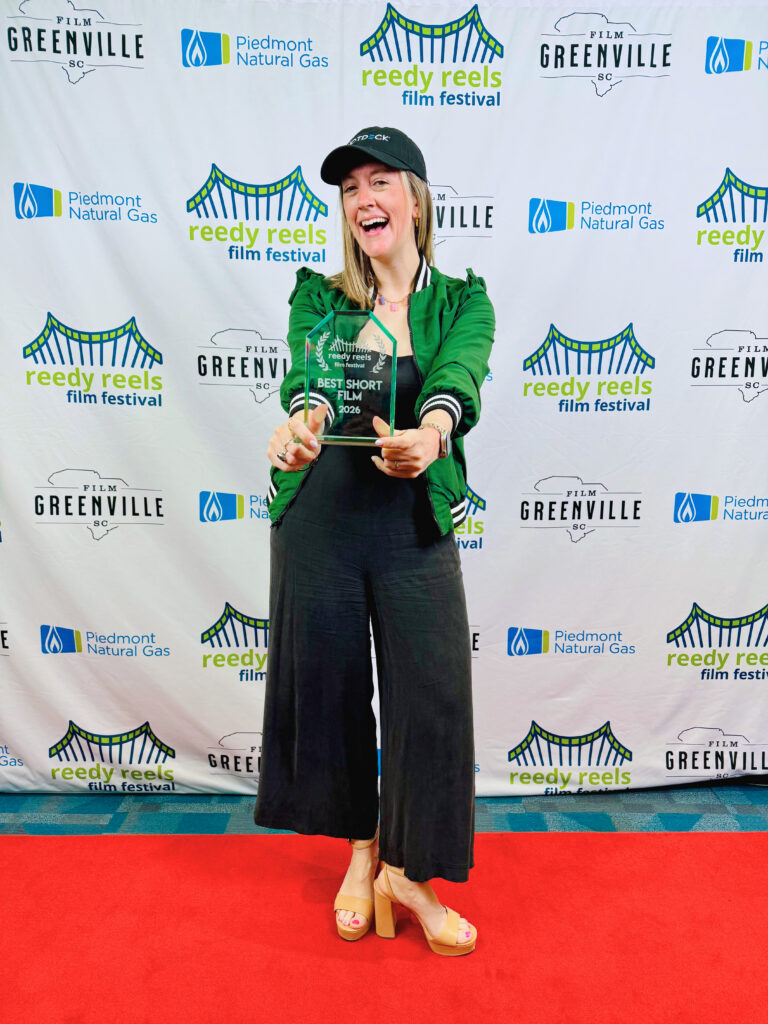
Just days after speaking at Clemson, Catherine earned Best Short Film at the 2026 Reedy Reels Film Festival in Greenville, South Carolina, for her short film interiorem pueri (inner child), a “reverse coming-of-age” film centered on the difficulty associated with the loss of one’s inner child on the journey to maturity.
Designing a path in fashion
McNamara’s journey followed a similarly entrepreneurial arc, one that required additional training, persistence and adaptability.
After graduating from Clemson, she pursued a second degree in fashion design at the Fashion Institute of Technology in New York. She then began a career in the corporate fashion industry before launching her own brand.
“I didn’t want someone else telling me what to design,” McNamara said. “I wanted to create what I envisioned.”
Now based in Greenville, South Carolina, she is the founder of her label, EAM 1992, and the reigning emerging designer at Greenville Fashion Week. Her work blends playful, feminine elements with a distinctive personal aesthetic, which incorporates original prints she designs herself.

Advice for current students
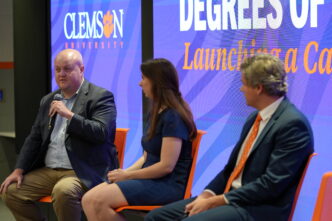
During a Q&A session with performing arts students, both alumni encouraged graduates to focus on building skills, community and a clear sense of direction.
“Figure out what you’re missing and go after that,” Catherine said. “That’s how you start to build your network—by putting yourself in the spaces where people are learning the same things.”
McNamara echoed the importance of intentional growth, adding that early career paths are rarely linear.
“It’s not going to happen on the timeline you expect,” she said. “But when you look back, it often makes sense exactly the way it unfolded.”
Both emphasized the value of persistence and what Catherine described as “endurance.”
“Out of the people I trained with [in graduate school], only a few are still pursuing it,” she said. “You have to keep coming back to the thing you love. That’s what keeps you going.”
A broader definition of success
Ultimately, the event reinforced the core message of the Degrees of Success series: that a single path does not define careers in the arts and humanities, but rather that careers are defined by adaptability, creativity and long-term vision. By blending artistic passion with entrepreneurial strategy, Catherine and McNamara demonstrated that success in these fields is not only possible but also highly individual. Moreover, as Dean Vazsonyi suggested at the outset, perhaps the better question is not “What are you going to do with that degree?” but “What can’t you do with it?”