


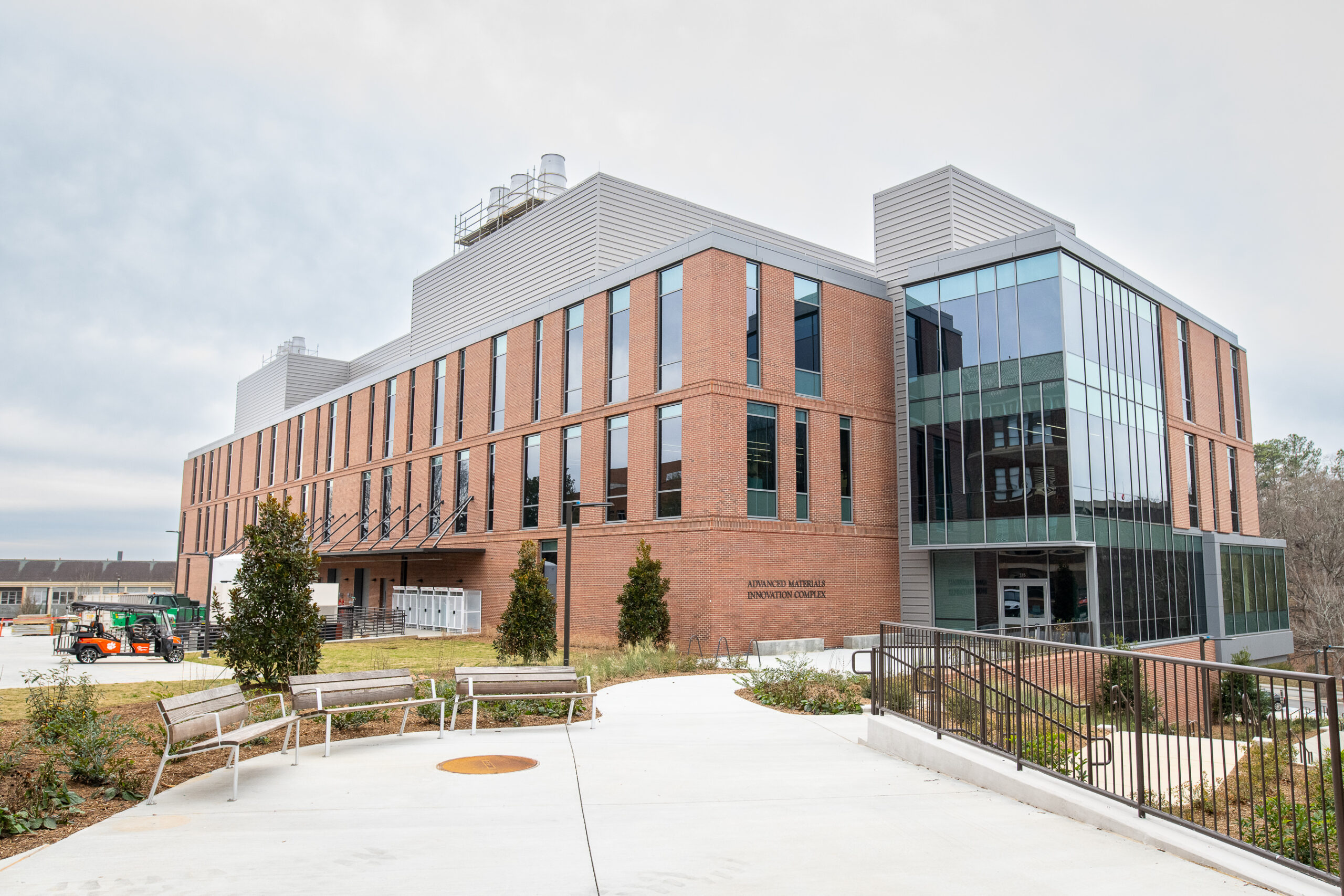
Clemson University began 2026 with the opening of South Carolina’s most technologically advanced research facility, a 150,000-square-foot Advanced Materials Innovation Complex (AMIC). The sharp new building sits in the center of campus and provides classrooms and labs that support the University’s three core advanced materials departments: Materials Science and Engineering, Chemistry, and Chemical and Biomolecular Engineering.
The three departments have historically been housed in separate spaces scattered across the main campus and satellite campuses around the Upstate. They also are housed in two different colleges: the College of Science and the College of Engineering, Computing and Applied Sciences. AMIC centralizes materials science-related classes, offices and labs from both colleges into a sweeping new space designed to promote multidisciplinary research and education, hallmarks of an R1 research institution, and to solidify South Carolina as a major player in the advanced materials industry.
“Every Tiger who aspires to be a doctor, veterinarian, scientist or engineer will come to AMIC to learn in state-of-the-art organic chemistry teaching labs. When they do, they will be surrounded by cross-disciplinary teams of faculty and students pushing frontiers to develop the advanced materials of tomorrow,” said College of Science Dean Cynthia Young. “Together, they will improve lives in South Carolina and beyond.”
What are advanced materials?
Advanced materials are created by manipulating substances at an atomic level, creating new, purpose-built materials with enhanced properties like strength, conductivity and responsiveness that far outperform naturally occurring materials. These materials have quickly become crucial to high-tech industries such as aerospace, electronics and healthcare. Most often, they are conventional materials — think metals, polymers and ceramics — that are modified or designed at microscopic levels for specific applications, enabling lighter, stronger, more efficient products. Some examples include carbon fiber composites, ceramic polymers, nanoparticles with unique optical properties, and biomaterials used in medicine, such as DNA-based materials.
“AMIC will spark new opportunities for collaboration among faculty and students from complementary disciplines to drive advanced materials innovations that impact numerous critical industry sectors, including energy, healthcare, manufacturing, automotive and others,” said Tanju Karanfil, senior vice president for research, scholarship and creative endeavors.

“The work conducted at AMIC will help shape the next generation of leaders and innovators who will fuel economic advancement across our state, nation and world.”
Engineered materials are inherently innovative but they’re not necessarily new. For instance, people have been experimenting with alloys to improve the performance of metals since the Bronze Age. Major scientific advances of the 20th century, plus a new understanding of atoms during that same time period, led to the creation of advanced materials our ancestors could hardly imagine.
Some examples of advanced materials applications in key Clemson focus areas include:
- Aerospace: Carbon fiber composites and superalloys improve aircraft strength while reducing weight, enhancing fuel efficiency and durability.
- Healthcare: Biomaterials and smart materials are used in prosthetics, implants and drug-delivery systems, enabling personalized, more effective treatments.
- Electronics: Nanomaterials and conductive polymers enable faster, smaller and more efficient devices, such as smartphones and advanced computing systems.
- Energy: Advanced materials like silicon carbide and perovskite solar cells optimize energy storage and generation, pushing the boundaries of renewable-energy efficiency.
- Transportation: Lightweight magnesium alloys and shape-memory materials are applied in electric vehicles to improve their range and performance.
The scientific community is still on the threshold of the advanced materials’ technical revolution. The next 20 years will likely see a leap forward that surpasses the progress of roughly a century of the Industrial Revolution, experts say. The only fundamental limitations are the laws of physics — and human imagination. AI will almost certainly break open even more possibilities for the creation and implementation of advanced materials in virtually every aspect of our lives.

It’s going to happen fast, University and legislative leaders agree, and AMIC will do much to help South Carolina keep up with the times.
“The Advanced Materials Innovation Complex positions Clemson University, and South Carolina, at the forefront of the materials revolution,” said Anand Gramopadhye, dean of the College of Engineering, Computing and Applied Sciences. “Home to both fundamental and translational research, it will spur cutting-edge innovation and attract top students and researchers worldwide.

“Through strong partnerships with industry, state and federal agencies, AMIC will help drive transformative advances in energy, health care, infrastructure, transportation and advanced manufacturing, delivering impact vital to our state’s future and economy,” Gramopadhye said.
A look inside the most advanced building on campus
Memorial Stadium can be seen over one shoulder as one approaches the main entrance of AMIC, a modern citadel of brick, steel and glass.
Just as football brings a diverse state together to cheer a team toward winning, AMIC also binds a broad cross-section of supporters: scientists and engineers, industries and individuals — all in pursuit of efficient processes, a more productive workforce and broad research collaborations. More than 300 research faculty and graduate students will call the complex home at any one time, with more than 12,000 students expected to utilize the laboratory space annually.

Inside, visitors enter a three-story atrium, the KYOCERA AVX Lobby, where a massive wall of notched wooden beams made from trees felled during the construction process creates waving patterns that sweep across the space. A pristine stone-and-steel staircase descends into the lobby, inviting students up to the second floor, where state-of-the-art laboratories line the long hallways.
In the Bishop Family Teaching Lab, students working with the latest 3D printing machines can choose between machines that print in plastic, carbon fiber, or steel. The experience they gain transfers directly to career fields in automotive design, construction, and many other booming industries.

Downstairs in the Kekas Family Teaching Lab, students conduct chemistry experiments from neat rows of lab stations protected by large panes of glass that they can reach their arms under. Each station is outfitted with the latest technology, and students even have the option to work under UV or different colored light.

“I was blown away the first time I stepped in through the doorway,” says senior lecturer in chemistry James Plampin III. “It’s a whole new game in here. I believe the air changes in this room twice every 30 minutes. So, no matter what you’re working with, it’s not going to affect you.”
Another named lab, the Norville Family Teaching Lab, will also be home to student discovery and state-of-the-art equipment designed to support advanced materials teaching and learning.
Other unique features in the AMIC labs include a lab coat cleaning service, so students have clean ones ready before each class, and lab stations that are ADA-compliant for students with disabilities.

What advanced materials mean to South Carolina
Advanced materials drive advanced manufacturing, and that creates jobs. Consequently, enrollment in these high-demand science and engineering disciplines has grown by more than 25 percent in the last decade.
In South Carolina alone, the advanced materials industry accounted for 5,800 job announcements and $1.7 billion in capital investment announcements from 2017-25, according to the state Department of Commerce.
The South Carolina legislature voted overwhelmingly to allocate crucial state dollars that helped fund the complex’s construction. Students who pass through the building during their college journey will be both educated and empowered to make South Carolina a leader in this critical industry — one that becomes more crucial to the nation and the world every day.

At Clemson, cutting-edge resources like those offered in the AMIC are critical to supporting the research goals outlined in the University’s strategic plan, Clemson Elevate, which aims to double research expenditures by 2035. That includes increasing total research space from 996,000 to 1.4 million square feet by 2028.
Clemson’s vision for the Advanced Materials Innovation Complex is clear: As its doors opened in 2026 to welcome the first cohort of eager Tigers, a bright future has been set in motion. In the years to come, the students and researchers who pass through the wide hallways, innovative classrooms and state-of-the-art labs will improve lives in ways we can only dream about now.
Advanced Materials Innovation Complex: Fast Facts
- Over 10,000 cubic yards of concrete poured
- 172 fume hoods but uses 38% less energy than a typical “code compliant baseline” science building
- Building achieved 2 Green Globe Sustainability award – Indicates a commitment to sustainability and environmental responsibility.
- Over 625,000 manhours of craft labor building onsite
- Total square footage approximately 150,000 square feet
- 140-person auditorium
- Wood tables and benches crafted from harvested trees, reusing what was removed in order to clear the building footprint.