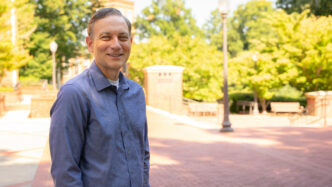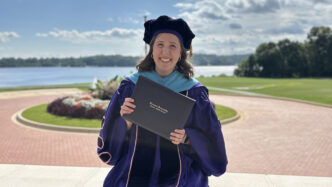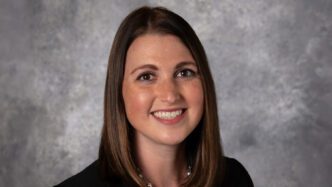

J. Kessa Roberts joins the Clemson University College of Education faculty ranks this fall, bringing her diverse career experiences and an extensive background in rural education research. Roberts’ backgrounds as a school psychologist and a prolific academic researcher inform her knowledge of education across multiple contexts and fuel her passion for the work.
Roberts comes to Clemson from Utah State University, where she served as an assistant professor of school leadership and affiliate faculty in cultural studies. Roberts was not on the job market, but colleagues at Clemson and the College of Education’s growing reputation in the rural education space helped to attract her to an open position with the college.
“I had so many trusted colleagues who spoke highly of Clemson and were hired with a rural focus,” Roberts said. “Increasingly at conferences and in the research space, Clemson was quickly becoming known as a ‘rural powerhouse.’ My on-campus interview only proved that to be true and helped show me this was the correct move.”
That on-campus interview doubled as Roberts’ first ever visit to campus; she found a warm welcome and faculty with an authentic interest in her background and possible future collaborations. She felt she was joining a college and university community invested in rural education. She was touched by how many faculty and staff members met with her during a busy exam week.
Roberts said she saw an ideal mix of theory and practical application in her future colleagues, which is crucial to her because of her history working as a K-12 school psychologist. She started her career in rural Pennsylvania, often stepping up to serve in other roles – social worker, assistant principal, MTSS (multi-tiered system of support) director – that were absent in the district due to limitations imposed by geography, budget or both. While these demands were challenging, they afforded her invaluable leadership experiences such as developing school and district initiatives, creating policy and delivering professional development to her colleagues.
After growing frustrated with “urban-normative” policy assumptions that rarely applied in the settings she knew, Roberts responded to others’ encouragement to “go fix it.” Pursuing a Ph.D. was the first step in that journey.
“I felt called to higher education and education leadership and policy because of what I continually saw as a mismatch between the needs of rural communities and the federal and state policies at play,” Roberts said. “I fell in love with teaching and research early in my doctoral studies, and I am really passionate about preparing future leaders who have an ideal vision of schooling but can balance it with real-world constraints.”
According to Kristin M. Gehsmann, dean of the College of Education, Roberts’ career transition from school psychologist to rural education research leader will bring valuable insight to students and faculty members in the College and campus community.
“Dr. Roberts is one of the leading voices in rural education, contributing to the body of research on rural education and advocating for people and places often left out of public discourse and policy,” Gehsmann said. “We are thrilled to have her join our faculty, and we know her skills in outreach and service will contribute to Clemson University’s land-grant mission in South Carolina and beyond.”
At the request of the National Rural Education Association (NREA), Roberts partnered with a team of five other researchers at universities and research organizations around the country to create a national research agenda for the next five years of rural education research. This project uses data from various stakeholders gathered through surveys, interviews and focus groups to guide educational researchers on areas of need for rural education research.
Among its output, the research team produced two peer-reviewed publications, one of which earned the National Rural Education Association’s Best Research Paper of the Year award. The second was published in a top-tier education journal, the Peabody Journal of Education.
Roberts has contributed to multiple publications involved in rural education, such as the Journal of Research in Rural Education, The Rural Educator and Rural Sociology.
Her research has also yielded more creative products, including those usually reserved for superheroes. Roberts was part of a team of researchers that worked with an artist and an artist-scholar to translate their research findings into “Uprooted: Voices of Student Homelessness,” a comic book that illustrates the diversity of student homelessness. The comic – funded by the Spencer Foundation – is intended to be used as a professional development tool by schools and community service providers to improve implementation of federal education homelessness policy, as well as an advocacy tool to highlight student needs and policy implications.
Roberts earned a Ph.D. in educational policy from Ohio State University, a master’s degree in psychology from Millersville University and a bachelor’s degree in psychology from the Templeton Honors College at Eastern University.