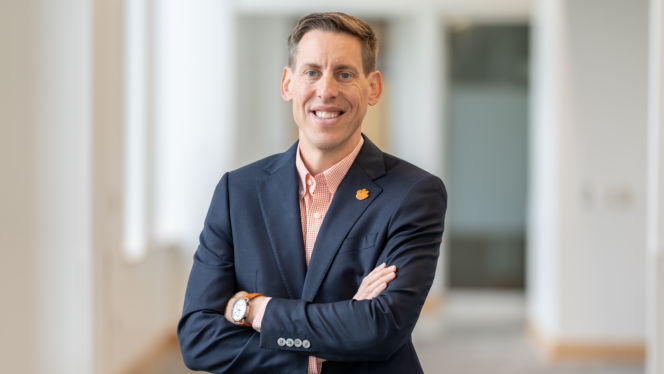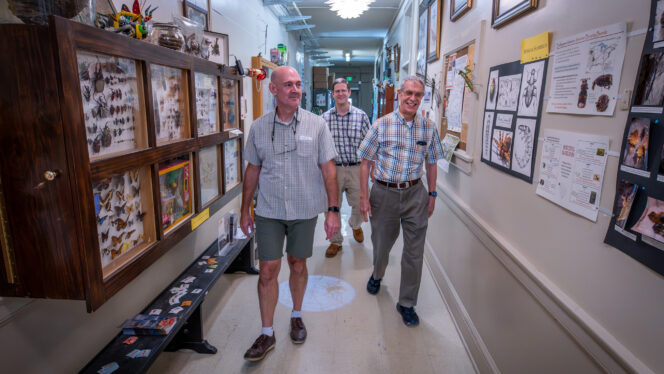

Clemson University Clinical Professor Gary Shiffman believed that his time in Washington, D.C. had come to an end.
He began his career in the military, worked overseas and in the Pentagon, served as a national security adviser in the U.S. Senate and taught national security and economics at Georgetown University for 20 years. After moving to Greenville and beginning his role in the John E. Walker Department of Economics, housed within the Wilbur O. and Ann Powers College of Business (PCoB), around five years ago, he believed that chapter had closed.
Then the Treasury Department called.
In November 2025, the Treasury asked Shiffman to return to Washington as a national security economist. After discussing the opportunity with his wife and Clemson leaders, the couple rented an apartment in the city and Shiffman spent the Spring semester of 2026 working in the Treasury Building.
For about four months, from January through May, he developed what he described as an intellectual framework, or scaffolding, for economic security policy for today’s geopolitics. His work addresses the pursuit of economic growth while protecting the foundations that make growth possible.
An economic security framework
At the Treasury, Shiffman applied a career spent at the intersection of economics and national security to a term that can mean different things to different people.
His framework joined two goals often discussed separately. The country wants a strong, growing economy with jobs, wages and rising prosperity. It also wants security in a world shaped by conflict, competitors, adversaries and allies. Neither goal can be treated as an afterthought.
Artificial intelligence makes the relationship especially visible.
“Artificial intelligence is both a threat and an opportunity,” Shiffman said.
AI may strengthen cybersecurity and support manufacturing. It may also cause unintended damage, give criminals new capacity and deepen strategic competition. The technology depends on critical minerals, semiconductors and specialized manufacturing processes spread across a global supply chain.
Shiffman pointed to those dependencies as an economic security concern. If AI helps drive U.S. growth, the country must also consider the resilience of access to the materials, chips and the manufacturing capacity beneath it.
The tension is just as immediate for businesses.
According to Shiffman, companies know competitors are adopting AI, but some are concerned about its adoption. For companies delaying AI adoption, Shiffman believes waiting may carry its own cost. However, he also believes that moving too quickly to adopt AI can expose an organization to flawed systems, poor decisions and risks it has not prepared to manage.
Shiffman described the bind in blunt terms: “A company may adopt AI badly and suffer the consequences or refuse to adopt it while competitors move ahead.”
The same pressure exists in cybersecurity. Criminal organizations can use generative AI to make convincing calls at a scale that once required large call centers. They can imitate familiar voices and contact thousands of potential victims. Organizations trying to stop those crimes cannot respond with older tools alone.
“The criminals are thrilled that we’re considering slowing down the adoption of AI,” Shiffman said.
That does not make speed sufficient. Risk sits on both sides of the decision. “The cost of adopting badly and the cost of not adopting belong in the same sentence,” said Shiffman
“We have to adopt AI as fast as possible,” he said. “And we also have to be really careful about adopting AI because a lot of things can go wrong.”
“There is no easy button here.”
A role for Clemson
Shiffman sees a role for Clemson in that difficult middle.
Clemson is not building frontier AI models, he said. Those efforts require billion-dollar investments. He believes the University’s comparative advantage lies in applying AI in fields that already matter to South Carolina, including advanced manufacturing, materials science and logistics.
That approach can connect academic expertise with companies facing practical decisions and place students inside problems that do not have clean technical answers.
“We need to get our students into the middle of that,” Shiffman said.
He has begun doing so through a separate Clemson effort that predates his Treasury assignment. Shiffman is working with engineering professor Carrie Russell and industry organizations on AI adoption and optimization. The collaboration brings business and engineering perspectives together.
“This is not an engineering task, and it’s not a business task,” he said. “It’s both. The right way to do this is with multiple disciplines.”
The work is entering its second year. Shiffman said participating companies in Fall 2026 include BMW, Current Lighting and Axio, LLC. He described these companies as excited to give challenging problems to Clemson related to AI optimization in manufacturing.
“We are working with corporations that are in our ecosystem right now on AI adoption so that they adopt and use AI smartly and safely,” said Shiffman.
For Shiffman, that is where the University can add value. Companies are under pressure to move, but they should not have to solve every technical and organizational question alone. Clemson can bring faculty, students and industry partners together, create room for academic review and experimentation and help organizations take deliberate steps.
“We’ve got advanced manufacturing. We’ve got material sciences. We’ve got logistics,” Shiffman said. “We need to lean into these industries and partner with these industries so that we understand how AI and our industries interact from the academic perspective, but also from the practitioner perspective.”
Separate work, shared questions
While Shiffman’s Treasury assignment and Clemson work remain separate, both experiences point to a common challenge: Progress depends on what AI can do, whether institutions and corporations can determine where it belongs, how it can be used and what safeguards it requires.
Shiffman wants students to be prepared to work across disciplines, understand why an organization is using the technology and help manage the risks that accompany its adoption and optimization.
The task, as Shiffman sees it, is to move as fast as the moment demands and as carefully as the risks require.