
By any measure, Colonel Christopher Kiss operates at a scale few architects encounter.
From his role at the Defense Health Agency, he oversees a $54.5 billion global health care facility portfolio, more than 80 million square feet of hospitals, clinics and medical infrastructure serving millions of service members and their families. But his path to that responsibility did not begin with large-scale projects or senior leadership.
It began with a teacher’s suggestion.
From geometry class to global impact
“I barely knew what an architect was,” Kiss said.
As a high school student, he excelled in geometry but was more interested in sketching than solving equations. A teacher recognized his combination of analytical and creative strengths and suggested architecture as a career path.
That early encouragement set the foundation, but his path was not linear.
Kiss entered the Army as a combat engineer officer but realized he was not using his architecture training. He transferred to the Medical Service Corps to focus on health facility planning and design.
At first, the move was practical.
“The only reason why I transferred was to get my license in architecture,” he said.
His perspective shifted once he began working in health care environments.
“Once I got into health care, that became one of the most important and exciting parts of my architectural interest,” he said.
Over the next two decades, Kiss built a career overseeing design and construction of military health care facilities around the world.
Why Clemson
When Kiss considered pursuing a doctoral degree, he was already managing complex military hospital projects in the Army health planning system. He wanted a program that focused specifically on health care design.
“I spent a really long time searching for which program would really focus on health system design,” he said.
That search led him to Clemson University’s Ph.D. program in Design and the Built Environment.
A visit to campus and a meeting with faculty member Dina Battisto helped confirm the decision.
“Our interests in research aligned,” Kiss said. “It’s really important that there’s a connection with your chair.”
Clemson also provided an environment that supported his family.
At the time, the Kiss family were raising two young children. He said Clemson’s community offered a balance between academic rigor and quality of life.
“It checked all the boxes,” he said.
He was an adult leader in Scouting activities, and participated in local youth sports and often found himself alongside faculty members in everyday community settings.
“It was a great, small-town experience,” he said.
A different way of thinking
Kiss said the Clemson experience changed how he approaches decision-making.
“The biggest thing … is it changed how I think about things,” he said.
Before Clemson, he used data to inform decisions. Afterward, he focused more on how to generate the right data when none existed.
“If I don’t have the information needed to inform a decision, I spend more time thinking about how I can create that data,” he said.
That shift has influenced his approach to planning and project development across the Military Health System.
It also changed how he views building codes, which the Department of War has its own codes. Rather than treating codes as fixed, he began questioning whether they support performance and innovation.
“I now ask why some of them are set up the way they are,” he said.
That perspective has contributed to updates in Department of War building codes to better support health care delivery and innovation.
Learning across generations
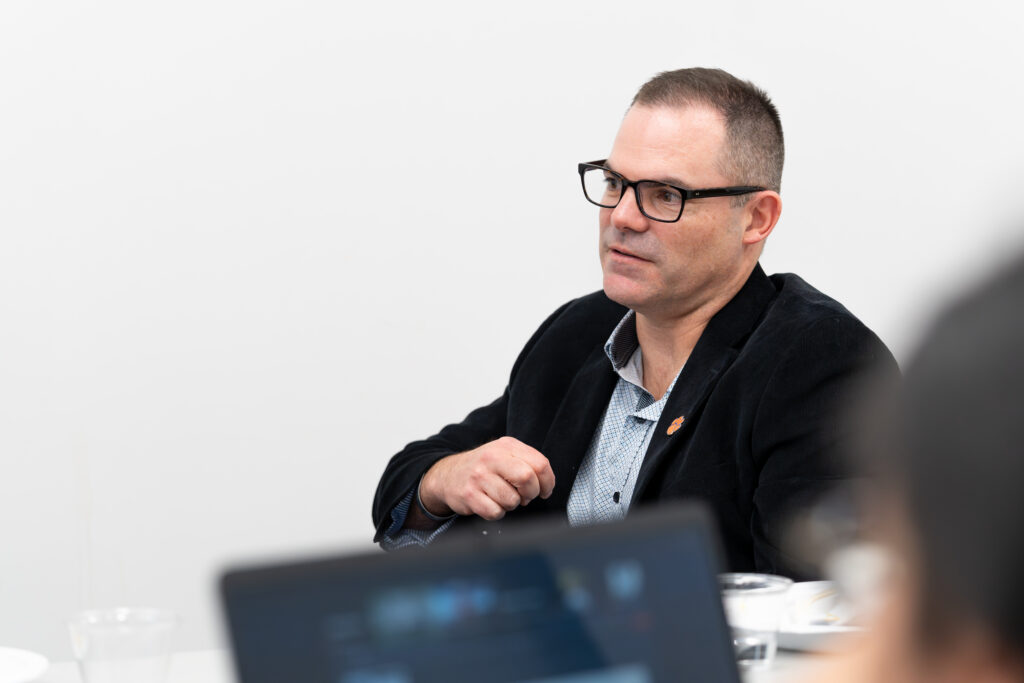
One of Kiss’ most memorable experiences at Clemson came through collaboration with students from different stages of their careers.
In a health care planning course, he worked alongside master’s students significantly younger than he was.
“They were so sharp and skilled,” he said. “It was humbling.”
The experience reinforced the importance of continuous learning, a principle he continues to apply in leadership roles.
Leading the Military Health System
Kiss now serves as the Director of Facilities Enterprise for the Defense Health Agency, overseeing the full life cycle of military health facilities.
He leads a workforce of almost 300 professionals responsible for planning, construction, operations and maintenance across a global portfolio. That portfolio includes:
- 45 hospitals
- 525 medical clinics
- 175 dental clinics
- Hundreds of additional facilities worldwide
The Facilities Enterprise manages billions of dollars in construction, modernization and sustainment efforts while advising federal leaders on infrastructure investment.
The role requires both technical expertise and strategic leadership.
The architect’s role
Kiss said architects play a critical role in coordinating complex systems within health care environments.
Hospitals require collaboration across multiple disciplines, including mechanical, electrical, structural and information technology systems.
“An architect isn’t supposed to know everything,” he said. “But we should know enough to coordinate it all.”
That systems-based perspective reflects the approach he developed during his time at Clemson.
A message for future designers
Kiss said careers in military health facility design are often overlooked.
“There are very few architects in the military,” he said. “Many don’t even know this career field exists.”
He encourages students to explore the field, noting that the military often provides significant responsibility early in a career.
“It’s a lot of responsibility,” he said. “But it’s also a lot of opportunity.”
Designing what matters
Kiss’ career spans architecture, engineering coordination and large-scale systems leadership. At its core, he said, the work is about improving environments that support both health and combat readiness.
His time at Clemson played a key role in that journey.
The program provided not only technical knowledge, but also a framework for asking questions, evaluating data and improving systems.
That perspective continues to guide his work today — designing and managing facilities that serve millions of service members, military retirees and their families around the world.