By Drew Henry
As Clemson University prepares to host the 40th Annual Clemson University Global Tire Conference in April 2026, the milestone arrives at a pivotal moment for the mobility sector. The conference has long served as a space where industry leaders gather to share insights, anticipate change and shape the future of tire design, manufacturing and performance. This year, that legacy expands further through a new collaboration with Clemson’s MBA Program and the Clemson Center for Corporate Learning. Together, they are advancing the University’s Fiercely Forward mission to ignite student potential, deepen industry partnerships and accelerate real-world innovation.
The Clemson University Global Tire Conference was established at a time when the University’s textile expertise supported a growing global demand for polyester and synthetic fiber integration in tires. From those origins, the conference has evolved to reflect the sweeping technological and environmental shifts transforming the industry.
Former head of Michelin Americas R&D and Adjunct Instructor Prashant Prabhu said the conference has earned its reputation by continually adapting alongside the sector it serves.
“The Clemson University Global Tire Conference has distinguished itself by its ability to adapt and evolve with changes in the tire industry,” Prabhu said. “The enduring themes that guide the conference enable it to offer interested participants from the tire and related industries, academia and regulatory bodies a big tent under which the exchange of ideas can contribute to continued progress in the broad field of mobility.”
That spirit of progress aligns directly with the goals of the Center for Corporate Learning, which presents the conference each year in partnership with leading tire and auxiliary industry companies. The center’s mission is to enhance leadership and strengthen industries through high-impact professional education.
Jeremy Kröber, Director of Operations for the Center for Corporate Learning, said the conference is an example of academic collaboration at its best.
“The Center for Corporate Learning exists to strengthen leadership, sharpen skills and elevate entire industries,” Kröber said. “And the Clemson University Global Tire Conference demonstrates how education and industry can come together to shape the future of mobility and manufacturing.”
The three-day event brings together experts in engineering, materials science, sustainability, vehicle automation, manufacturing and regulatory affairs. It remains one of the few conferences where C-level leaders, researchers, suppliers and students can come together to explore how tires shape the evolving mobility landscape. As the industry confronts challenges such as electrification, sustainability standards, and supply chain shifts, the 40th anniversary conference is expected to spark timely conversations about the road ahead, building on last year’s deployment.
For David Shelton, Director of Industry Relations at Giti Tire, the conference represents a powerful gathering point for the global tire community.
“For 40 years, the Clemson University Global Tire Conference has been known for bringing together all the factors influencing the moment that the rubber meets the road,” Shelton said. “Here at this annual gathering, one can find the collective of all the people and enterprises, present and future, which help shape and advance tires and technology. Today, where virtual meetings are the norm, this is the conference where it pays to be there, face to face.”
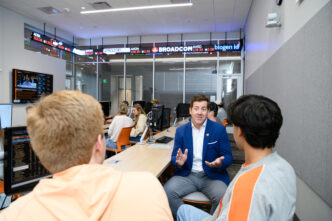
This year, the “rubber meets the road” in another meaningful way. In Clemson’s MBA Program, lecturer Ankita Bakre introduced a new experiential consulting project in her Advanced Marketing Strategy course that tasks students with developing a comprehensive marketing strategy and go-to-market plan for a new EV-focused tire line. The project mirrors the pressures and decision-making challenges real companies face as they adapt to a rapidly changing automotive landscape, one defined by high sustainability expectations and new consumer behaviors.
“Unlocking student potential through immersive, real-world learning is a core priority at Clemson,” Bakre said. “I firmly believe that leadership capabilities are best developed through hands-on experience. This experiential group project meaningfully elevated student learning.”
The top-performing student teams will present their work at the conference in April, offering students unprecedented visibility and the opportunity to engage directly with industry leaders. Bakre said the partnership is perfectly aligned with Clemson’s commitment to bridging academic excellence with real-world relevance.
“Partnering with the Clemson Center for Corporate Learning and the Clemson University Global Tire Conference will help strengthen this experience further, giving students the opportunity to contribute insights with industry relevance,” she said.
That intersection of education, innovation and industry collaboration reflects the broader mission behind Clemson’s Fiercely Forward campaign. Designed to activate changemakers, cultivate future leaders and fuel purpose-driven innovation, the campaign aligns closely with Clemson’s Automotive Engineering program’s mobility-focused initiatives. Venkat N. Krovi, the Michelin SmartState Chair Professor of Vehicle Automation, said Clemson’s emphasis on experiential learning and transdisciplinary collaboration positions students to thrive in a rapidly evolving mobility ecosystem.
“Innovation in mobility has always focused on getting the right person or part to the right place at the right time in ever more efficient and sustainable ways,” Krovi said. “Automated, connected, electrified and shared technologies are rapidly reshaping the automotive landscape, and Clemson University International Center for Automotive Research is at the forefront. Our world-renowned technical programs, with the emphasis on experiential learning, are helping shape the next generation of mobility-industry leaders with both the technical expertise and the business acumen to thrive.”
Krovi said the partnership between CU-ICAR, the Center for Corporate Learning and the Clemson University Global Tire Conference gives students direct exposure to the opportunities and challenges driving future mobility systems.
Behind the scenes, the 40th anniversary event is also guided by the leadership and enthusiasm of the conference coordination team.
Lydia Thomas, Clemson University Global Tire Conference Coordinator, said the experience has been eye-opening.
“I am amazed at how much there is to learn about the industry, and helping manage the tire conference has been an honor,” Thomas said. “Greenville is a great place of innovation and the perfect place to bring together leaders, manufacturers and students. We have great things planned for the 40th year.”
With four decades of history and an expanded focus on sustainability, electrification and innovation, the 2026 conference promises to be one of the most significant gatherings yet. Registrants can look forward to presentations from top researchers and industry leaders, networking opportunities, panel discussions and emerging insights shaping the tire industry’s next era.
As Clemson continues to forge ahead with purpose and innovation, the Clemson University Global Tire Conference stands as a testament to what can happen when academia and industry unite to create meaningful change.
The 40th Annual Clemson University Global Tire Conference will take place April 21–23, 2026, in Greenville, South Carolina.
To register, submit a paper or explore sponsorship opportunities, visit the conference website at clemsontireconference.com. For updates, follow along on Facebook and LinkedIn.