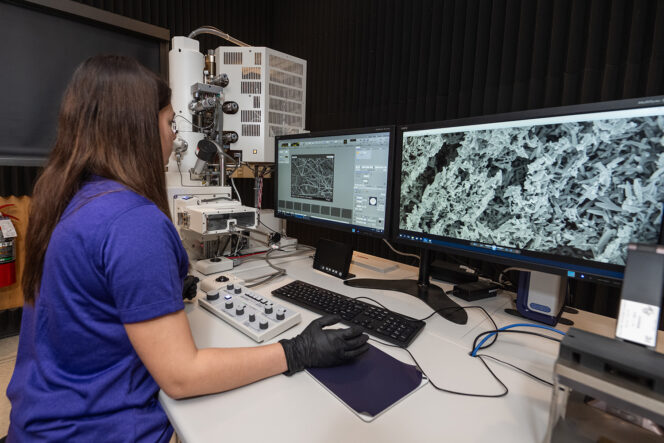

Clemson University physics major Drew Hodges is exploring the intersection of space research and nuclear engineering — work that recently earned him a 2026 Astronaut Scholarship.
The award provides $15,000 in financial support, access to industry mentors and an opportunity to present his research in atmospheric and space physics at the foundation’s national symposium in Houston this summer.
“I am very excited about the mentorship and alumni opportunities associated with this award,” said Hodges. “The Astronaut Scholarship is unique in that it was created by NASA astronauts and offers special opportunities to engage with current and former astronauts, as well as other scholars.”
Launching research
Almost four years ago, Hodges watched the first images from the James Webb Space Telescope livestreamed alongside students and professors from around the world, while also participating in scientific research for the first time through a summer astrophysics program at the University of North Carolina at Chapel Hill. He credits those experiences with sparking his interest in a research career and solidifying his decision to major in physics in college.
His Clemson research began before his first official day on campus through the Honors College’s EUREKA! program. He worked in a physics-based deep learning lab for computer vision led by Nianyi Li, an assistant professor in Clemson’s School of Computing.
That fall, Hodges reached out to Stephen Kaeppler, an associate professor of physics and astronomy, about joining his atmospheric physics lab. They have worked together ever since, which Hodges said helped him build the technical understanding and maturity needed to pursue a career in research.
For his part, Kaeppler was quickly impressed by Hodges’ initiative and ability to work independently.
“I assigned Drew a computational project using the nudged elastic band method to trace ionospheric rays for high-frequency radio waves,” said Kaeppler. “Drew made rapid and significant progress on this project by not only getting the code running but also producing some initial results within only a couple of weeks of work.”
Kaeppler said Hodges even taught himself Lagrangian mechanics — a method physicists use to model motion and energy — to better understand the project’s computational approach.
Building NASA connections
Hodges has also worked with NASA, interning at the Goddard Space Flight Center’s Climate and Radiation Laboratory. He worked with NASA scientists and engineers to improve the functionality of advanced infrared cameras, with applications focused on airborne imaging of clouds, wildfires and other phenomena.
“My NASA internship exposed me to the nitty-gritty aspects of experimental science and the importance of hands-on work with real systems,” said Hodges.
He carried that experience into Clemson’s student spaceflight projects, joining a team developing a payload for a NASA Student Sounding Rocket mission. Hodges traveled to Norway in November to assist with payload integration and final testing before launch, an experience that inspired him to continue working alongside other Clemson students on future spaceflight research projects.
That interest in collaborative spaceflight research now has Hodges leading a student team developing several instruments, including a radiation sensor, for the upcoming 2026 RockSat-X mission, scheduled to launch from NASA’s Wallops Flight Facility in Virginia this June.
Expanding horizons
Hodges is working to increase the visibility of his field on campus, co-founding the Clemson chapter of the American Nuclear Society and serving as its treasurer. The group has organized career panels with industry experts, tours of local nuclear facilities and community outreach events.
Hodges said that his Clemson coursework, his research experiences, internships and campus engagement have all helped him understand how nuclear engineering and radio technologies can be applied to medicine, agriculture and space exploration.
“I first became interested in nuclear engineering as a discipline supporting a clean and abundant energy future,” said Hodges. “I hope to combine my experiences to pursue a career in the emerging frontier where nuclear engineering and science exploration meet.”
Students interested in the Astronaut Scholarship or other nationally competitive programs should contact the Office of Major Fellowships at 864-656-9704 or fellowships@clemson.edu.