Chris Spellman has worked in student leadership development for years. Through his own undergraduate experience at Old Dominion University in Virginia, as a graduate assistant and full-time staff member in Clemson’s Division of Student Affairs — or internship experiences in between — he has long focused on one straightforward goal: building tomorrow’s leaders.
Now, he’s taking it a step further by bringing together faculty and staff educators from across Clemson to establish a community of practice. Over the past year, Spellman took to heart the encouragement of his boss — Kate Radford, executive director of the Center for Student Leadership and Engagement (CSLE) — and created a process for collecting shared resources and best practices from a variety of campus partners.
“I’ve had a desire to prepare the next generation of global leaders,” says Spellman, a former graduate assistant with Residential Learning who earned a full-time role with CSLE in 2022. “That vision is inclusive of so much more than me. We know leadership development occurs all over campus, so (we began asking) how we can support or boost those other experiences and figure out a way to holistically see how different groups approach this critical topic?”
To answer that question, Spellman rolled up his sleeves and went to work. One by one, he identified partners across campus to meet with. He listened intently, getting a better idea of the enormity of leadership experiences available to students on campus. Moreover, he began to outline four buckets through which student leadership opportunities are best categorized:
- Credit
- Programs and Training
- Mentorship
- Leadership in Action
From his initial meetings, Spellman developed a centralized repository of student leadership experiences that fit into the four buckets — either a course, program or training where leadership competence is an expressed learning outcome.
Among those opportunities are some of Clemson’s most recognizable leadership experiences. Students develop skills through programs such as the ACC Leadership Symposium, Call Me MiSTER, Breakthrough Scholars and P.A.W. Journey — just to name a few. Together, they illustrate the wide variety of ways students can grow as leaders across the University.
In all, Spellman found 116 total leadership experiences, including 71 from Clemson’s academic colleges. Many originate in Student Affairs, Athletics, Undergraduate Learning and other divisions or units. The bulk, though, come from within the Wilbur O. and Ann Powers College of Business.
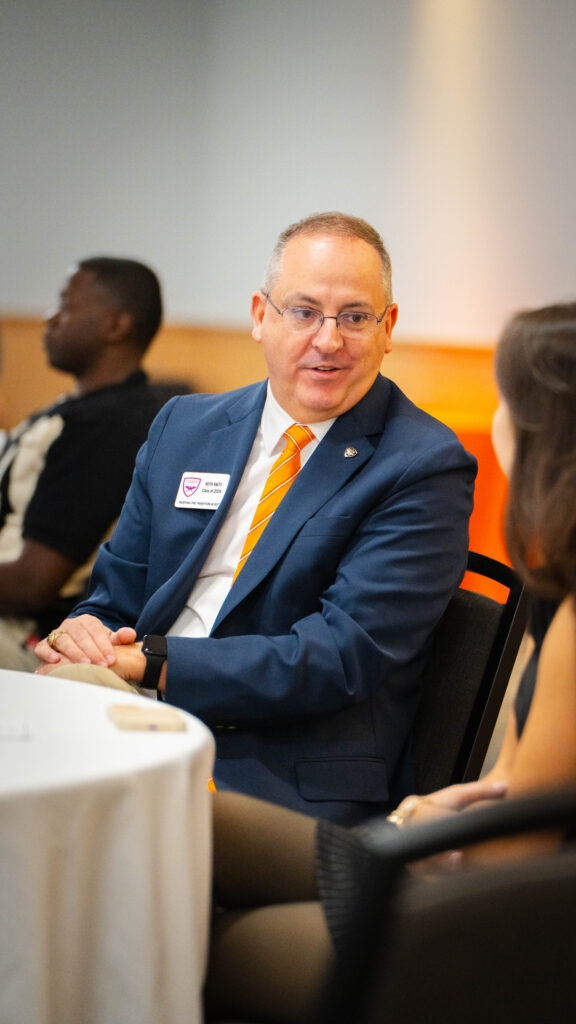
Retired U.S. Air Force colonel Keith Balts serves as the director of the college’s Leadership Signature Program, a five-semester program based in large part on ROTC.
“It’s been tremendously fulfilling to provide a space for business undergraduates to explore and experience leadership development in a highly interactive environment,” Balts says. “Giving students a chance to accelerate their development will pay huge dividends with their employers and those they lead in the future.”
Balts was one of many faculty and staff who came together in Summer 2025 as part of this new community of practice, where Spellman led an initial two-hour session. The group then met on a quarterly basis in Hendrix Student Center in 90-minute periods.
Spellman outlined four goals for the community of practice. First, he wanted to map leadership efforts across Clemson’s enterprise. Second, he aspired to fill gaps and reduce any duplication of efforts. Third, encourage the exchange of ideas and insights into what others do within their respective curriculum, training or assessment. And finally, and most importantly, to better tell the story of how Clemson is building better leaders.
“The distinction of this group was having a tangible end goal that was constantly repeated, telling our University’s story of student leadership development,” Spellman says. “Because of that, people had a greater desire to take time out of their busy schedules to proudly say, ‘I’m contributing to this specific goal.’”
Balts is quick to credit Spellman for his facilitation of the community of practice and feels his own participation in it offered valuable insight into what colleagues are doing.
“Having a local forum will help focus our efforts and provide more frequent, Clemson-specific touchpoints,” he says. “Coming together for relationship-building, idea sharing and problem-solving through diverse programs has been beneficial for all involved.”

Currently, Spellman is working with Marketing and Communications to populate an interactive page on the University’s website, so students can easily track all of the leadership development opportunities available to them in one place. He’s also set up each of the quarterly meeting dates and times for 2026-27. Eventually, he hopes to scale the community of practice from a resource maximization group to a leadership advocacy group.
“We want to be a best college for future leaders in action, not just in name,” he says, referring to recognition Clemson earned in recent years from Time magazine. “This community is a great first step in making sure we show how the resources poured into leadership programming benefit our students in a measurable way.”