

Plutonium is supposed to stay put. For decades, scientific models have assumed that this heavy metal will form plutonium dioxide in the soil, becoming insoluble — meaning it shouldn’t dissolve into or spread through groundwater.
But field data tells a different story. Plutonium has been detected in groundwater kilometers away from underground nuclear test sites and waste storage areas, indicating that current models underestimate its mobility.

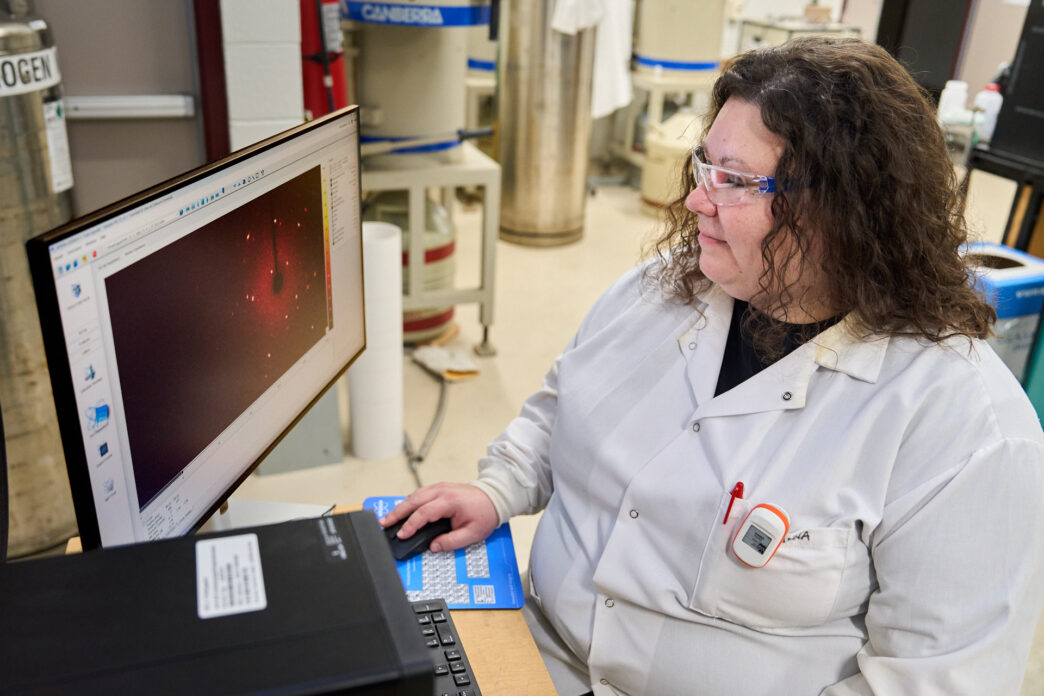
Shanna Estes, an assistant professor in the Clemson University Department of Chemistry, has received a prestigious Early Career Research Program award from the U.S. Department of Energy. Her research will examine how small molecular fragments of plutonium dioxide behave in water and whether specific changes to those fragments make plutonium more likely to move through the environment.
The awards are designed to bolster the nation’s scientific workforce by supporting exceptional researchers during crucial early career years when many scientists do their most formative work.
“Shanna has been a great addition to our department, and I am excited to see her research program continue to develop. This award is a testament to her strong start in her independent career and underscores her position as an emerging leader in the field of aqueous plutonium chemistry,” said Daniel Whitehead, Department of Chemistry chair.
Estes will receive nearly $1.3 million over five years for her project.

“Plutonium is one of the most complex elements on the periodic table,” Estes said. “If we can understand how plutonium behaves in water, we can improve predictions for how it might move in the environment.”
One challenge to predicting plutonium behavior in water includes plutonium’s tendency to form products that are difficult to characterize. To circumvent this, Estes’ lab will use controlled syntheses to create and isolate tiny, well-defined plutonium-oxygen clusters that mirror the atomic arrangement of plutonium dioxide. The team will study how easily the plutonium in these clusters changes its oxidation state — gaining or losing electrons. Changes in plutonium oxidation state are expected to control the stability of the clusters and whether they break apart or stay suspended.
Unique set of tools
To study that behavior, the researchers will use a unique suite of advanced tools, including electrochemistry to drive redox reactions and X-ray absorption spectroscopy at national synchrotron facilities to determine how the local structure around plutonium atoms shifts in real time.
The lab will work primarily with plutonium-242, a radioactive isotope with a half-life of about 370,000 years.
Clemson is one of only a handful of U.S. universities that have the capability and expertise to safely handle the quantities and isotopes of plutonium needed for experiments that enable molecular-level characterization.
“Although plutonium-242 is more radioactive than natural uranium, Clemson researchers have been working with radioactive elements beyond uranium for quite a long time. I’m certainly not the first. We have the expertise to understand and do this work safely,” Estes said.
The project will support two graduate students and a postdoctoral researcher specializing in X-ray spectroscopy.

Translatable research
Beyond its environmental significance, the work also contributes to the DOE’s broader goal of unraveling the mysteries of actinides, the family of heavy elements that includes uranium, neptunium and americium. By studying electron transfer in these discrete plutonium-oxygen clusters, the behavior of 5f electrons — the electrons that give actinides their unusual chemistry — is better understood, allowing this research to translate beyond plutonium, Estes said.
“I was so thrilled to get the award,” she said. “It means the DOE believes in the science we’re doing and our ability to do the work and do it well.”
The DOE has funded these early career awards since 2010.