
A Clemson University bioengineering team is seeking patent protection and exploring business opportunities after a device it created as part of a class project won a $15,000 national prize.
The LidoSound is designed to reduce the pain of intrauterine device (IUD) insertion. It was a senior design project last academic year for five bioengineering majors, who all graduated in May and are now in medical school, pursuing a Ph.D. or working in industry.
It was the latest Clemson victory in the annual DEBUT Challenge, sponsored by National Institute of Biomedical Imaging and Bioengineering (NIBIB).
The Clemson team won in a category called the Office of Research on Women’s Health Technologies to Improve the Health of Women Prize.
The team consists of Jade Bowers, Landon Ethredge, Samantha McNabb, Audreanna Miserendino and Andrew Polson.
Their clinical collaborator was Dr. Christian Cook of Novant Health East Cooper OB/GYN in Mount Pleasant. Faculty advisors were: Tyler Harvey, senior lecturer in bioengineering; Vishal Thomas, lecturer in bioengineering and general engineering; and John DesJardins, the Hambright Distinguished Professor in Engineering Leadership.
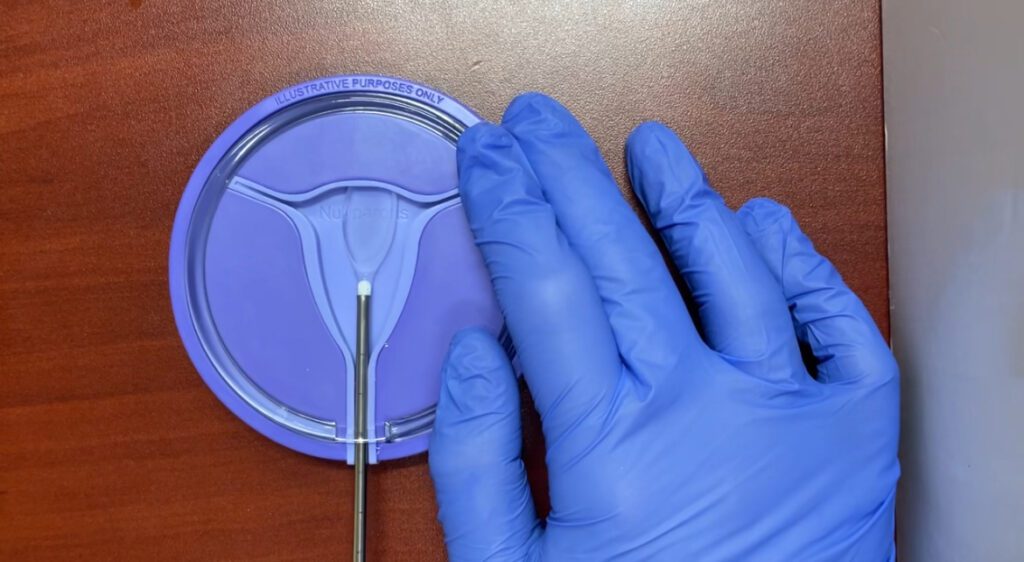
The team created the LidoSound by modifying a uterine sound, a common clinical tool used to measure uterine depth before inserting an IUD.
But the LidoSound does more, acting as a delivery system for lidocaine anesthetic. As the device is withdrawn, the clinician pushes a sliding mechanism to dispense lidocaine through small holes at the tip, numbing the uterus and cervix.
This step is aimed at addressing the sharp pain patients often feel at the moment the IUD deploys inside the uterus. The team believes the same approach could also improve other procedures, such as endometrial biopsies and dilation and curettage.
Behind the design was nearly a year of brainstorming, trial and error, and long hours in a Rhodes Engineering Research Center conference room. The students started with prototypes made of pipe cleaners, straws and whatever else was handy to work out their ideas before moving on to refined versions.

But what began as a senior design project evolved into a device with market potential and momentum well beyond their original expectations. The team found that by 2032 the IUD market is expected to reach over 10 billion with a projected growth rate of 9.7%.
The students credit Dr. Cook for helping them focus on the biggest source of pain and their faculty advisors for pushing them to think not only about engineering but also about regulatory pathways, market needs and the realities of product design.
Along the way, they learned how to advocate for patients, how to simplify solutions to complex problems, and how to operate as a small start-up team under pressure.
DEBUT is an acronym for Design by Biomedical Undergraduate Teams. This year’s challenge drew a record 123 teams representing 534 students from 67 universities in 24 states. Eleven top prizes were awarded by NIH and three by its partner VentureWell, along with five honorable mentions.
Clemson has built a strong track record in national bioengineering competitions. Since 2012, Clemson bioengineering teams have received NIH prizes 15 times and about $200,000 in design awards overall, in addition to top finishes in contests such as the Collegiate Inventors Competition, the ACC InVenture Prize and the Johns Hopkins Healthcare Design Competition.
The LidoSound previously won first place in the SPARK Challenge and second place in the Brook T. Smith LaunchPad Liftoff, both Clemson competitions. In all, the device has won the team $20,000 in prize money.
The team is now weighing whether to launch a company or work with manufacturers to bring the device to market.
Here is what each team member had to say about the LidoSound project:
Jade Bowers, surgical neurophysiologist at SpecialtyCare:
“Sometimes solutions don’t have to be an overly complicated idea. We were told many times from people at competitions that they loved the simplicity of our solution. We modified an existing device to address a problem that had been overlooked. Sometimes the simplest answer is the best.”
Landon Ethredge, first-year medical student at the Medical University of South Carolina in Charleston:
“I wasn’t expecting to work in women’s health for my senior design project, but it opened my eyes to how wide open the field is for innovation. Learning what goes into creating devices for real clinical needs was the most exciting part for me.”
Samantha McNabb, Ph.D. student in biomedical engineering at Wake Forest University School of Medicine:
“What stood out to me was the support from our faculty and TAs. They encouraged us to submit to competitions we might not have entered otherwise, and that made all the difference. It reinforced how invested Clemson is in helping its students succeed.”
Audreanna Miserendino, Ph.D. student in pharmaceutical engineering at the University of North Carolina:
“This project pushed me far beyond the classroom. We weren’t just learning theory—we were making prototypes, filling out FDA paperwork, and tackling real-world problems as if we were running a small company. I learned more by doing than I ever could from lectures alone.”
Andrew Polson, first-year medical student at the Medical University of South Carolina in Charleston:
“This project showed me the importance of advocacy within medicine. It gave me the chance to advocate for women’s health and highlight gaps in care where devices like ours can make a difference. That lesson is going to stick with me throughout my career.”