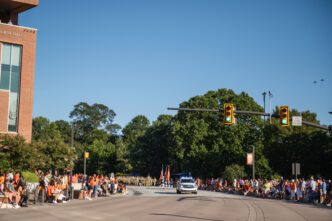

On Friday, Aug. 29, a crowd of campus and community members alike gathered for Clemson’s annual First Friday Parade in anticipation of the home football opener against LSU. They cheered as the procession followed its standard route through the roads of Clemson, never thinking to lift their attention to the sky — until the roar of two F/A-18 C planes blazing overhead captured attention and awe from all.
This flyover was the first in Clemson’s First Friday history, but it was also a last. The stunt was the final flight of United States Marine Corps veteran and Clemson alum Jeff Butler ‘05, signifying the conclusion of an incredible career over the place where it all began.
The military was always in the cards for Butler, whose grandfather and father had both served. Butler had a passion for flying, earning his pilot’s license in high school, and hoped to continue the hobby in his following of the family tradition. Growing up in Burke, Virginia, Butler didn’t know much about Clemson, apart from the recounted experiences of a few friends and his guidance counselor’s encouragement. When he visited for the first time, he thought it was like a “resort on the lake” and concluded it was the place for him.
Clemson offered a strong foundation for Butler to build his dream on. He earned the Clemson Corps scholarship, which waived his out-of-state tuition and allowed him to further his education with less financial stress. He was a member of the Air Force ROTC program for two years, making close friends and gathering valuable experience, before he found himself drawn to the Marine Corps. He enrolled in the Marine Corps Platoon Leaders Class and finished his time at Clemson on track to be a commissioned officer. The Marine Corps offers a guaranteed air contract, giving members the opportunity to register for flight school before even signing the contract to be a Marine, and Butler knew he couldn’t pass up the chance to live his aerial dream and follow in his father’s footsteps.
“I told my dad it would mean more for me to be a Marine than to just be a pilot, and he agreed that it was the right course,” Butler says.
After graduating in 2005, Butler attended The Basic School for six months, where newly commissioned Marine Corps officers develop leadership, knowledge and military skills. Then, he advanced to flight school, where he found himself challenged like never before.
“Every day is a test, but you start to gain more confidence as you pass events,” he says. “The way they push you is so good — you can come in not knowing anything and come out having the confidence to lethally fly an airplane.”
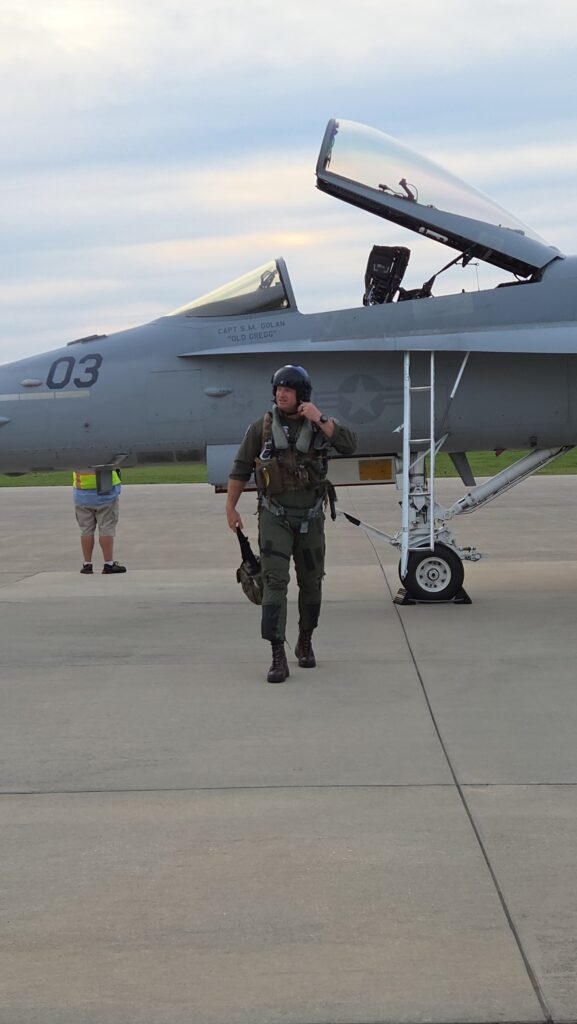
Butler also attended one of the top courses in the Marine Corps — the Marine Division Tactics Course (MDTC), an equivalent to a more familiar “Top Gun” Naval Fighter Weapons School — as well as a high-level Weapons and Tactics Instructor course. In both programs, he was shaped into a top-level mission commander, capable of leading strikes of over 100 planes. The process was brutal — seven days a week of training and work-ups, twelve hour study days on the weekend — and Butler still claims he felt out of place at each evaluation. Nonetheless, he continued to excel, and he found purpose in the demands of his new role.
“They don’t want to make you good just for being good; they want to make you good to teach other pilots and make them better,” Butler says. “Watching the guys I trained go on to be high-level instructors was the proudest part of my career.”
Butler was sent on six full deployments throughout his career, as well as a number of other small assignments, and he has many memorable moments from this time overseas. He will never forget the gratification of watching everything come together to make a mission flow — all of the members of a joint force working in harmony to “change the world,” in his view.
One particular experience stuck out to him — on the 31st Marine expedition to the Pacific, three ships worth of Marines had set a course to Bali for a week and a half of rest and relaxation following a big mission. At the last second, Butler’s ship was rerouted and sent to Saipan, the capital of the Northern Mariana islands, to perform disaster relief in the wake of a typhoon. Many of his fellow soldiers were disappointed, but upon arriving at the site of complete devastation, they recognized their duty and went to work immediately. Butler claims it’s the “dirtiest he’s even been in his life” — manual labor in the stifling humidity, sleeping on the docks for three weeks and even enduring a second typhoon on the island. Despite the less than ideal conditions, Butler identifies the experience as one of the most rewarding of his life and a profound demonstration of the Marines’ commitment to service above all else.
Planning to retire at the beginning of September, Butler wanted his last flight as a Marine to be special, and a return to his roots seemed to be a worthy conclusion. After contact from Clemson Corps Board of Directors member Trey Kennedy ‘08 and acquiring all of the necessary permissions, Butler flew from Fort Worth — where his unit is stationed — to Tennessee, then to Greenville, Anderson and finally, Clemson. Despite fighting the sun in his face the entire way, he was able to conduct a successful flyover at exactly 1000 feet — amazing all of Clemson below.
Funnily enough, Butler claims he was nervous preparing for the flyover, despite having participated in over 20 during his decorated flying career. However, he categorizes the nerves as motivation.
“You want to have events that stress pilots out a little bit and make them put the effort in to do it right,” he says.
As Butler transitions into his next chapter, flying commercial airplanes for Delta Air Lines, the valuable lessons he learned at Clemson and in the Marine Corps will never leave him — lessons of work ethic, perspective and how to make his mark. In reflecting on the impact Clemson University had on his journey, it was no surprise he decided to conclude his career with one final act of service for his alma mater.