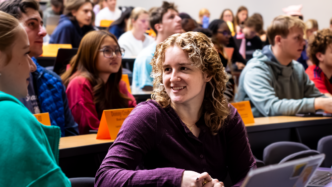

George Fields, Ph.D., lecturer in the Department of Political Science, incorporated a full-scale Constitutional Convention simulation into his American national government course of more than 200 first-year political science students this semester.
Experiential learning is an integral part of Fields’ teaching style, and he uses simulations to connect classroom concepts to the processes that shape government.
“This type of educational simulation allows students to see the Constitution as a document they can engage with today rather than just a piece of history,” said Fields. “The exercise allows students to experience pluralism first-hand and learn how competing perspectives, debate and compromise can contribute to effective government.”
At the beginning of the semester, Fields introduced foundational documents, including the Magna Carta, Declaration of Independence, Articles of Confederation, the Constitution and selected Federalist Papers. Students reviewed the Constitution and considered how an imperfect governing document might be improved.
Then, each student proposed an amendment as a graded assignment. Fields grouped similar proposals into committees and subcommittees, and during the first convention session, subcommittees discussed their ideas and selected amendments to advance to the full committee. After a committee vote, students narrowed 260 proposals to 12 for consideration by the full convention.
Students were randomly assigned to state delegations and elected a convention president to lead the proceedings. They voted on how the simulation would operate, including weighted voting and the thresholds needed to approve individual amendments and ratify the Constitution.
During the full convention sessions, amendment sponsors presented their proposals and answered questions from delegates. Students then debated each measure before delegations conferred and cast their votes. By the end of the convention, seven of the 12 amendments were approved.
For the remainder of the semester, a drafting committee of amendment sponsors, student editors and the convention president will finalize the approved amendments before student delegates vote on whether to ratify the amended Constitution.
Throughout the simulation, students have reflected on their expectations and experiences, with a final reflection planned at the end of the semester. Samuel Broaddus ’29 said the exercise brought the curriculum to life and engaged students in meaningful discussions about real-world topics while strengthening their understanding of how government works.
“During the convention, we applied political theory to modern-day scenarios and topics that matter to us,” said Broaddus. “Serving in leadership roles also strengthened my communication skills and provided opportunities to work with people who held different viewpoints to find common ground. It gave me skills for collaboration that I will use throughout my time at Clemson and provided a deeper understanding of American government.”
In partnership with the South Carolina Forum, Fields plans to refine the simulation over the Spring semester before offering it as a campus-wide engagement opportunity.
Ultimately, Fields said his goal for the experience is to demonstrate the importance of civic engagement and prepare students to contribute to their communities and participate in government throughout their personal and professional lives.
“Dr. Fields’ Constitutional Convention simulation is an excellent example of hands-on learning that engages students in important conversations, promotes collaboration and applies the principles of government in a unique format that resonates with students,” said Joe Ura, chair of the Department of Political Science.
The Department of Political Science is part of the College of Behavioral, Social and Health Sciences. Established in July 2016, CBSHS is a 21st-century, land-grant college that combines work in nine disciplines – communication; nursing; parks, recreation and tourism management; political science; psychology; public health sciences; sociology, anthropology and criminal justice – to further its mission of “building people and communities” in South Carolina and beyond.