With some laboratory tests, two drug molecules can look identical.
They may have the same exact mass and chemical formula, but a slight difference in the way their atoms are arranged can make one compound significantly more potent or produce a different effect altogether.
Some of the modifications are deliberately made to evade existing drug laws or laboratory tests for banned substances. Others are created unintentionally when illicit drugs are manufactured in poorly controlled conditions. And, increasingly, a pill or powder sold as one drug can contain several others, making drug analysis challenging.

“There may be several different drugs. That makes it more challenging to figure out exactly what someone was exposed to and treat. It’s a threat not only to recreational drug users, but also potentially to first responders, hospital staff and clinical care staff,” said Clemson University chemist Chris Chouinard, who specializes in mass spectrometry, an analytical tool that helps scientists determine which chemicals are in a sample.
Chouinard has received a five-year National Science Foundation CAREER grant to develop new methods to distinguish closely related illicit drugs, including fentanyl analogs and other novel psychoactive substances.
Powerful drug
In 2024, synthetic opioids, primarily fentanyl, accounted for 60% of all overdose deaths in the United States, according to the United States Government Accountability Office. Two milligrams of fentanyl, which is the size of a few grains of sand, can cause a lethal overdose.
Fentanyl is about 100 times more potent than morphine, Chouinard said. Some fentanyl analogs are even 10 times more powerful than fentanyl itself.
“There are over 1,000 fentanyl analogs. They are molecules that look very, very similar but can potentially have significantly different biological effects,” he said.
Mass spectrometry helps researchers identify a molecule by measuring its mass.
Telling the difference
“Fentanyl has a much different mass than something like glucose or cocaine,” Chouinard said. “We can take the mass of that molecule and use that to infer what molecule is present in a sample. But one of the challenges we have in analytical chemistry is that we have a lot of molecules that have the exact same weight.”
Molecules with the same weight are known as isomers.
Ion mobility spectrometry, which Chouinard said has especially emerged for drug analysis applications over the last decade, separates ions according to their size, shape and charge.
“Mass spectrometry can tell you very accurately the weight of a molecule. Ion mobility allows us to differentiate a lot of different isomeric molecules,” he said.
As part of the grant of more than $665,000, Chouinard’s lab will study how novel psychoactive substances form ions and how their structures affect the patterns produced during analysis. The project will focus on fentanyl analogs and other drug classes, including nitazenes, benzodiazepines and synthetic cannabinoids.
The research will also examine how differences in instrumentation and operating conditions influence measurements. That could be important for moving ion mobility methods from specialized research settings into clinical and forensic laboratories.
The technology may eventually be useful beyond drug analysis. Chouinard said the methods could be applied to pharmaceutical research and to fields such as metabolomics and exposomics, where scientists analyze complex mixtures of small molecules.

In addition to research, the CAREER award requires an educational component. Through the University’s Creative Inquiry program, Chouinard plans to establish a two-semester course in which undergraduate students will analyze emerging drugs identified by the Center for Forensic Science Research and Education.
The students will characterize the compounds during the first semester and study their simulated metabolism during the second.
Hands-on experience
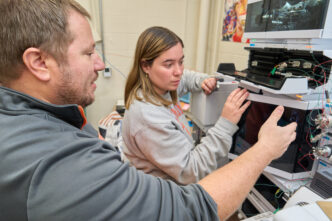
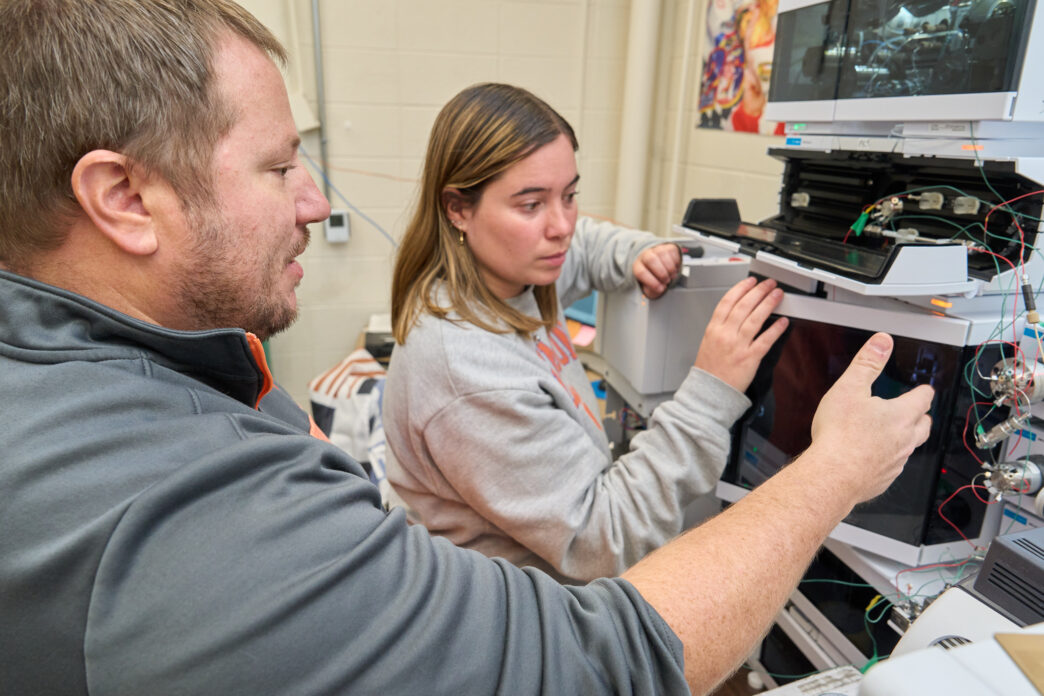
The course will provide hands-on experience with liquid chromatography, high-resolution mass spectrometry, ion mobility, tandem mass spectrometry and data analysis.
Rather than working only with compounds whose characteristics are already known, students will investigate substances that may be newly detected or poorly characterized. Their findings could be added to a public database and shared through conference presentations or scientific publications.
Chouinard also wants to modernize instruction for some chemistry academic labs by incorporating newer mass spectrometry experiments.
The project meets a workforce need as well as a scientific one. Mass spectrometry and liquid chromatography are skills increasingly sought by industry.
“If you put mass spectrometry on your resume and you have real hands-on experience with that, you’re much more hirable,” Chouinard said.
Chouinard said the impact of the research is much broader than illicit drugs.
“The technology and the methods we develop could easily be applied to other types of pharmaceutical analysis,” he said.