The first cohort from a research project designed to improve student achievement among multilingual learners has wrapped up its work with Clemson researchers. Now, educators and caregivers involved in the project have had the time to put tools and best practices to use in the classroom and the living room, respectively, and the results have been overwhelmingly positive.
The Department of Education Office of English Language Acquisition awarded funds to Clemson University researchers in Fall 2022. Researchers sought to increase early multilingual learner instructional capacity in South Carolina by preparing literacy leaders to deliver English for Speakers of Other Languages (ESOL) instruction and support families of multilingual learners.
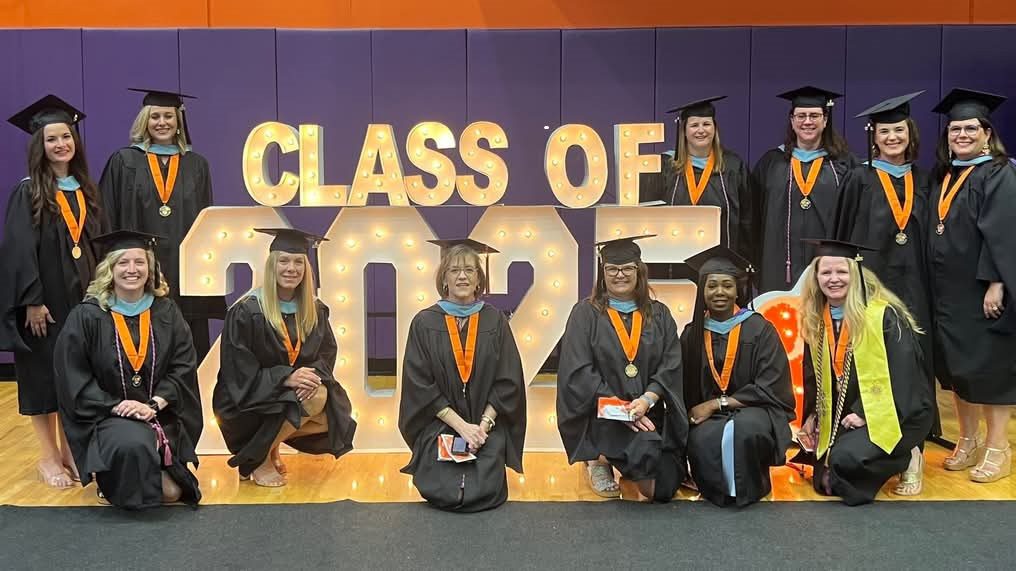
In Spring 2025, the program graduated its first cohort of teachers and caregivers from its literacy course, which allowed support to carry over to students’ time outside of school. Teachers participated in professional development through a master’s in literacy program focusing on ESOL and earning certification requirements in literacy teaching, literacy coaching and ESOL. Meanwhile, caregivers engaged in online weekly sessions on bilingualism, literacy and language learning, and communication and advocacy.
According to Emily Howell, principal investigator on the project, the impact on teachers, students and caregivers is proving to be career- and life-changing for many involved.
“Our work focuses on improving many aspects of learning for students, but one of the primary ones is self-efficacy,” Howell said. “We want teachers, their students and the caregivers of multilingual learners to feel capable toward literacy learning so that they can respond to academic difficulties and use learning strategies to succeed. By working with teachers and family members, we see success in that vital area of the student experience.”
Researchers worked with teachers and a community advisory council to understand students’ local context to create effective learning for caregivers. The project, now working with a second cohort, includes around 25 teachers and caregivers per cohort, directly impacting nearly 100 total teachers and caregivers.
Teachers from six districts earned 36 credit hours over six semesters, with a 100% completion rate on exams required for literacy teaching and coaching for ESOL students. Researchers noted a significant, positive change in teacher self-efficacy and knowledge of best practices for the student population. One educator involved candidly shared that, thanks to the coursework, their attitude toward multilingual students in general has evolved to seeing them as an asset and not a burden in the classroom.
Teaching Tips for Multilingual Learners
- Teach important words through texts and experiences that integrate children’s languages and lives.
- Center oral language by giving children daily opportunities to talk, listen, and make meaning together across subjects.
- Provide regular opportunities for writing and small-group collaboration, explicitly connecting to children’s languages, to support literacy and language development.
Due to the requirements of the research project, researchers require participants to remain anonymous while the project is ongoing. One reading interventionist from an Upstate school involved in the project said they were pleasantly surprised by how much the program material immediately benefited them in their day-to-day work. Taking lessons learned back to the workplace also benefited their coworkers because solutions in assignments involved real issues or challenges from the workplace that affected entire classrooms.
“The program helped me be more open-minded, patient and understanding of my students while not seeing them through a deficit lens,” the interventionist said. “I will continue to use the knowledge and resources that I have learned to be a better interventionist and team member, but I also made connections and formed friendships with different cohort members from across the state that I still stay in contact with and know I can reach out to at any time with a question.”
The interventionist said they felt better equipped to communicate with parents and caregivers in person or through an app. They also learned more about the Spanish language and the similarities and differences from English, which allows them to better connect words with similar roots across languages.
The interventionist said the program has reinforced and provided more training in supporting students and focusing on their strengths. The interventionist also said they are more willing to “raise the bar” in expectation for what students can achieve and communicate those expectations to fellow teachers, parents and caregivers. They learned that caregivers play a larger role than they previously thought in their child’s learning.
“Caregivers are very important and are a major part of the team in ensuring the student’s success,” the interventionist said. “The language barrier can be difficult, but if parents can be encouraged and shown how to work with and help their children, it can make a huge difference. We encourage using both languages at home because research shows that students with strengths in their first language can usually successfully learn a new language.”
Tips for Caregivers of Multilingual Learners
- Encourage the use of your home language(s) because this maintains your child’s cultural and linguistic heritages, affirms their identity, and supports healthy socio-emotional development.
- Promote speaking opportunities for your children through storytelling, games, questions, and conversations; intentionally make your home full of spaces to talk, read, and write in multiple languages.
- Choose picture books and materials that incorporate all of your languages and connect to your culture.
Caregivers also positively rated the coursework designed to extend learning to the home. Researchers measured a significant increase in caregiver knowledge of best practices for multilingual learner literacy across all items throughout the course. Caregivers said they created or maintained daily reading routines and acquired strategies for oral language, writing and reading development.
During the online course, caregivers and children worked together to create a digital book on Book Creator. Their books highlighted children’s topics of interest and cultural traditions and included photos, illustrations, text and video. As a celebration of this process, in the last session, they presented a page of their book and explained how they collaborated. Researchers selected books, discussion cards, games and a course manual and delivered these items in person to support family literacies.
Researchers measured a significant increase in how competent the caregivers saw themselves as they helped students, and surveys revealed they had increased knowledge of resources available to them and tools they could use to communicate with teachers and schools. Caregivers agreed that the tools provided by researchers were valuable, and including multiple experts and guest speakers helped build their confidence when it came to advocating for their kids as learners.
“The most important thing I have learned is how to help my child grow in her native language,” one caregiver said. “I also learned how to help her with her reading and writing and make it fun to do it with her.”
The project team includes Howell as principal investigator, Lindsey W. Rowe and C.C. Bates as co-principal investigators, Hazel Vega as project manager, and Katie Crook as graduate research assistant. The research team works with the external evaluation company MN Associates, Inc., headed by Kavita Mittapalli.