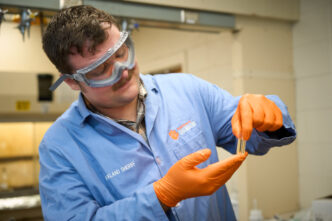

Clemson University chemist Kirkland Sheriff has received an Intelligence Community Postdoctoral Research Fellowship to continue his research to develop sensors that can rapidly detect explosives and other hazardous materials.
The research is especially relevant in an era where improvised explosive devices and chemical contamination present escalating threats to the public.

“Rapid, sensitive detection of hazardous substances directly impacts health and safety for investigators and the public,” said Sheriff, who earned his Ph.D. in chemistry at Clemson in May. He is now a postdoctoral researcher in the lab of Ya-Ping Sun, the Frank Henry Leslie Chair Professor of Natural and Physical Sciences.
The fellowship supports unclassified basic research in areas of interest to the intelligence community. It is funded primarily by the Office of the Director of National Intelligence as a part of the Oak Ridge Institute for Science and Education (ORISE).
Carbon dots
Sheriff’s research focuses on carbon quantum dots — tiny, fluorescent particles derived from the most basic carbon sources. These dots, each just five billionths of a meter wide, glow brightly under the right light.
Sheriff aims to embed these dots in hydrogels, forming sensors that can rapidly spot traces of explosive materials or toxic metals in the field, whether the sample is a suspicious powder, a drop of water or atmospheric dust. A user can expose the gel to an unknown material and, aided by artificial intelligence, compare the brightness of the carbon dots before and after exposure. Dangerous chemicals cause the fluorescence to “quench” and dim the emission.
“AI can distinguish changes that we may not be able to see with our eyes,” something that makes the tool more sensitive than traditional methods, he said.
While instruments such as mass spectrometers or nuclear magnetic resonance could provide answers, they are not practical for use by a bomb squad or environmental team at a cleanup site.
Sheriff said his research focuses on detection of hazardous materials at low concentrations or a “standoff distance,” which is the minimum distance required from a hazard to be considered safe.
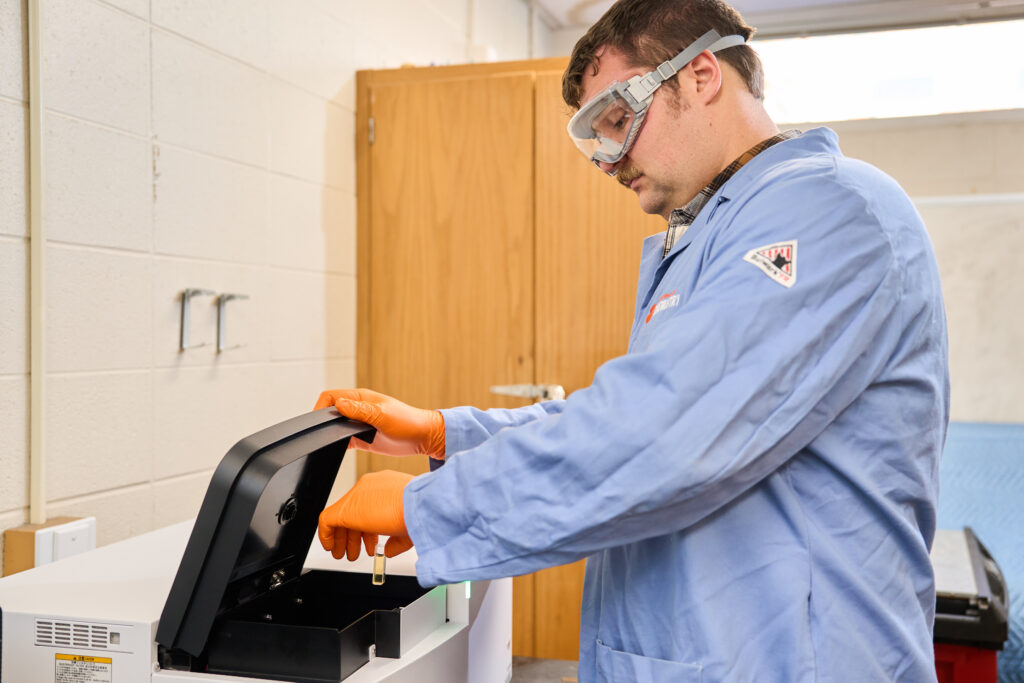
Sheriff’s project builds on years of work he completed while earning his Ph.D., which revealed new ways to make carbon dots brighter and more reliable by modifying their surfaces, sometimes using nanoscopic coatings of titanium dioxide. This treatment boosted the sensor’s sensitivity while keeping it nontoxic and accessible.
Balancing act
He said one challenge will be balancing selectivity and sensitivity in the sensors.
“In some cases, sensors can be very sensitive but not as selective and vice versa. I will be investigating how to balance those two goals in my research,” he said.
The fellowship provides Sheriff with funding and laboratory resources for up to three years. He plans to work with colleagues at Clemson and partners at Oak Ridge National Laboratory.
“It’s designed to promote research that has direct relevance to national security while also advancing foundational science,” he said.
Sheriff earned his bachelor’s degree in chemistry from Georgia Southern University.
While a graduate student at Clemson, Sheriff received the Outstanding Graduate Student Researcher Award in Chemistry in 2025. In 2023, he participated in the Office of Science Graduate Research Program at Oak Ridge. He also received the Frederick Mandel Fellowship at Clemson.