The College of Science is highlighting some of its Ph.D. students in honor of National Dissertation Day, which is April 26.
Beneath the soil, there’s a world that most people never see.
For Clemson University Ph.D. student Nichole Giani, that hidden world became the focus of her dissertation as well as a way to help farmers grow healthier crops.
Originally from northeastern Pennsylvania, Giani came to science by way of a small undergraduate college and an unexpected change in direction. At Keystone College, where she earned dual degrees in general biology and wildlife biology, she first imagined a future in wildlife work. Then she took a microbiology course and found herself hooked.
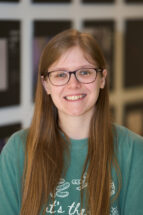
“I was in the lab so much,” she said. “It was just fun for me.”
That interest grew into a passion for microbial ecology, the study of how microscopic organisms interact with their environment. When she started exploring graduate programs, she wanted a project that combined biology, ecology and hands-on research. Clemson offered all three.
She was especially drawn to the work of Barbara Campbell, an associate professor in the Department of Biological Sciences, and to the atmosphere of Clemson’s campus during a visit. Compared with the city setting of another program she considered, Clemson felt like a better fit.
“I just liked everything about it,” she said.
She arrived at Clemson in 2019 for a master’s degree, completed it in 2021 and moved straight into the Ph.D. program. She expects to earn her doctorate in August.
Collaborative culture
What stood out about Clemson right away was the collaborative culture in her department, she said. Labs share space, students help one another and research feels like a team effort.
That spirit has shaped her doctoral work, which looks at the microbes living in soil and how they respond to cover crops. Farmers often alternate plantings of cover crops and cash crops such as corn or soybeans to protect and improve the soil. Cover crops can reduce erosion, add nutrients and support the ground between growing seasons. But they also influence the microscopic communities underground.
Her research focused on which cover crops do the best job of building a healthy soil community for the crops that come next.

To answer that question, she studied radish, rye and pea grown alone and in mixtures. One of the biggest surprises in her work is that more is not always better. A five-species mixture did not outperform everything else. Instead, a three-species mix often produced stronger results, and rye alone sometimes did better than more complex combinations.
A key part of the research is something called functional redundancy — the idea that different microbes can perform the same useful jobs in the soil. The more overlap there is, the more stable and resilient the ecosystem may be.
“We care more about the functions and not the name of the microbe. We care more about what the microbe is doing because that’s the most important part and creates stability in the ecosystem,” she said. “More functional redundancy equals more stability and a better overall healthy ecosystem.”
Crops with the best return
Her work helps identify which cover crops give farmers the best return. If growers are already planting cover crops, knowing which combinations best support soil health could help improve future yields and crop resilience.
Giani also studied how drought changes those soil communities, an important question as weather becomes less predictable. Even under drought conditions, the three-species mixture continued to perform well.
Clemson has shaped more than her research. During her time here, she built skills in molecular biology, bioinformatics and coding, while also teaching anatomy and physiology. That teaching experience, she said, helped her become more confident and more comfortable communicating complex ideas.
After she completes her Ph.D., she hopes to move into industry, possibly in molecular biology, health or public health. She said that while samples may change, the tools she has learned at Clemson — from DNA extraction to sequencing and analysis — will continue to serve her well.