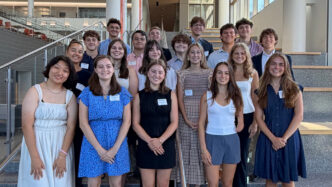


An Honors history and economics student, Owen Eastman will graduate with not only two degrees, but with three minors (English, philosophy and legal studies) and a resume full of diverse campus experiences. These experiences are more to Eastman than just lines on a page; they reflect his educational philosophy, a philosophy that has equipped him to enter Harvard Law School directly after finishing his undergraduate degrees.
Eastman’s Clemson Experience didn’t begin with the intent of pursuing the law. But it did begin with a community of students and faculty he felt he could learn from and grow beside.
After being accepted into the Honors College, Eastman received an interview invitation for Clemson’s premier university-wide scholarship program, the National Scholars Program (NSP). During the interview weekend, he quickly connected with other students and felt welcomed by Honors-affiliated professors, including Associate Dean in the College of Arts and Humanities Michael LeMahieu who would become a mentor for Eastman.
“That absolutely sealed the deal,” Eastman said, reflecting on the weekend. The Honors College offered him “the best of both worlds”: small classes, a community within a community and access to professors, while also getting to experience lots of student organizations, R1 research and the school spirit of a power four conference.


The Road to Law
Eastman originally thought he wanted to be a secondary school teacher in the humanities, but his academic and extracurricular experiences revealed an interest in law.
“The number one thing I’ve done regarding wanting to go into law is research with Dr. LeMahieu,” Eastman said.
LeMahieu invited Eastman to join his research team after the NSP interview weekend. They’ve been working together for the past four years on a variety of projects. A conference paper on judicial rhetoric—the word choice that judges use and the rhetorical function it serves—particularly inspired Eastman to explore the legal field.
“Getting into the nitty gritty of that was personally fulfilling and helped me recognize the power of writing in that context,” Eastman said. “The things that judges say matter, and the precedents that they set reverberate throughout the subsequent decades.”

His first-year NSP seminar course also pointed Eastman towards law. The course included a professional development project where students were given a spreadsheet of past program alumni. They were required to talk with at least three people who work in a field that they may be interested in. Eastman spoke with a secondary school teacher, an analyst at a bank and a lawyer. He connected most with the lawyer.
“She presented an exciting vision of using my skillset in a particular way,” Eastman said.
Interdisciplinary Approach
Set on pursuing the law, Eastman made a strategic decision: expanding his disciplines of study to expand his lenses of thinking as a lawyer.
“Once I started going down the lawyer track, I started thinking about my classes less as immediate job preparation and instead started asking how many different disciplines I could take,” Eastman explained. “The economic way of looking at the world is different than the philosophical view, but both have specific applications, making them equally useful for law school.”
One way he lived out this philosophy was by working as a Writing Fellow in the Clemson University Writing Lab. As a Writing Fellow, Eastman worked with students across all disciplines. He learned to study and understand different genres of writing by assisting his clients with their discipline-specific work.

Mission-Minded Accessibility
Working at the Writing Lab brought Eastman’s legal career ambitions into focus.
“Writing Lab work is essentially institutional translation,” he explained. “Something I have to do is communicate to our writers the explicit and implicit conventions of the genre, the things that they are expected to know but might not have been communicated to them.”
“Law, in many ways like the Writing Lab, is one of those things where many concepts are often not presented in a way that’s accessible to a layperson. A large part of that client-facing work is to communicate in a way that somebody without three years of legal training can understand.”
Working with Institutional Compliance Solutions, LLC (ICS) was “the final piece of the puzzle” for Eastman’s future legal pursuits.
ICS handles Title IX compliance for K-12 districts and small colleges. One of Eastman’s main responsibilities was to work on a weekly newsletter that explained the impact of changes to Title IX policies.
Eastman completed similar meaning-making efforts on campus, specifically as Editor-in-Chief of “The Pendulum,” Clemson’s student-run international affairs magazine.
A “big believer in a time and place for everything,” Eastman is heading to Harvard ready for the next step in his journey. His Clemson Experience began with a group of curious scholars, and that’s something he doesn’t plan on letting go of anytime soon.
“Clemson has instilled in me intellectual curiosity,” he said. “All of the different experiences, professors and classes exposed me to more ways of thinking than I ever thought possible.”