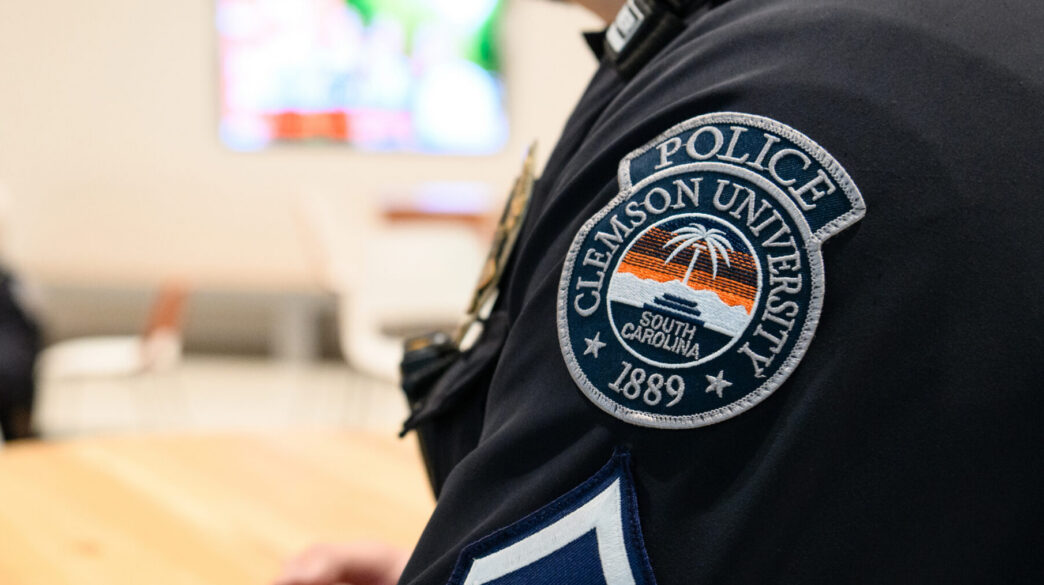
The Clemson University Police Department (CUPD) and Clemson University Center for Public Safety Research (CPSR) have partnered to integrate virtual reality modules into Crisis Intervention Team (CIT) training, delivered by the National Alliance on Mental Illness in South Carolina (NAMI SC) statewide to law enforcement officers.
“CUPD’s partnership with Clemson University’s Center for Public Safety Research on the Byrne State Crisis Intervention Program is a continuation of our long-standing relationship with the Center, Clemson research faculty, and the National Alliance on Mental Illness in South Carolina,” said CUPD Deputy Chief Christopher Harrington. “This collaboration supports the integration of immersive virtual reality experiences into the CIT/CRIT training program and provides an additional layer of strength to an already highly impactful program.”
Traditional police training and tactics inadequately prepare police officers to deal with individuals experiencing mental crises. In 1988, the Memphis Police Department developed the first CIT training. Bringing together law enforcement, mental health specialists and community stakeholders, CIT was developed to make police interactions with those experiencing mental health crises safer for everyone.
Building upon the success of “the Memphis model”, CIT International was formed in 2008 to assist communities worldwide with crisis response system reform by developing CIT programs at local, state and regional levels. Since then, CIT training has become the standard for police training on mental health issues. A 40-hour course, CIT trains officers on recognizing signs of mental illness and responding appropriately to effectively de-escalate crises and manage the safety of all involved.
CUPD and CPSR are looking to build upon this existing CIT training by integrating VR systems into training modules as a companion to face-to-face role-play scenarios.
“Our project aims to update this training through the use of new technology, specifically virtual reality,” said Kyle McLean, Director of CPSR and lead researcher for the project. “We are working with CUPD and NAMI SC to revise their curriculum to include virtual reality scenarios embedded within modules on various types of mental illness.”
Adding the virtual reality modules would allow participants to “live out” the experience of mental health crisis encounters through the lens of both the responding officers and the individual experiencing the crisis.

“We hope that the virtual reality scenarios will improve understanding and empathy, as the virtual reality format provides a unique ability to put the officer in the shoes of someone with mental illness,” said McLean. “The scenarios themselves not only put you in the perspective of the individual in crisis but use sound, blurring lights, and other functionalities to mimic the effects of mental health disorders, such as schizophrenia or autism.”
Through the VR capabilities, officers would hear voices in their head, have trouble concentrating because of the various distractions, or even become hyper-fixated on cameras or other stressors like an individual with paranoia.
“We believe that the lessons learned through the use of this training tool will not only enhance the CIT/CRIT program delivery, it will provide first responders across our state with a better understanding of the challenges associated with responding to mental health calls for service and interacting with individuals experiencing crisis,” Harrington said.
McLean also points out the importance of this training for first responders serving in rural communities, where specialized units for mental health response may not be available.
“While co-responder programs and mobile crisis units have become more common in recent years, in many rural jurisdictions, fast-response specialized units are not as feasible as they are in urban jurisdictions,” said McLean. “In those cases, having patrol officers ready to respond to mental health crises is critical.”
Once the curriculum is ready for a full roll-out, an evaluation will be conducted to estimate the impacts of not only CIT, but also any differences between CIT with and without the VR modules.